
Most battery-life extending pack tend to be brain dead, they automatically charge when they’re the needed. The Wi.U is a bit different. You can set the date, time and percentage you want the charger to activate. More
Most battery-life extending pack tend to be brain dead, they automatically charge when they’re the needed. The Wi.U is a bit different. You can set the date, time and percentage you want the charger to activate. More
iOS 4.3.1 was just released earlier today, but there's already a tethered jailbreak available for it—which'll work assuming you're not using an iPad 2. More

Okay, so we might be chasing the flying unicorn of modern technology here — and, no, we’re not talking about the white iPhone 4 — but as you’ve probably noticed, our hunger for a quantum computer is basically insatiable. Lucky for us, some folks who actually know something about producing qubits are similarly persistent — a team of researchers recently presented a scalable quantum chip at a meeting of the American Physical Society in good old Texas. The 6 x 6-cm processor sports four qubits, the basic units of quantum computing, and its creators say it has the potential to be scaled up to support 10 of the things within the year. So what does that mean for our quest for the ultimate super computer? Well, it means we’re closer than we used to be… and the dream lives on.
Researchers show off scalable architecture for quantum computing, expand our minds originally appeared on Engadget on Fri, 25 Mar 2011 21:59:00 EDT. Please see our terms for use of feeds.

Supercomputers are expensive to make no matter how you look at it. But if you use a whole bunch of PS3s, you can save over 10x the cost compared to this guy. The Condor project is a supercomputer made up of 1,716 PS3s for the Air Force’s image processing tasks and is considered one of the top forty fastest computers in the world. Its big task involves monitoring 15 square miles 24/7, but not in the way you think.
Because the PS3 is really good at image processing, the Air Force hopes it will solve their problem of processing images from all their recent aerial photo gathering. With all the satellites they have, it has become pretty easy to snap loads of photos, but figuring what parts are important is difficult.

What’s crazy about Condor is that users will be able to move cameras around like you’re playing Starcraft. “You can literally rewind or predict forward (in the future), based on the information you have,” said Mike Barnell, director of HPC at the Rome Research Lab.
Let’s hope that Condor is used for military analysis and not tuning in on our daily activities. Though it would be funny to point the satellites at the Bay Area, I don’t think anyone in the Air Force wants to know how boring my life is.
[via Hot Hardware; image credit: John Berry / The Post-Standard]

Visit link:
“Condor” Supercomputer Made Of 1,716 PS3s Now Online

Buffalo just outed their new portable BDXL Blu-ray writer, the BRXL-PC6U2-BK. BDXL is the new Blu-ray spec that can store up to 100 GB on three layers and 128 GB on four. The burner can operate at speeds of up to 4x using dual USB 2.0 ports and 2x speed using only one.
The device is claimed to be the first portable BDXL Blu-ray burner on the market and will release later this month in Japan for about $286 — no word yet on a US release.
While this is certainly good news for the Blu-ray standard, 3-layer BDXL discs can cost about $57 apiece. I’m not so sure I’d want a portable drive writing on $60, write-once, discs.
In other news, Newegg is selling a 1 TB drive for $60.

See more here:
Buffalo Launches First Ever BDXL Portable Blu-ray Burner
 This site allows you to track price history and has price drop and price watch alerts. Ever since I discovered it a few weeks ago, I’ve looked at it before I bought anything on Amazon just to make sure I was at or near a historical low. The price charts are intuitive, and allow you to see highs and lows for the past year, 6 months, 3 months, 1 month. You can set your tracker to include just Amazon.com, 3rd party sellers, or Used. The best part? It’s absolutely free.
If you need something immediately, there’s not a whole lot this can do for you. But, for example, I’ve had my eye on the MEElectronics M9P headphones. It’s currently $15. Hopping on CamelCamelCamel, I can see that historically, it has run at about $23 until early December, took a dive to $15, a dip all the way down to $10 earlier this month, then popped back up to $15. I don’t want to pay 50% more than what it was a few weeks ago, so I’ll set up the Tracker to notify me by e-mail when it gets back down to $10.
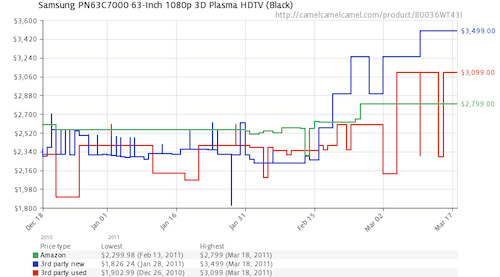
While I’ve found some bugs, such as hours-behind updating, and while I wish it incorporated shipping costs, it’s still allowed me to save cash. More than that, I learned a long time ago I get a great deal of satisfaction from knowing I got a great deal.
CamelCamelCamel give me the data I need. If used car salesmen could hand you data-rich, neutral third-party charts like this every time they told you you were getting a steal, it’d go a long way to negating that sleazy image.
Alas, we can only dream, as it only covers Amazon.com and Newegg, BestBuy, BackCountry and Zzounds.com through sister-sites.
— Doug Wong
CamelCamelCamel
http://camelcamelcamel.com/
Don’t forget to comment over at Cool Tools. And remember to submit a tool!


Read the article:
CamelCamelCamel

When Tesla’s Elon Musk first came to Silicon Valley he was researching advanced, highly-energy-dense super-capacitors at Stanford. Coincidentally, when speaking at the Cleantech Forum in San Francisco about the future of electric vehicles Musk said, “If I were to make a prediction, I’d think there’s a good chance that it is not batteries, but super-capacitors.”
Super-capacitors are similar to batteries in that they both store energy. But in electric vehicles, super-capacitors would be much more efficient at storing the massive amounts of energy taken in during regenerative braking. And when the time comes to accelerate, the super-caps would be able to deliver the that large amount of energy much faster than batteries, with less energy loss.
Currently, hybrid vehicles have batteries because super-caps cannot store the same amount of energy pound-for-pound. Super-capacitors require a large amount of surface area to store a large enough amount of electricity to be useful for electric cars. However, the introduction of nanotechnology could increase surface area exponentially, as recent experiments have shown. Picture infinitesimal conductive surfaces storing electrons for rapid use; no more chemical reactions requiring huge and expensive thermal management systems would be needed.
Seeing how Musk creates electric cars powered exclusively by lithium-ion batteries, his comment on batteries seems a bit out of place — unless his company is at work researching the next big thing.
[via AllCarsElectric]

View original post here:
Elon Musk Says Super-Capacitors Not Batteries, Will Be Breakthrough For EVs

We’ve been covering the Volvo C30 Electric pretty closely because, well, let’s face it: it’s one of the few genuinely good looking electric cars in the pipeline. Sure, the Focus Electric looks fine, despite the excessive dental gear, and Tesla‘s products are certainly saucy, but for every Roadster in the world there are a couple-dozen Leafs and Prii putting their owners to sleep.
The C30 Electric, however, looks almost exactly like the C30 non-electric, which is a good thing, and it drives more or less like one too. About four months after we first saw the thing Volvo finally tossed us the keys, in the process taking us on a tour of Indianapolis-based Ener1, source of the battery packs that make the thing move. Yes, it’s a funky little Swedish car with a big ‘ol American battery pack. Read on for our impressions.
Gallery: Volvo C30 Electric


Continue reading Volvo C30 Electric test drive (video)
Volvo C30 Electric test drive (video) originally appeared on Engadget on Fri, 25 Mar 2011 17:17:00 EDT. Please see our terms for use of feeds.
This New York Times primer on DIY food projects will show you how to make your own butter, cheese, corn muffin mix, fancy mustard, and more!
View article:
DIY food: From kimchi to bootleg Nutella

We take it for granted nowadays that thumbnail-sized silicon chips can crunch through the most complex of calculations, but early last century, mathematical tasks were still being carried out by humans. It was around that time that one Alan Turing, Enigma code breaker and general computer science pioneer, came up with what was essentially a thought experiment, a mechanical machine capable of simulating and solving algorithms just like a grown-up CPU. Well, you know where this is going by now, one British software engineer decided to build just such a device, out of old bits and bobs he had lying around his geek lair, producing a working model that was recently shown off at the Maker Faire UK in Newcastle. The only downer, as he points out, is that it’d take “months to add two numbers together,” but all good things start off humbly. Video after the break.
Turing machine built from wood, scrap metal and magnets, ‘geek’ achievement unlocked (video) originally appeared on Engadget on Fri, 25 Mar 2011 15:24:00 EDT. Please see our terms for use of feeds.