
Should you ever need a floor plan of your home, bringing in a professional to do the measurements might be expensive. And time consuming! So MagicPlan wants to replace human work, automatically creating a map of your humble abode. More
Should you ever need a floor plan of your home, bringing in a professional to do the measurements might be expensive. And time consuming! So MagicPlan wants to replace human work, automatically creating a map of your humble abode. More

Congratulations to Microsoft, who somehow in the face of teasing from very important bloggers like us, has managed to sell quite a few copies of Windows 7 since that OS’s release 18 months ago. And by quite a few, I mean 350 million. That’s a lot.
See more here:
Microsoft Has Sold 350 Million Copies Of Windows 7

Leaving your gadgets plugged in, charging all the time can decrease the battery’s lifespan. The Conserve Socket saves you by cutting off power after a predetermined amount of time. More
 Amazon has formed a partnership with Overdrive allowing for Kindle users to borrow eBooks from libraries.
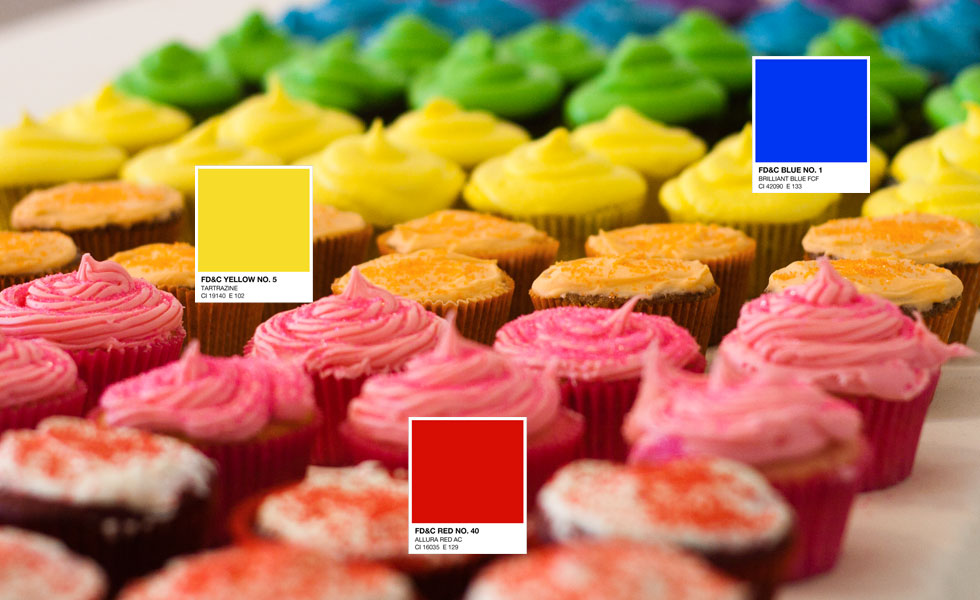
Say hello to Blue No. 1, Yellow No. 5, and Red No. 40.
These numbers make up part of an artificial color palette approved by the United States’ Food and Drug Administration. First introduced in 1906, the FDA’s Pure Food and Drug Act (and later the Food, Drug, and Cosmetic Act) was put in place to ensure the safety and wholesomeness of food products. Before this, more than eighty dyes were used to color food, without regulation—the same dye could be used to color both clothing and candy.
Currently, the FD&C color palette features seven colors

The Lions Mane Jellyfish is the largest jellyfish in the world. They have been swimming in arctic waters since before the dinosaurs (over 650 million years ago) and are among some of the oldest surviving species in the world.
The largest can come in at about 6 meters and has tentacles over 50 meters long. Pretty amazing when you think these things have been swimming around for so long.
They have hundreds of poisonous tentacles that it used to catch passing by fish. it then slowly drags in it’s prey and eats it.

Proving the words of countless mothers across countless nations, new research shows that spending all day staring at computers and TVs actually is bad for kids, giving them heart problems later in life. More
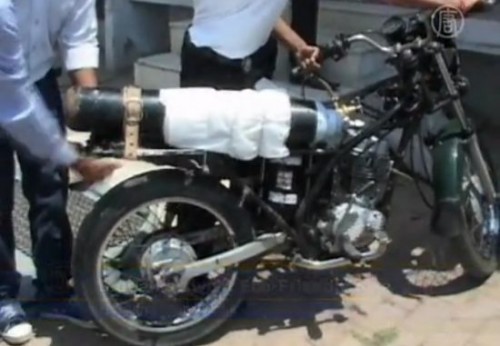
Engineering students in Palwal City, India, built a motorcycle that runs on a tank of compressed oxygen:
“This bike is different from others because the engine doesn’t burn fuel, nor does the temperature rise. The air is compressed and transferred to the engine without any combustion. The piston reciprocates from the air pressure leading to an up-down movement, making the flywheel run and the bike move.”
Students say the basic concept behind the invention is to achieve an equivalent thrust of blast inside the engine without using any combustion.
The bike can run at a speed of six to 12 miles an hour for up to 370 miles using 100 liters of 300 PSI oxygen.
Video at the link.
See original article:
Indian Students Built Motorcycle That Runs on Oxygen

Here’s some exciting news for all you data storage enthusiasts and academics out there: researchers in France have found a way to double the storage capacity of magnetic disk drives by constructing “3D towers” of information. The team from SPINTEC created these pillars out of bit-patterned media — separated magnetic nanodots, each of which carries one bit of data. By layering the dots in specific formations, the team created a “multilevel magnetic recording device” with an areal density of two bits per dot — twice what it started with. According to researcher Jerome Moritz, these findings could provide IT companies with a new way to circumvent physical limitations to their data storage capacities, allowing them to build up and over the vaunted one Tbit per square inch barrier. The team’s full findings were recently published in the American Institute of Physics’ Journal of Applied Physics. You can read the full article at the source link or, if you’re afraid of paywalls, just check out the PR below.
Continue reading ‘3D Towers’ double disk storage capacity, don’t require glasses
‘3D Towers’ double disk storage capacity, don’t require glasses originally appeared on Engadget on Fri, 22 Apr 2011 14:09:00 EDT. Please see our terms for use of feeds.
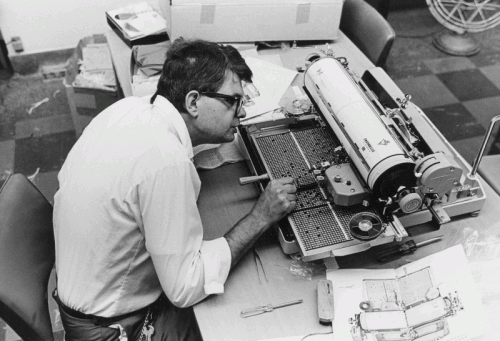
The most agonizingly complex language that I’ve ever tried to learn is OT Hebrew, which (among other challenges) expresses vowel intonations through a vast variety of tick marks, jots, and tittles surrounding the consonants. These are not constant; rather, the meaning of the different markings varies depending upon the order of the letter within the word, order within the syllable, the nature of the preceding consonant and the following consonant, and all possible combinations thereof. But I gather that Hebrew is comparatively simple to Mandarin. As a necessary result of that complexity, Mandarin typewriters are sophisticated machines:
As you can see, the typewriter is extremely complicated and cumbersome. The main tray — which is like a typesetter’s font of lead type — has about two thousand of the most frequent characters. Two thousand characters are not nearly enough for literary and scholarly purposes, so there are also a number of supplementary trays from which less frequent characters may be retrieved when necessary. What is even more intimidating about a Chinese typewriter is that the characters as seen by the typist are backwards and upside down! Add to this challenging orientation the fact that the pieces of type are tiny and all of a single metallic shade, it becomes a maddening task to find the right character. But that is not all, since there is also the problem of the principle (or lack thereof) upon which the characters are ordered in the tray. By radical? By total stroke count? Both of these methods would result in numerous characters under the same heading. By rough frequency? By telegraph code? Unfortunately, nobody seems to have thought to use the easiest and most user-friendly method of arranging the characters according to their pronunciation.
Link via Geekosystem | Photo: Victor Mair
Original post:
Chinese Typewriters