Scratch-built “freedom press”

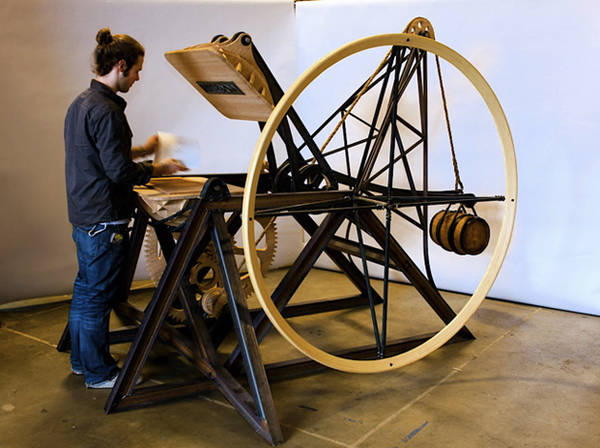
Artist Shawn HibmaCronan scratch-built this beautiful printing press for San Francisco International Airport’s Terminal 2, working in steel, bamboo, oak, cork, and rope.

I cut the bamboo gears with a CNC router. A few of the steel parts — namely the counter weight and head arms, as well as the FREEDOM text — I waterjet cut from 3D SolidWorks files. (I like SolidWorks because it lets me run the gears and get the tolerances perfect.) The steel frame is made out of 3″ I-beam that I cut and welded together in my studio. I had to buy a bigger saw and a nice welder for it.

This build was great. Problem solving and finessing things into place for months = happiness. One of the toughest things was keeping all of the components aligned, greased, and square with all of the welding I was doing. Welding and heat makes steel move and do weird things. There are so many tight tolerances and chunky pieces of steel that had to be spot on. It made for lots of fun moments with a big mallet.

The Press (Shawn HibmaCronan)

Building the Freedom Press (Craft)


Read More:
Scratch-built “freedom press”

Honeycomb 3.1 Confirmed By… Adobe


While I think we all knew, deep down inside, that at some point there would be an Android 3.1, it hasn’t actually been mentioned by anyone except as a potential future upgrade. But Adobe let the cat out of the bag today with an update to Flash: the changelog to 10.2 includes a few features with “(requires Android 3.1)” on the end – or at least, it did until they fixed it. Luckily, Droid-Life got a screenshot.

Not much else was mentioned; chances are, like the other X.1 releases, it’ll be mostly bug fixes, performance increases, and support for newer hardware. This accelerated Flash content will certainly be welcome; the 16:9 form factors are great for watching video, but decoding 720p Flash video with your CPU only is a tricky affair that, if it even works, tends to suck the battery dry. Hopefully this release will fix that.

[via Engadget]

Excerpt from:
Honeycomb 3.1 Confirmed By… Adobe

Prague to host world’s most powerful laser


To us, Prague will always be the Eastern European capital of roast duck, potato dumplings and tasty, cheap pilsner. But come 2015, the former Soviet Bloc city will also become home to the world’s most powerful laser, as part of the European Union’s Extreme Light Infrastructure project. According to plans released by the European Commission, the laser will produce peak power in the exawatt range (equivalent to one trillion megawatts). So, for a very small fraction of a second, the beam will generate one million times more power than the entire U.S. electric grid. Believe it or not, that’s plenty of time to conduct experiments that could reveal new cancer treatments and ways to deal with nuclear waste. Breakthroughs in either category would be incredible for the €700 million (about $1 billion) project, which also includes future plans to build two similar lasers, and a third that's twice as powerful the Prague installation — roughly the same current draw as an HTC Thunderbolt.

[Image courtesy of Instructables]

Prague to host world’s most powerful laser originally appeared on Engadget on Thu, 28 Apr 2011 21:29:00 EDT. Please see our terms for use of feeds.

Permalink

Ubuntu 11.04 ‘Natty Narwhal’ brings new Unity UI, controversy to the desktop

Ubuntu 11.04 Natty Narwhal

It’s April, the fourth month of the year, and that means it’s time for a new Ubuntu release. (This also true of the tenth month of the year — those Canonical folks like to keep busy.) Ubuntu 11.04, or Natty Narwhal as the kids are calling it, is here and packing some significant changes from earlier editions of the Linux distro. The most obvious being the arrival of the Unity desktop environment, which was previously relegated to netbooks. It's got integrated search, a combination launcher and taskbar, and app menus that have been moved to the top of the screen

Heart Plunging Machine

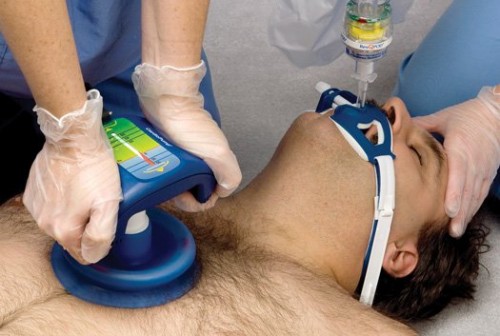
After one man went into cardiac arrest and his family successfully performed CPR on him with a toilet plunger, Advanced Circulator Systems developed the ResQPump. It’s a machine that regulates chest compressions and airflow during the resuscitation process:

According to a study published in The Lancet this winter, the ResQPump, which is used for chest compressions, and the ResQPOD, which prevents too much air from entering the lungs during CPR, could increase certain cardiac-arrest victims’ chances of survival by 50 percent.

The ResQPump works like a toilet plunger, but while decompressing it can draw air back into the lungs. The ResQPOD, cleared by the FDA in 2003, regulates airflow by creating suction in the chest, which draws blood up into the brain.

Link | Photo: Advanced Circulatory Systems

Previously: CPR Certification at Home with the Nintendo Wii

View post:
Heart Plunging Machine