Important Scrabble News: Two New Q (without U) Words

A full English-language Scrabble tile set. See...

Image via Wikipedia

The official scrabble list of words has undergone another update to reflect the changing nature of language. The big news is that there are two new words using the letter Q that do not require U.

QIN (n): A Chinese zither, with strings stretched across a flat box. Scrabble score: 12

and

FIQH (n): An expansion of Islamic sharia law, based directly on the Koran and Sunnah. Scrabble score: 19

So, word up folks. Print this out and be prepared. There are other words also added to the list including Wagyu (a Japanese Beef) and Webzine (which should make us all happy).

(via The Scotsman)

Enhanced by Zemanta

See more here:
Important Scrabble News: Two New Q (without U) Words

YouTube adds 3,000 movies for rental from Universal, Sony, Warner Bros. (Update: they’re live)

In the midst of a blog post welcoming us to “the future of video” head of YouTube Salar Kamangar confirms that starting today it will add around 3,000 new movie titles for rental in the US, along with reviews and behind the scenes extras. More details are promised to come in another post later today, but right now the video page appears to have the same list of flicks we’ve seen before so the question of which studios will bite is still up in the air. The rest of the post also mentions the YouTube Next program to push new original content on the site with “much more to come” — consider the week of Google I/O underway.

Update:Additional details have been posted on the YouTube Blog and are also after the break — NBC Universal, Sony Pictures and Warner Bros. are the new studios YouTube is partnering with to add the 3,000 new and catalog releases, doubling the amount previously available. The pricing is $2.99/$3.99 for movies viewable via PC or Google TV (no other device support is mentioned) and the FAQ notes that YouTube supports resolutions up to 4K but “most” of the new additions are sadly in SD, a choice which is apparently up to its partners.

Update 2: The YouTube Movies page is updated now, as seen above. There’s plenty of well known movies to be seen now replacing the catalog of older and indie movies that filled the page before. Rotten Tomatoes ratings integration is also front and center, while the Extras are on each movies individual page, but really just show a list of related videos on YouTube, while there doesn’t appear to be a way to tell if a movies is one of the few in HD before you pay.

Continue reading YouTube adds 3,000 movies for rental from Universal, Sony, Warner Bros. (Update: they’re live)

YouTube adds 3,000 movies for rental from Universal, Sony, Warner Bros. (Update: they’re live) originally appeared on Engadget on Mon, 09 May 2011 15:23:00 EDT. Please see our terms for use of feeds.

Permalink

Novel Concepts’ ThinSink claims title of world’s thinnest air-cooled heat sink

Heat sinks may not ordinarily be the most exciting sort of component — but the world’s thinnest air-cooled heat sink? That’s… something. According to the folks at Novel Concepts, their new credit card-sized, 0.75mm thick ThinSink has now laid claim to that title, and it may soon lead to thinner tablets, laptops and monitors. What’s more, despite its small size, the company claims that the ThinSink still has a cooling efficiency “25 times greater than today’s best microprocessor heat sinks,” and it consumes just 0.031 watts of electricity when equipped with a fan spinning at 6,000 RPM. Those interested in an evaluation unit will have to fork over a hefty $750, but the company promises it will be cheaper in larger quantities, and notes that it could also easily be stamped or molded from metal or plastic, as it only consists of two thin flat parts in addition to the motor.

Continue reading Novel Concepts’ ThinSink claims title of world’s thinnest air-cooled heat sink

Novel Concepts’ ThinSink claims title of world’s thinnest air-cooled heat sink originally appeared on Engadget on Mon, 09 May 2011 18:13:00 EDT. Please see our terms for use of feeds.

Permalink

Microsoft Research Looking Into Better, Whole-Hand Touchscreen Gestures

One of the main limitations on touchscreen interfaces these days is that all you can do is poke at them. We do all kinds of things with our hands, but when it comes to screens, we just poke at them all day. UIs are doing all right, since our phone OSes still mimic mouse-based desktop OSes to some extent, but Microsoft is looking to ways to integrate more natural hand gestures incorporating more than just a “click” derived from a fingertip.

Hrvoje Benko, a researcher at Microsoft, is working on methods of recognizing shapes formed by hands and equating those with spatially-consistent gestures. Putting the side of your hand down like a wall forms a straight line that could be used for a boundary, cropping, or “pushing” objects. Forming an O with your hand could automatically call up the magnification loupe, and so on.

It’s a very natural extension of how you interact with a surface, since really, that’s how you interact with most surfaces. Right now “Rock and Rails” only includes support for three gestures: a fist, which holds things down, a straight hand, which sets a line to which UI elements can move perpendicular, and a “curved rail,” which sets a pivot point. I’m sure you can imagine a few more, but at the same time, limiting the “vocabulary” of a UI is part of making it usable. Nobody wants to remember a dozen different gestures.

Speaking of surfaces, the video shows the tech being demonstrated on a Surface, which uses a different detection method than your average smartphone or tablet — it can detect shapes far more easily. And the new Surface units, as we learned at CES, have thousands of pixel-sized cameras that can even detect patterns and text. So don’t expect this kind of special recognition to come to iPads any time soon, although it would be similarly unwise to underestimate developers who might want to make it happen.

The whole paper is being published later, so unfortunately this video is pretty much all there is right now, but if you head over to Hrvoje’s page, you can keep track of this and his other projects.

Read More:
Microsoft Research Looking Into Better, Whole-Hand Touchscreen Gestures

YouTube will add 3,000 streaming movies for renting (Update: NBC Universal, Sony and Warner are on board)

In the midst of a blog post welcoming us to “the future of video” head of YouTube Salar Kamangar confirms that starting today it will add around 3,000 new movie titles for rental in the US, along with reviews and behind the scenes extras. More details are promised to come in another post later today, but right now the video page appears to have the same list of flicks we’ve seen before so the question of which studios will bite is still up in the air. The rest of the post also mentions the YouTube Next program to push new original content on the site with “much more to come” — consider the week of Google I/O underway.

Update: Now we have the additional details, available on the YouTube Blog and after the break — NBC Universal, Sony Pictures and Warner Bros. are the new studios YouTube is partnering with to add the 3,000 new and catalog releases, doubling the amount previously available. The pricing is $2.99/$3.99 for movies viewable via PC or Google TV (no other device support is mentioned) and the FAQ notes that YouTube supports resolutions up to 4K but “most” of the new additions are sadly in SD, which is up to its partners.

Continue reading YouTube will add 3,000 streaming movies for renting (Update: NBC Universal, Sony and Warner are on board)

YouTube will add 3,000 streaming movies for renting (Update: NBC Universal, Sony and Warner are on board) originally appeared on Engadget on Mon, 09 May 2011 15:23:00 EDT. Please see our terms for use of feeds.

Permalink

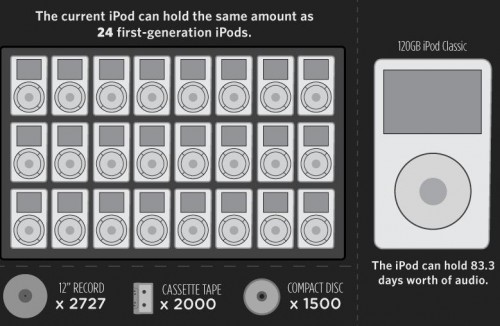
Physical Storage Vs Digital Storage

It’s amazing how the storage of music and movies and increased exponentially over the years. This diagram illustrates how far we have come from vinyl records which could hold 44 minutes of music to today’s iPods which can hold over 83 days of music.

Xplore Technologies’ iX104C5 tablet PC is built for abuse

Sure, we all drool over the slender lines of the latest slates, but there’s no shortage of folks in the field who dig the tablet form factor and need a more durable device than anything running Android or iOS. Enter Xplore Technologies and its newest bombproof tablet, the iX104C5. This feshly minted model follows its progenitor PCs, the C2, C3, and the C4, in that it has a 10.4-inch XGA display and rugged good looks. Underneath that industrial exterior, the C5 improves upon earlier models with a 2.13GHz Intel Core i7 620UE processor and 2GB of RAM (expandable to 8GB) running Windows 7. It has dedicated GPS, Gigabit ethernet, Bluetooth 2.1, 802.11 a/b/g/n WiFi, and a Gobi 2000 mobile broadband card to keep you flush with 3G data out in the wild. There’s also a hot-swappable 10-cell Li-Ion battery and dual SSD drive capability with RAID support, so your data is as safe as the hardware housing it. Xplore’s not telling how much the iX104C5 costs, but we do know it can survive being thermally shocked, dropped, vibrated, and generally abused. All that’s left is a snowmobiling showdown with its spiritual soulmate to determine which rugged PC platform reigns supreme.

Xplore Technologies’ iX104C5 tablet PC is built for abuse originally appeared on Engadget on Mon, 09 May 2011 17:02:00 EDT. Please see our terms for use of feeds.

Permalink

Bento Book by Rene Lee

bentobook-13.jpg
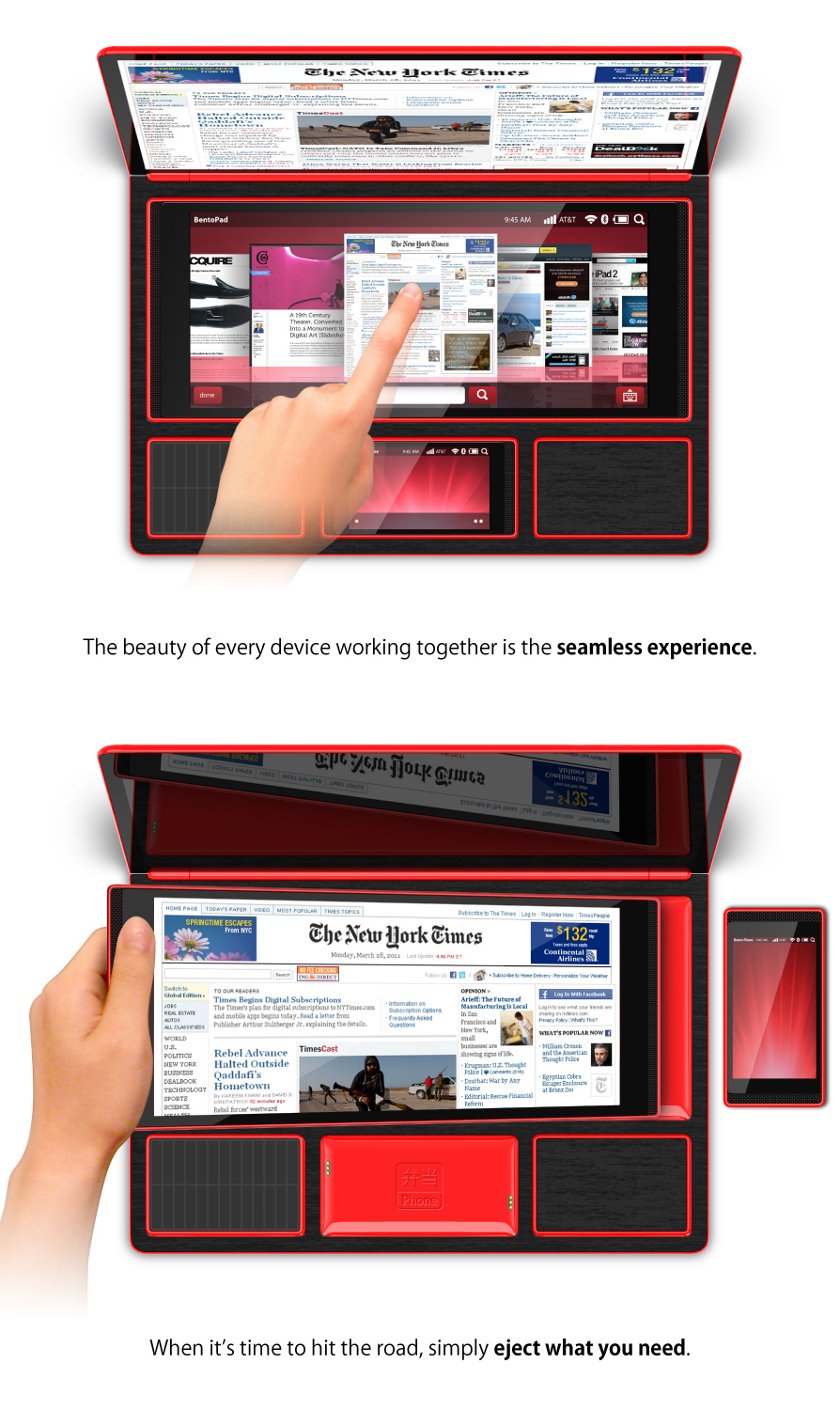
Modern life is full of portable digital devices, each with it’s unique interaction, chip-set, and form factor making it uniquely appropriate for it’s own set of use cases. Managing all of these devices can be a pain to say the least when it comes to syncing, transporting, charging, and most importantly sharing and creating content. In response to this, RISD ID student and former frog design intern, Rene Lee, has designed the Bento Book.

bentobook-11.jpg
The Bento Book is a system of devices that work together… kind of like Voltron. The phone, tablet, hard drive, and battery dock into the base of the laptop to essentially form half of it. The phone becomes the track pad, the tablet becomes a touch screen keyboard/input area, somewhat like a Nintendo DS. Content can be surfed on the tablet, and then say you want to modify that content, or interact with it more deeply, you dock the tablet into the screen to continue working with it in a more focussed way. Then you can pop the phone out to take it all on the road.

bentobook-08.jpg
The Bento Book is a nice manifestation of where the current trend of device convergence could go. Check out all the details on Rene’s site HERE

(more…)

Continue Reading:
Bento Book by Rene Lee