
For over a decade, people suffering from Morgellons disease have been told that they’re experiencing delusions. Even when they show doctors evidence that strange, multicolored fibers are growing out of itchy patches on their skin. More
For over a decade, people suffering from Morgellons disease have been told that they’re experiencing delusions. Even when they show doctors evidence that strange, multicolored fibers are growing out of itchy patches on their skin. More
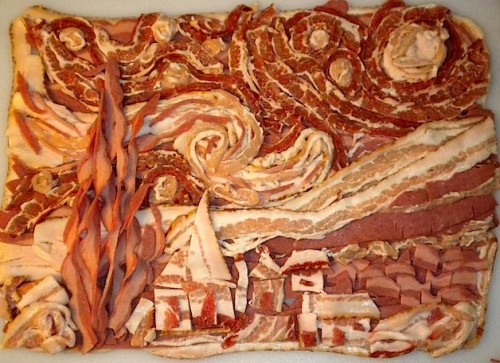
Is it possible to improve upon a work by Van Gogh? Instructables user CopperTwist proves, beyond all doubt, that the answer is ‘yes’. Just substitute various pork products for paint.
See the original article here:
Vincent Van Gogh’s Starry Night Rendered in Pork Products
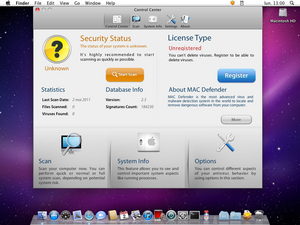
A new piece of malware is spreading, notable because it targets computers running Mac OS X, rather than Windows. Reports of the trojan “MAC Defender” (aka Mac Protector, aka Mac Security) first surfaced on May 2, but the malware has since morphed and proliferated.
The basics: it spreads as search engine optimization (SEO) poisoning, using popular search terms for prominent search engine results.
More: PC World, MacWorld, Ars Technica, Fortune, and a full description updated today at SecureMac.com.
And if you are a Mac user, now is as good a time as any to consider installing *actual* anti-virus and malware scan apps. Intego’s VirusBarrier, Sophos and MacScan are several with free demo versions.
Apparently, “osama bin laden” is one of the popular search terms used to deploy. I just encountered a MAC Defender come-on page in Safari after clicking on a poisoned msnbc.com link via Twitter, hence the inspiration for this blog post. Pretty sure one of the remnant ads on msnbc.com served it. The serving IP is below, load it at your own risk, I paste it for informational purposes only.
http://178.17.162.163/7d81dd5ca78c961d206fb04f2f1709c2fbc6f0515ca0adda


More:
Beware MAC Defender: OSX malware disguised as anti-virus software

When the Wall Street Journal reported last night that Microsoft was going to buy Skype, the response was puzzlement. Though Skype has some value, the estimated $7 billion-8 billion valuation was unfathomable. Microsoft has now confirmed the purchase and held a press conference to announce the takeover. The morning after the night before, is it making any more sense?
From what little the company has said, not really. Microsoft will buy Skype for $8.5 billion in cash. The companies have entered into a definitive agreement, and the deal has received approval from both boards of directors; pending regulatory approval, it will close by the end of the year. Skype will be run as a new business division within Microsoft, with Skype CEO Tony Bates taking a new role as president of the Microsoft Skype Division, reporting directly to Microsoft CEO Steve Ballmer. Speaking at the press conference, Ballmer said that Microsoft originally planned a partnership before deciding to buy the company outright.

Read the comments on this post
Read more here:
Why Skype? Microsoft confirms $8.5 billion purchase, clarifies nothing

Google’s upcoming Android 3.1 is coming for tablets, of course, but it’s also improving Google TV’s interface. Even better, Google TV gets the Android Market as well. More

Remember that plug-in Prius we drove for a bit? Yeah, Toyota is bringing that technology to more models. The Prius has long been the popular hybrid vehicle but cars like the Volt and Leaf are stealing a good deal of the public’s love thanks to their plug-in ability. It seems Toyota is looking to recapture some of its lost karma by shifting the entire Prius line to plug-in hybrids by the 2014 model year.
This comes by way of a short and sweet Reuters report that also states the plug-in feature will come standard and the models should sell at the current Prius’s rate. The big change comes as the automaker switches from NiMH to Li-ion batteries.
The Prius brand is set to explode in the coming years. Toyota previously detailed plans to introduce new models including the Prius v, which features a hatch and 50% more interior room than the current model.
A plug-in Prius isn’t really anything new. We had a chance to tool around town in a prototype for a week and found the experence as wonderful as it seems. The fuel economy was fantastic and the switch between the electric motor and gas engine seamless. The product edition should be refinded even more although the prototype was nearly perfect.
See more here:
Report: The Entire Prius Line To Be Plug-In Hybrids Starting With The 2014 Model Year
https://kenmay.net/mp3/techtoday051011.mp3
Juliane Black from Blackfire Studios talks to us about Social Media, and how it affects your business.

Google’s upcoming Android 3.1 is coming for tablets, of course, but it’s also improving Google TV’s interface. Even better, Google TV gets the Android Market as well. More

When Intel wanted to take a serious stab at the tablet market it turned to PowerVR, the company already providing the graphical muscle for its embedded chips that power the Logitech Revue and other set top boxes. Now, the folks at VR-Zone claim that Intel will be adopting the company’s tech across the Atom line and ditching its own integrated graphics for the upcoming Cedarview platform. Specifically, it’s rumored that Chipzilla will stick the SGX545 (an upgraded version of the pixel pusher inside Samsung’s Hummingbird platform and Apple’s A5) in all Cedar Trail processors. The switch will bring support for DirectX 10.1 and OpenGL 3.2 to the low-power CPUs while improving HD video decoding. Sure, when the next-gen Atoms land the graphics chip it will already be almost two years old, but its low power and robust Android support make it a natural match for Honeycomb — Intel’s best bet for tablet success now that Nokia is distancing itself from Meego.
Atoms rumored to ditch Intel graphics for PowerVR originally appeared on Engadget on Tue, 10 May 2011 11:02:00 EDT. Please see our terms for use of feeds.

The next version of Google’s Android operating system, codenamed Ice Cream Sandwich, will converge the formerly disparate phone and tablet versions of the OS, Google announced at its I/O keynote today. Ice Cream Sandwich will maintain a single UI across all form factors and will allow developers to create applications for both kinds of devices in one motion. It will follow the rollout of Android 3.1 to the Motorola Xoom tablet and Google TV.
Google says the Ice Cream Sandwich version of Android will “all be open source,” including APIs for face-tracking and other new features. Developers will be able to account for all form factors within this same version of the OS, and Google will be adding a lot of UIs to accommodate Android devices of all shapes and sizes.
The announcement of Ice Cream Sandwich followed news of Android 3.1, which carries desirable features like resizable widgets in the application launcher. Android 3.1’s trip over to Google TV will also carry with it the Android Marketplace and the usability of USB devices. At the keynote, Hugo Barra, director of Android product management, demoed the use of an XBox 360 controller with an Android game.
No official launch date has yet been announced for Ice Cream Sandwich, but Android 3.1 will be available to compatible devices as of today.
Read the comments on this post
View original post here:
Google announces Android Ice Cream Sandwich will merge phone and tablet OSes