Verizon dominates 'Fastest Mobile Networks' testing, considers calling AT&T to brag

Not all wireless carriers are created equal, nor for that matter is all 4G — anyone who’s ever swapped networks or done any sort of traveling across the country can tell you that. And while it seems like we have fewer and fewer choices as the days go by, our increasing reliance on mobile devices makes the efficiency of our data delivery all the more important. PCMag invested some serious man / woman-hours for its annual “Fastest Mobile Networks” story, gathering mobile data in 21 cities — running more than 140,000 tests in all. According to the results, Verizon's LTE rules supreme in pretty much every area tested, save for those “in-between” rural locations, where AT&T nabbed the top spot. Perhaps it's time to take old “Test Man” out of retirement for celebratory victory lap?

Verizon dominates 'Fastest Mobile Networks' testing, considers calling AT&T to brag originally appeared on Engadget on Mon, 27 Jun 2011 20:18:00 EDT. Please see our terms for use of feeds.

Permalink

TomTom’s iPhone App gets updated, brings HD traffic updates along for the ride

Hate gridlock? We’d surmise you aren’t alone, so pardon our excitement surrounding the latest addition to TomTom’s longstanding iPhone app. New in version 1.8 is the addition of HD Traffic, which extends congestion data to both “major” and “secondary” US roads. Existing TomTom Traffic subscribers get the functionality gratis, with the rest of us dishing out $20 via an in-app purchase. Free for all who upgrade are multi-stop routes, allowing one to tweak excursions to your heart’s content — provided you can count those diversions on one hand. The updated app is already live in the App Store, but please, pull over before downloading — cool?

Continue reading TomTom’s iPhone App gets updated, brings HD traffic updates along for the ride

TomTom’s iPhone App gets updated, brings HD traffic updates along for the ride originally appeared on Engadget on Mon, 27 Jun 2011 19:46:00 EDT. Please see our terms for use of feeds.

Permalink

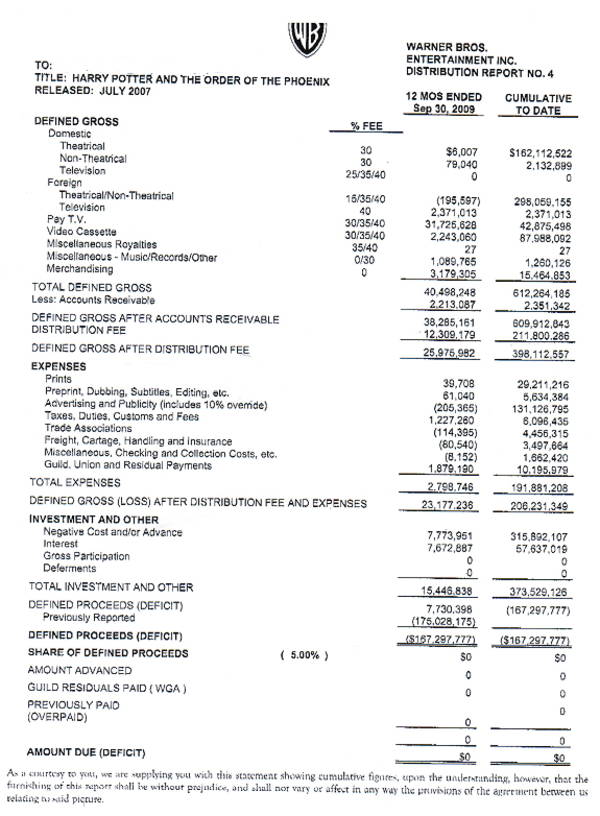
Hollywoodonomics: how Harry Potter and The Order of the Phoenix “lost” $167M

Last summer, Deadline released this balance-sheet (“participation statement”) detailing the alleged financial state of the corporate entity struck to run the Warner Bros movie “Harry Potter and The Order of the Phoenix.” The movie, which had grossed nearly $1B at the time, was nevertheless running $167M in the red. The losses are largely attributable to to prints and advertising/marketing — and, as many commenters on the original post point out, a major recipient of that marketing budget would have been Warner’s itself, in the guise of its other media divisions. Another culprit is high interest fees, though the film didn’t have outside financing, so Deadline speculates that the loan note was also held by Warner’s.

The original post holds this out as an example of why only a fool accepts “net-participation” compensation for work associated with a film, but I think this is also a great example of why all financial numbers released by the entertainment industry should be treated as fiction until proven otherwise. Especially piracy “loss” figures, alleged contributions to national GDP, and job creation numbers.

As one dealmaker tells me: “If this is the fair definition of net profits, why do we continue to pretend and go through this charade? Judging by this, no movie is ever, ever going to go to pay off on net participants. It’s an illusion to make writers, and lower-level actors and filmmakers feel they have a stake in the game.”

And yet Warner Bros isn’t doing anything differently here than is done by every other studio. Clearly, nothing has changed since Art Buchwald successfully sued Paramount over the 1988 hit Coming to America when the subject of net participation was scrutinized, and a judge called studio accounting methods “unconscionable”.

STUDIO SHAME! Even Harry Potter Pic Loses Money Because Of Warner Bros’ Phony Baloney Net Profit Accounting

(via Reddit)


Read More:
Hollywoodonomics: how Harry Potter and The Order of the Phoenix “lost” $167M

NVIDIA teases a pair of mystery laptop GPUs running Crysis 2 (video)

Did someone say controlled leak? NVIDIA’s come clean about the fact that it has some news to share tomorrow, but until then, it’s being oh-so demure about what it has up its sleeve. Behold, an unnamed GPU — two of ’em, in fact! — running Crysis 2 in SLI mode. What you see in the short clip below is the DirectX11 version of the game running at 1080p resolution with tesselation enabled and a high-resolution texture pack. All told, the game appears to play smoothly, even with the settings cranked to the max. So just what is this thing? Looks like we’ll find out in the morn, folks.

Continue reading NVIDIA teases a pair of mystery laptop GPUs running Crysis 2 (video)

NVIDIA teases a pair of mystery laptop GPUs running Crysis 2 (video) originally appeared on Engadget on Mon, 27 Jun 2011 16:33:00 EDT. Please see our terms for use of feeds.

Permalink

Nailing the Cause of Recent Linux Power Issues

An anonymous reader writes “For the Linux kernel power regressions that were found a few months ago, and hit in Ubuntu 11.04, Phoronix has found the regression that’s still present in the Linux 3.0 kernel. The power regression is caused by a change in ASPM, the Active-State Power Management, for PCI Express support.”

Read more of this story at Slashdot.

More:
Nailing the Cause of Recent Linux Power Issues

Super Talent USB 3.0 Express RC8 looks like a thumb drive, acts like an SSD

It seems too much to hope for, but Super Talent insists it has the benchmarks to prove it: a USB 3.0 stick that achieves 270MB/s reads and 240MB/s writes under optimal conditions. Unlike your average joe flash drive, the RC8 boasts a fully-fledged (albeit previous-generation) SandForce SSD controller that permits the simultaneous use of eight channels of NAND memory. In other words, this zippy little thing actually is an SSD, enclosed in an aluminum case that measures 1-inch wide, 4-inches long and 0.3-inches thick. No definitive word on pricing yet, but it was reported at Computex that a 50GB variant would go for around $110, while 25GB and 100GB capacities will also be available. Now, could someone please hurry up and build a Thunderbolt version?

Super Talent USB 3.0 Express RC8 looks like a thumb drive, acts like an SSD originally appeared on Engadget on Mon, 27 Jun 2011 09:22:00 EDT. Please see our terms for use of feeds.

Permalink