Tech Today w/ Ken May

Archive for July, 2011

First 24/7 Solar Plant

Posted by kenmay on July - 31 - 2011

One of the difficulties with using solar energy is its inability to produce electricity around the clock. Torresol Energy in southern Spain has solved this problem by storing thermal energy in two tanks of molten salt. This enables the plant to generate electricity long after sundown in order to satisfy the energy needs of the local populace. The molten salt — known as MSES — stores enough thermal energy during the day to create steam power during the night. The MSES consists of 60% potassium nitrate and 40% sodium nitrate. This mixture has the amazing ability to retain 99% of the heat energy generated by the CSP plant to be reused later. Essentially what Forbes calls a “battery” that lasts for about 15 hours – more than double Andasol I’s 7 hour capacity – the MSES is not considered especially toxic to the environment. Gemasolar is expected to produce approximately 110,000 MWh of energy each year – enough to power 25,000 homes. Although a 19.9 MW plant is relatively small, this functions on par with a 50MW plant that

Categories: Uncategorized

Buying An Electric Car

Posted by kenmay on July - 31 - 2011

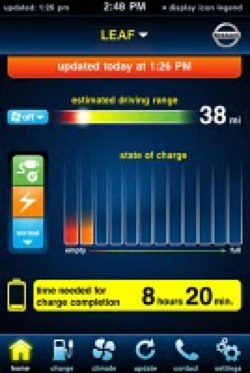
This guest post is by venture capitalist David Cowan . David has recently purchased a Nissan Leaf after going car-less for two year. After 3.5 years, I’ve finally re-joined the community of car owners. Between February 2008 and last week, I was car-less . I borrowed and rented cars, took taxis and Zip cars, and occasionally biked. I also bummed a lot of rides (thank you very much – you know who you are). It had started when the warranty on my fancy German gas guzzler expired; I sold the thing, and never really found the time to shop around for a replacement – Who Has Time For This ? I felt a lot more excited about the prospect of driving an electric sedan, which should be greener, potentially faster, simpler to operate, and cheaper to fuel. Most importantly, I’d never have to kill ten minutes stopping for gas – Who Has Time For This? So I put my name down on the lists for a Tesla Model S, Fisker Karma, Nissan Leaf and Chevy Volt, deciding to wait for one to be built. Three years later, I got calls from Fisker, Nissan and Chevy, and it was time to decide. After examining the options and driving the cars, it was a pretty easy decision to buy the Leaf for these eight reasons: 1. Compared to the others, the Leaf gets twice the range from a battery charge: 100 miles, or 85 miles with the AC cranking. (Plugging the car in and out adds about 15 seconds a day to your daily routine, or 5 minutes a month – about half the time we spend at gas pumps.) 2. With a pure electric motor (not a hybrid gasoline engine) the Leaf is nimbler, less fragile, and legal to drive in California’s carpool lanes so I can bypass the Highway 101 traffic jams – WHTFT? 3. Driving in electric mode (without the help of a hybrid gasoline engine) is wonderfully quiet and smooth (no transmission). Even at 80 miles per hour the acceleration is immediate and impressive. 4. The Leaf steers as smoothly as a Lexus, and the small wheels turn on a dime. 5. Only the Leaf has open, comfortable seats with ample head room in front and leg room in back (a must if you have kids) 6. Only the Leaf carries 5 passengers (a must if you have THREE kids!) 7. The Leaf has the largest trunk, and the back seats fold down for more cargo space. 8. The Leaf costs 3/4 as much as the Volt, and 1/3 as much as the Karma. You get at least $7500 in tax credits, offset by the $2,000 expense of a home 220 volt charging station. These reasons explain why the Nissan Leaf now the outsells the pack. I can think of only three good reasons why you might wish to buy one of the other cars: 1. The Leaf’s pure electric motor is not a problem for two car families – on that rare day once a month when you drive more than 100 miles, you can always take the gas guzzler instead (Honda Odysseys are awesome). But without that fallback, one-car households will find the Volt more practical (albeit expensive and cramped). 2. If you love driving enormous, heavy sports cars that sit low to the ground and you’ve got $100k to burn (like these guys ), then you might prefer the gorgeous design of the Karma. It has the look and feel of a luxury muscle car with a growling engine, bucket seats, and beautiful wood/leather interiors. (The Leaf is all plastic.) Having said that, the Karma performs like a sports car at lower speeds but on the highway I found it downright sluggish compared to the Leaf. The Karma handled highway acceleration nearly as well as the Leaf only when in Stealth Mode which means that the gasoline engine is off. (You may be as disappointed as I was to learn that people can still see you in Stealth Mode.) 3. Stephen Colbert will mock you for driving a Leaf. All three cars come chock full of gizmos we all love (rear view camera, navigation, keyless entry, XM radio, Bluetooth, heated seats…) so there’s no reason to stick with gasoline. The Leaf even comes with a cool iPhone app for remote operation of the charger and climate control. So I’ve been zipping around in my Leaf for a week now and absolutely loving it. Even after three years, it was worth the wait. CrunchBase Information David Cowan Information provided by CrunchBase
Categories: Uncategorized

Our last quarterly special report looked at the PC industry in 2011; this one jumps into the future to discuss where we’ll be in 2015. The complete 6,500 word report is available in PDF and e-book formats, but it’s only for Ars Technica subscribers. Sign up today ! In an earlier report , we surveyed the state of the PC, circa the first quarter of 2011. While not the primary focus of that piece, we also touched on some of the long term trends affecting the future of that cherished platform. In this followup, we take a more forward-looking perspective—what will PC hardware look like in 2015? Four years is an eternity in the semiconductor and PC industry—companies have been started, grown, and collapsed in less time—so any attempt to look this far is prone to uncertainty. This report therefore doesn't aim for crystalline precision but rather approximate accuracy. Our analysis starts by examining semiconductor manufacturing in 2015, then moves to general integration trends and specific expectations for the three key vendors—AMD, Intel, and Nvidia. Finally, we conclude with a look at the major sub-markets for the PC—client systems, discrete GPUs and servers. Let’s step into the time machine. Manufacturing context Since the PC ecosystem is so closely tied to the semiconductor industry, it’s a natural first step to examine manufacturing in 2015. Intel’s schedule for process technology is fairly clear; they are still on a two-year cadence and have not expressed any interest in slowing. 22nm will debut at the end of 2011, after which Intel will shift to the so-called ‘half nodes.’ If history is any guide, 14nm will be Intel’s high volume option in 2015, with 10nm coming online at the end of the year. There’s no doubt that fabs like Global Foundries and TSMC will continue to lag Intel’s manufacturing. Traditionally, the gap has been 12-16 months, but there are strong suggestions that this disparity will widen, rather than narrow, over time. Recent AMD roadmaps indicate that their products will lag a full 2 years behind Intel, with 14nm chips going into production at the end of 2015. Comments from TSMC also suggest a similar time frame for 14nm production. Taken together, the most likely scenario for 2015 is that Intel will be in high volume production of 14nm chips while the rest of the industry is shipping 20nm products. The density advantage is a given, but performance is unclear. If Intel moves to fully depleted silicon-on-insulator or tri-gate transistors, the performance delta could be substantial. But if Intel continues with a more traditional process, then the difference will be much less pronounced. Either way, this means that chips inside a PC will have roughly 4x the available transistors that they do today, giving architects plenty of room for improvement. Read the comments on this post

Categories: Uncategorized

Solar Energy Is the Fastest Growing Industry In the US

Posted by kenmay on July - 29 - 2011

Hugh Pickens writes “According to Rhone Resch, the last three years have seen the U.S. solar industry go from a start-up to a major industry that is creating well-paying jobs and growing the economy in all 50 states, employing 93,000 Americans in 2010, a number that is expected to grow between 25,000 to 50,000 this year (PDF). In the first quarter of 2011, the solar industry installed 252 megawatts of new solar electric capacity, a 66 percent growth from the same time frame in 2010. Solar energy is creating more jobs per megawatt than any other energy source (PDF) with the capability, according to one study, of generating over 4 million jobs by 2030 with aggressive energy efficiency measures. There are now almost 3,000 megawatts of solar electric energy installed in the U.S., enough to power 600,000 homes. In the manufacturing sector, solar panel production jumped 31 percent. 'The U.S. market is expected to more than double yet again in 2011, installing enough solar for more than 400,000 homes,' writes Resch. 'Last year, the industry set the ambitious yet achievable goal of installing 10 gigawatts annually by 2015 (PDF) – enough to power 2 million more homes each and every year.'” Read more of this story at Slashdot.

Categories: Uncategorized

Paying Red-Light Camera Fines Are For Suckers!

Posted by kenmay on July - 29 - 2011

Did you get a red-light camera ticket? Did you pay the fine? If you did, then you’re a sucker. That's the message that motorists in Los Angeles got when it was revealed that red-light camera fines – some of which were as high as $476 – were actually “voluntary.” The Los Angeles Times has the story: City officials this week spotlighted a surprising revelation involving red-light camera tickets: Authorities cannot force violators who simply don't respond to pay them. For a variety of reasons, including the way the law was written, Los Angeles officials say the fines for ticketed motorists are essentially “voluntary” and there are virtually no tangible consequences for those who refuse to pay. Unlike other moving citations, which are issued directly by a police officer to a driver who signs a promise to appear in court, red-light camera tickets are mailed to the registered owner of the vehicle allegedly involved in the violation. That has limited the Los Angeles County Superior Court system’s willingness to aggressively enforce camera ticket collections for the city and 32 other photo enforcement programs in Los Angeles County, officials said. Under state law, court officials have discretion over how they pursue those who do not respond to camera-generated citations. Los Angeles County Superior Court officials, as a matter of fairness, said that for the last decade they have chosen a less forceful approach partly because the person receiving the ticket may not be the person who was driving the car. Link (Photo: Glenn Koenig)

Categories: Uncategorized

Beyond HDTV

Posted by kenmay on July - 29 - 2011

The Hub writes “The Economist writes a thoughtful article about the next generation of HDTVs and how they will provide resolutions beyond 1080p. The drive for higher resolution is driven in part by the demands of 3D content. Also, some see streaming higher resolution content to the home as a way to make up for declining DVD sales. This would mean the studios would have to better embrace services such as Netflix or stream directly to the consumer. Mind you, picture quality is driven by more than the number of pixels.” Read more of this story at Slashdot.

Categories: Uncategorized

The Isostick Makes A Mockery Of Optical Disk Hegemony

Posted by kenmay on July - 29 - 2011

In the old days, you used to have to put something called “optical media” into a “DVD drive” to install software and operating systems. Those days are long over thanks to an odd little USB key called the Isostick. Although the project doesn’t officially exist – it’s almost funded on Kickstarter – the IsoStick promises to allow you to load any ISO disk image from any computer just as if it were loading it from an optical disk. Why would you want to do this? Well, some computers can’t boot directly from a USB thumbdrive and the IsoStick solves this by masquerading as an optical drive first and a thumb drive second. Almost any PC will boot from an optical disk, which makes the Isostick so useful. You can write multiple ISOs onto the FAT32 drive and a special selector lets you pick which one to load. This means you could keep multiple install images on one USB drive and install them as needed. Write the creators: The isostick is targeted at IT people, computer technicians, and geeks in general that are sick and tired of carrying around lots of discs that always get lost, broken, scratched, or just stop working. Often times you’ll have to update your discs with the latest patches or virus definitions or what-have-you. With isostick it’s a breeze, just drop the new iso on the flash drive and you’re ready to go! $225 gets you a 32GB stick and some stickers while the cheapest model costs $125 for 8GB. If you’re unsure what you’d do with this, you’re probably not the target market but they’ve had $21,000 in pledges (out of a target of $25,000) so far, so it’s likely this has always been an itch that needed scratching. Project Page

Categories: Uncategorized

AT&T Chokes Unlimited Data Dead. Dead Dead Dead. [At&t]

Posted by kenmay on July - 29 - 2011

If you've still got an unlimited AT&T data plan that you're holding onto for dear life to stream gigs and gigs of Spotify and Netflix and god knows what else, your life is about to suck a lot more . More

Categories: Uncategorized

MTV News Coverage from 1995: The Internet

Posted by kenmay on July - 29 - 2011

In this four-minute clip from 1995, the intrepid MTV News team takes on The Internet. Their coverage is wonderfully dated, showing the state of the art at the time: animated GIFs, Netscape, CompuServe, and blurred-out nudie pictures. Yes indeed, the coverage is primarily about online porn (this is MTV, after all), though a few nods are given to sites about Twinkies, Godzilla, Star Wars , music (a teeny tiny QuickTime video), and they guess email is cool too. The whole piece uses a CB radio metaphor to explain the World Wide Web, at one point describing websites as “truck stops.” Enjoy this blast from the not-too-distant past: A partial list of celebrities weighing in on the matter: Billy Corgan, Michael Jackson, Sandra Bullock, Coolio, Ozzy Osbourne, Mike Heidorn (of Son Volt), David Bennahum ( “Cyber Journalist” ), Newt Gingrich, Perry Farrell, Dave Matthews (“It’s gratifying as hell…it’s a little weird”), Moby, and David Bowie (“I got so tired of the rubbish [online] that I dropped out”). (Via Waxy .)

Categories: Uncategorized

Another Cell Phone-Cancer Study Emerges

Posted by kenmay on July - 29 - 2011

oxide7 writes “Since the advent of cellular phones, researchers have pondered whether a connection exists between cell phone usage and brain cancer. New evidence always seems to emerge to support or refute such a link. On Wednesday, another study was added to the list. A European study involving nearly 1,000 participants found no link between cell phone use and brain tumors in children and adolescents. This marks the 3rd study this month and the 4th major one this year, all with different conclusions” Read more of this story at Slashdot.

Categories: Uncategorized