
This hard drive contains software like Adobe’s Font Collection, a 124GB music collection, tons of games, books and more. All the files were downloaded illegally and is supposed to represent, I’m assuming here, the freedom and/or piracy of art. More
This hard drive contains software like Adobe’s Font Collection, a 124GB music collection, tons of games, books and more. All the files were downloaded illegally and is supposed to represent, I’m assuming here, the freedom and/or piracy of art. More

Remember Places, the Facebook Foursquare clone feature you probably didn’t use? I say probably, because Facebook just axed it entirely, BI reports, admitting inevitable defeat in the check-in war. It’s about time! More
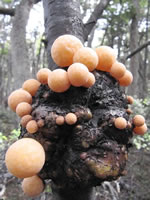 Mystery
solved! Scientists have discovered the “missing link” in beer
brewing. Ladies and gents, take a good look at the orange-colored galls
on the beech tree to your left: they were found to harbor the specific
strain of yeast that makes lager beer possible.
How did lager beer come to be? After pondering the question for
decades, scientists have found that an elusive species of yeast isolated
in the forests of Argentina was key to the invention of the crisp-tasting
German beer 600 years ago.It took a five-year search around the world before a scientific
team discovered, identified and named the organism, a species of wild
yeast called Saccharomyces eubayanus that lives on beech trees.“We knew it had to be out there somewhere,” said Chris
Todd Hittinger, an evolutionary geneticist at the University of Wisconsin-Madison
and a coauthor of the report published Monday in the Proceedings of
the National Academies of Sciences.
I assume the scientists appropriately celebrated their discovery with
a few pints: Link
(Photo: Diego Libkind)
Previously on Neatorama: Neatolicious
Fun Facts: Beer
See more here:
Scientists Discovered the “Missing Link” of Beer Brewing
Facebook has just announced that starting Thursday, a major overhaul of the site’s privacy controls will begin rollout to all users. The goal is to help users share exactly what they want with exactly who they want by improving privacy setting transparency, simplicity, and accessibility.

Amongst the many significant changes, privacy settings will soon appear on the profile and news feed publisher in-line with the content rather than on a dedicated privacy settings page. Users will be able to their specific or city-level location to any post, retroactively change the privacy setting of previously published content, and opt to require pre-approval any time they’re tagged in a photo, checkin, or other type of post.
The changes may reduce the volume of content that is unwittingly overshared, and help users protect themselves from being associated with objectionable content against their will. The end result could be an increase in confidence in Facebook privacy that leads users to be comfortable sharing more, which could in turn increase engagement with the site.
Facebook last redesigned its privacy settings in May 2010 following criticism regarding the complexity of the controls.

[Thanks, Chris]
Square app update lets iOS users buy cookies on credit, sans signature originally appeared on Engadget on Tue, 23 Aug 2011 12:34:00 EDT. Please see our terms for use of feeds.
Chad Steen tells us all about the awesome open source media center app called Mediaportal.
Find out more at http://team-mediaportal.com
Ghostly International just posted this fascinating animated GIF of a pie chart that breaks down the year-by-year revenue stream of the American music industry from 1980-2010.