USPS Rescue Plan: More Junk Mail!

The US Postal Service is like a damsel in distress. Severe distress.
The rise of email and the Great Recession, coupled with bad management
and its high labor (and labor’s retirement) costs have caused the institution
to be near
collapse
.

But, like the analogy goes, there’s a white knight! Here’s how the Post
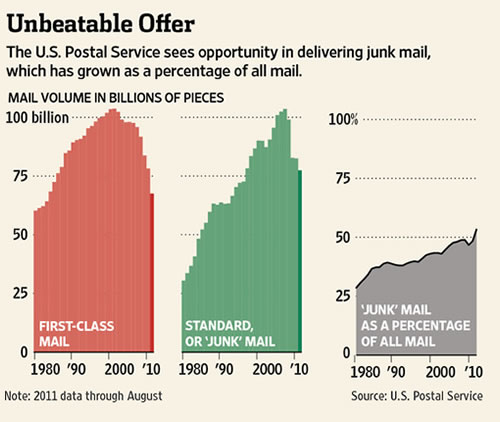
Office plans to rescue itself from bankruptcy: more junk mail for everyone!

Many consumers are irked by the catalogs, credit-card pitches and
other “junk mail” they receive. But the U.S. Postal Service
loves it—and wants to deliver more.

The agency, beset by historic losses and a plummet in first-class
mail, is running promotions, easing rules and planning television and
radio ads to encourage more businesses to send pitches by standard mail,
the official term for bulk mailings used by marketers to prospect for
customers.

“What we want to do is to make standard mail more interesting
for customers so we can grow the total volume,” Postmaster General
Patrick Donahoe said in an interview. “We don't call it junk mail—it's
a lucrative avenue for anyone who wants to reach customers.”

Link

View original post here:
USPS Rescue Plan: More Junk Mail!

Cybook prepping Odyssey reader with High Speed Ink System screen

Bookeen Odyssey

It looks like Bookeen may finally be through teasing us — the company is preparing to unleash the Odyssey, a reader sporting its High Speed Ink System. The modified Pearl E Ink screen has been shown off multiple times, playing back video and browsing the web. Now it will finally make the transition from interesting tech demo to actual product. Better yet, the 6-inch, full motion-capable screen has been paired with a touch layer, which means it could deliver a tablet-like experience with battery life closer to a traditional e-reader. Underneath the hood is a an 800MHz Cortex A8 processor from Texas Instruments and a WiFi radio, presumably for downloading content and browsing the web. The Odyssey is expect to start shipping in Europe in the next few weeks, but Bookeen has yet to reveal a price. You can check out the machine translated PR at the source link.

Cybook prepping Odyssey reader with High Speed Ink System screen originally appeared on Engadget on Sun, 09 Oct 2011 14:07:00 EDT. Please see our terms for use of feeds.

Permalink

BT Promises 300Mbps FTTP By 2012

twoheadedboy writes “UK service provider BT has launched its Fibre to the Premises (FTTP) product, pledging it will offer downstream speeds of 300Mbps by spring next year. At present, the service can hit 110Mbps downstream speeds and will be available in just six locations from the end of October. More locations will be added and speeds will rise, however, with a 1Gbps service currently being trialled in Kesgrave, Suffolk. There may be continuing disputes over BT Openreach’s pricing of fibre products, given the recent industry in-fighting. Nevertheless, 300Mbps fibre will provide some pretty speedy downloads for end users.”

Read more of this story at Slashdot.

View the original here:
BT Promises 300Mbps FTTP By 2012

Graphene Creates Electricity When Struck By Light

MrSeb writes with news out of MIT about another interesting and potentially useful property of graphene. Researchers have known for several years that graphene generates electricity when exposed to sunlight, but incorrectly attributed it to the photovoltaic effect. A new paper shows that the current is actually generated from the much more unusual 'hot-carrier' response. Quoting:
“The material’s electrons, which carry current, are heated by the light, but the lattice of carbon nuclei that forms graphene’s backbone remains cool. It’s this difference in temperature within the material that produces the flow of electricity. … Such differential heating has been observed before, but only under very special circumstances: either at ultralow temperatures (measured in thousandths of a degree above absolute zero), or when materials are blasted with intense energy from a high-power laser. This response in graphene, by contrast, occurs across a broad range of temperatures all the way up to room temperature, and with light no more intense than ordinary sunlight.”
It will take more work to determine what new applications are reasonable from an efficiency perspective, but it does broaden graphene's already-impressive capabilities.

Read more of this story at Slashdot.

See more here:
Graphene Creates Electricity When Struck By Light

Microsoft To Bring Cable TV To 360

iONiUM writes with a CNET article outlining the next step in Microsoft's plans for cable television, which he says “seems like yet another step forward in killing traditional cable companies.” From the article: “[Microsoft] announced this morning that nearly 40 television content providers — including Comcast, Verizon, and HBO in the United States — will roll out programming over Xbox Live. The company also has deals lined up with providers in the U.K., Spain, Canada, Mexico, Germany, and Italy.”

Read more of this story at Slashdot.


More:
Microsoft To Bring Cable TV To 360

Windows 8 To Reduce Memory Footprint

bheer writes “Microsoft’s Windows 8 blog has a good post about the work being done to reduce Windows 8’s memory footprint. The OS will use multiple approaches to do this, including combining RAM pages, re-architecting old bits of code and adding new APIs for more granular memory management. Interestingly, it will also let services start on a trigger and stop when needed instead of running all the time.”

Read more of this story at Slashdot.


Read More:
Windows 8 To Reduce Memory Footprint

FBI Plans Nationwide Face-Recognition Trials In 2012

hessian writes with this excerpt: “The FBI by mid-January will activate a nationwide facial recognition service in select states that will allow local police to identify unknown subjects in photos, bureau officials told Nextgov. The federal government is embarking on a multiyear, $1 billion dollar overhaul of the FBI’s existing fingerprint database to more quickly and accurately identify suspects, partly through applying other biometric markers, such as iris scans and voice recordings.”

Read more of this story at Slashdot.


Read More:
FBI Plans Nationwide Face-Recognition Trials In 2012