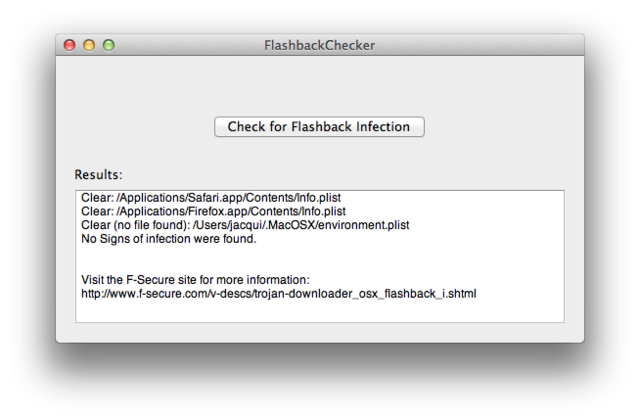
Checking for Mac Flashback infestation? There’s an app for that


Our post from Friday about how to check your Mac for a Flashback malware infection has been wildly popular so far. And with good reason, too, since a second security firm has now backed up the numbers indicating that more than half a million Macs have been infected. That’s slightly more than 1 percent of all 45 million Macs in the world—still a relatively small number, but a worrisome one for Mac users, as the tally of infected machines continues to grow.

But for those of us who are kept on electronic umbilical cords in order to help our family members with computer questions, asking them to open the Terminal and start typing in foreign commands can be daunting. That’s why Ars reader and programmer Juan Leon put together a quick Flashback checker that can be run on its own to see whether the Mac in question is infected. The download is posted to github and can run on Mac OS X10.5 and above; Leon also posted the source code for those interested in checking it out.

The downloadable app runs the same three Terminal commands that we outlined in our how-to last week—it either says “No signs of infection were found” or spits back further information if necessary. There is also a link to F-Secure’s instructions for removal, but if you have less-technical family members whose Macs are infected, you’ll likely need to step in and help before they have to start mucking with the Terminal.

Update: Leon says he didn’t include removal code in his app because it would require authentication, and we don’t want to start getting into that right now what with a malware infection making the rounds.

Read the comments on this post

See the original post:
Checking for Mac Flashback infestation? There’s an app for that

The Lumia 900 Becomes Amazon’s Best Selling Phone, Topping The RAZR MAXX And Galaxy Nexus

amazon

And we’re off! Even though the Nokia Lumia 900 launched yesterday and was largely unavailable thanks to the Easter Bunny, the phone quickly skyrocketed to the top of Amazon’s best sellers list. The phone hovered around the 5th spot yesterday but jumped to the first and second spot today with the black version preferred over the cyan edition. This puts the Nokia’s large Windows Phone over top of Android’s star players, the Droid RAZR MAXX and Galaxy Nexus.

Part of the instant popularity likely comes from Amazon’s price of $50 with a two-year service plan. That’s $50 less than AT&T’s price and $150 less than the previously most popular phone from Amazon, the Droid RAZR MAXX.

The other factor could be that for some reason AT&T and Nokia launched the phone in the US on Easter Sunday. Brian X. Chen of of the NYT’s Bits blog found most NYC-based AT&T stores and resellers were understandably closed, making the phone rather difficult to find in person. Launching a pivotal phone on a Sunday is strange but launching it on a major national holiday is downright idiotic.

Amazon has long been friendly to Windows Phone. Out of the top 100 best rated cell phones, the top three are slightly older Windows Phones with Verizon’s HTC Trophy occupying the top spot. Judging by the Lumia 900′s current high rating, Nokia’s Windows Phone could soon join the rest of the family on that list as well.

See more here:
The Lumia 900 Becomes Amazon’s Best Selling Phone, Topping The RAZR MAXX And Galaxy Nexus

No human interaction required: AT&T iPhone unlock can be done via iTunes


Hate going into AT&T stores and interacting with real humans? Worry not, as unlocking your AT&T iPhone is turning out to be a simpler process than expected for some users. The process can still be performed in-store by AT&T personnel, but it can also be done at home with the help of AT&T chat, Apple, and iTunes.

We reported on Friday that AT&T would begin unlocking iPhones for qualified customers beginning Sunday, April 8. That was yesterday, and readers have begun reporting back with their experiences. As it turns out, all you really need is an active Internet connection and your iPhone’s IMEI number to get started (you can get it from your iPhone under Settings > General > About). After logging into AT&T’s website with your account credentials, you can then bring up AT&T’s Wireless Support Chat where you can request your device be unlocked.

As long as you meet the criteria—your phone isn’t associated with an active-term commitment, you’re out of contract, and your account is in good standing—AT&T will likely approve the request. But then it comes down to Apple, which has to push your unlock code to your e-mail address before you can proceed (this happens within 72 hours, but many users have said it took an hour or less). Once you receive the code, you must perform a backup and restore of the device through iTunes while tethered to a computer.

As with most processes that are user-facing, the unlock process doesn’t always work smoothly. AT&T’s own documentation on the process points to this Apple support document on troubleshooting unlock issues, though there are a number of forum threads dedicated to discussing the nuances of performing the unlock procedure as well. Do you have any extra tips to offer for those who have yet to go through the process?

Read the comments on this post

More:
No human interaction required: AT&T iPhone unlock can be done via iTunes

Sony to purge 10,000 employees in attempt to stem losses


Sony Corp. is planning on cutting loose 10,000 of its employees in an effort to bring the company back to profitability, according to reports by the Japanese business newspaper Nikkei and the Associated Press.

The job cuts would amount to a global workforce reduction of six percent. Half of the layoffs will come from reshuffling related to Sony’s departure from the small LCD display business, and consolidation of its midsize display and chemical businesses. On April 1, Sony completed the spinoff and merger of its Mobile Display with the LCD and LED businesses of Hitachi and Toshiba to form Japan Display, an independent company that Sony holds a 10 percent stake in (with the Japanese government-financed Innovation Network Corporation of Japan holding the 70 percent majority stake).

Sony had forecast a $2.7 billion loss for its just-ended fiscal year; the company lost $2.1 billion in the last calendar quarter of 2011 alone, mostly because of its flagging television sales. Sony’s new CEO Kazuo Hirai promised “painful” measures to bring the company back to profitability when he assumed that post earlier this month.

Read the comments on this post

Read the original post:
Sony to purge 10,000 employees in attempt to stem losses

RIM to pull BlackBerry PlayBook away from “chaotic Android cesspool”


Research in Motion plans to drop the ability to sideload Android apps on the BlackBerry PlayBook, Alec Saunders, vice president of developer relations, announced Friday on Twitter. Saunders said that RIM wanted to avoid “duplicat[ing] the chaotic cesspool of Android market.”

This is a kick in the shins at Android’s app store, now called Google Play, which has had its share of problems with malware. The Android store environment also plays more heavily toward free apps than iOS, and the unfavorable sales-to-customer-support ratio can result in low profitability for developers. That aside, Saunders also highlights a issue that sideloading appears to facilitate: piracy. According to the RIM VP, there are instances of developers sideloading free Android apps they don’t own. Crackberry also notes that sideloading Android apps results in buggy and difficult-to-use incarnations on the PlayBook for customers.

Saunders says that RIM is creating another solution for developers who want to transfer their apps to the platform, but in the meantime, this means that the PlayBook platform loses potential access to some 300,000 active applications in the Google Play Store—better a puddle than a (cess)pool, the company seems to think.

RIM plans to announce more details on Android sideloading later today, Saunders tells Ars.

Read the comments on this post

Read More:
RIM to pull BlackBerry PlayBook away from “chaotic Android cesspool”

Major Textbook Publishers Sue Open-Education Textbook Start-Up


linjaaho writes “Three major textbook publishers have sued a startup company making free and open textbooks, citing ‘copyright infringement,’ as the company is making similar textbooks using open material. From the article: ‘The publishers’ complaint takes issue with the way the upstart produces its open-education textbooks, which Boundless bills as free substitutes for expensive printed material. To gain access to the digital alternatives, students select the traditional books assigned in their classes, and Boundless pulls content from an array of open-education sources to knit together a text that the company claims is as good as the designated book. The company calls this mapping of printed book to open material “alignment” — a tactic the complaint said creates a finished product that violates the publishers’ copyrights.'”


Share on Google+

Read more of this story at Slashdot.

See original article:
Major Textbook Publishers Sue Open-Education Textbook Start-Up

Intel Launches Z77 Motherboards, Preparing For Ivy Bridge


MojoKid writes “In preparation for the arrival of their 3rd Generation Core processor products based on their Ivy Bridge microarchitecture, Intel has readied a new chipset dubbed the Z77 Express. New socket 1155 Ivy Bridge processors offer 16 lanes of PCI Express 2.0 or 3.0 connectivity on-die and they feature integrated dual-channel, DDR3 memory controllers with maximum officially supported speeds of up to 1600MHz. The processors are linked to the Z77 chipset via Intel’s FDI (Flexible Display Interface) and 20Gb/s DMI 2.0 interfaces. The chipset itself is outfitted with 8 more PCIe 2.0 lanes, six ports of SATA (II and III), an integrated Gigabit MAC, and digital display outputs for up to three displays. Making its debut for the first time in an Intel chipset is also native USB 3.0 support with four USB 3.0 and ten USB 2.0 ports built in.”


Share on Google+

Read more of this story at Slashdot.

See the original article here:
Intel Launches Z77 Motherboards, Preparing For Ivy Bridge

Mercedes Can Now Update Car Software Remotely

MatthewVD writes “Our cars run millions of lines of code that need constant and, often, critical updates. Jim Motavalli writes that Mercedes-Benz’s new mbrace2 ‘cloud infotainment system’ has a secret capability: it can update software automatically and wirelessly. In a process called ‘reflashing,’ the Mercedes system turns on the car operating system (CU), downloads the new application, then cuts itself off. With companies like Fisker paying dearly for constant recalls for software problems, automakers will likely rush to embrace this technology. No more USBs in the dashboard!”


Share on Google+

Read more of this story at Slashdot.

Continue Reading:
Mercedes Can Now Update Car Software Remotely