Microsoft Launches Office 365 For Government

office_365_logo

Google scored an important win over Microsoft a few weeks ago when it won a $35 million U.S. government contract to bring its cloud-based office solution to the Department of the Interior. Microsoft’s legacy solutions, of course, remain a staple in government offices, but as more and more agencies want to move their productivity and collaboration services to the cloud, Microsoft is running the risk of losing out in this lucrative market. Today, however, the company is launching a new service that should give more of its government customers, which tend to have very strict data security and privacy regulations, the option to move to the cloud. Microsoft’s new Office 365 for Government is, in the company’s own words, “a new multi-tenant service that stores US government data in a segregated community cloud.”

Google touted its ISO 27001 certification for Google Apps for Business last week, which Office 365 for Government also qualifies for. Just like its predecessor, the Business Productivity Online Suite Federal, Microsoft’s new service also supports a plethora of other certifications, including SAS70 Type II, the US Health Insurance Portability, Accountability Act (HIPAA) and the US Federal Information Security Management Act (FISMA). Microsoft also plans to support Criminal Justice Information Security policies soon. The service will soon offer support for IPv6 as well.

The major difference between Microsoft’s enterprise solution and this government cloud is that the government data lives on its own segregated infrastructure. Besides this – and the additional certifications – Microsoft’s government solution includes virtually the same services as the enterprise version, including Exchange Online, Lync Online, SharePoint Online and Office Professional Plus. Given that Microsoft’s enterprise solution is also now FISMA certified, this new service is mainly meant for agencies that have requirements beyond this certification.

Read the original post:
Microsoft Launches Office 365 For Government

Faster than your router? Verizon doubles FiOS speeds to 300Mbps

Internet access as fast as a superhero.

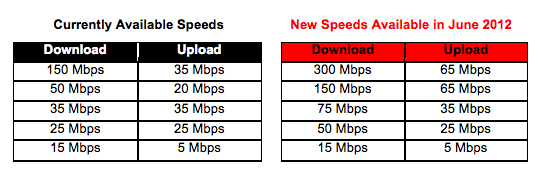
Verizon today said it will double its highest FiOS Internet speeds to 300 megabits per second. That’s faster than any cable offering, and faster than many of the wireless routers powering our homes. (If only FiOS was available in more places…)

The new speeds will be available in June, and offer a big boost to both upload and download times across most FiOS service levels. The biggest increase percentage-wise comes in the 50Mbps tier, which will triple to 150Mbps, as you can see in this chart provided by Verizon:

The vast majority of existing Verizon customers will be eligible for the upgrades. Unfortunately, Verizon may be stopping any major expansions of its FiOS infrastructure, so if cable and its 100Mbps max speed is your best option today it will likely stay your best option. But for existing customers, Verizon will provide free equipment upgrades (including faster routers) when necessary.

Read more | Comments

Read More:
Faster than your router? Verizon doubles FiOS speeds to 300Mbps

Rise Of The Machines: IP Traffic Set To Quadruple By 2016, Thanks To An Influx Of Devices

terminator-3-poster-0

Every year, Cisco issues its Visual Networking Index (VNI) to forecast the amount of data traffic that will be used worldwide. The latest VNI forecast shows a massive uptick in data usage, from the 369 Exabytes of IP traffic used worldwide in 2011 to approximately 1.3 zettabytes in 2016. According to Cisco, that rapid growth in data traffic will be driven by a proliferation of connected devices, ever-increasing broadband connectivity, and greater adoption of IP video worldwide.

Let’s put that into perspective: According to Cisco, the amount of data in 2016 will be more than all the IP traffic transferred between 1984 and 2012. And the rate of increase Cisco forecasts between 2015 and 2016 alone (330 exabytes) is nearly equal to all the data transferred last year.

So what’s driving that explosion in traffic? For one thing, an increase in the total number of devices that are connected to the Internet. With the proliferation of smart phones, tablets, connected TVs and other smart devices (think broadband-enabled washing machines, refrigerators and the like), folks are no longer just connecting to the Internet via PCs.

In fact, the number of network connections is expected to grow from 10.3 billion in 2011 to 18.9 billion by 2016. That represents nearly 2.5 connections for each person on Earth. More importantly, those devices are chipping away at PC dominance for amount of data transferred. In 2011, PCs accounted for about 94 percent of all consumer Internet traffic. That’s expected to fall to 81 percent by 2016, according to Cisco.

The total number of Internet users is poised to reach 3.4 billion by 2016, with ever-increasing broadband speeds increasing the average data usage among them. Cisco forecasts that the average fixed broadband speed will nearly quadruple, from 9 Mbps in 2011 to 34 Mbps in 2016.

As has been the case for the last several years, the fastest growing traffic type will continue to be IP video, which is expected to make up 86 percent of all data traffic by 2016. Cisco forecasts that the amount of video delivered via IP will reach 3 trillion minutes per month in five years, which amounts to about two years (833 days) worth of video transferred every second. That growth is predicated on the number of IP video viewers doubling over the next five years, from 792 million viewers in 2011 to 1.5 billion by 2016.

The massive growth in video online means that the influence of peer-to-peer file sharing will continue to decrease over time. While P2P files made up 77 percent of global consumer Internet traffic in 2011, that is forecast to fall to about 54 percent by 2016. That doesn’t mean actual file-sharing will decrease — in fact, traffic is expected to grow from 4.6 exabytes per month in 2011 to 10 exabytes in 2016. However, as a percentage of data usage, P2P traffic will grow much slower than video.

Anyway, so here’s the caveat: Cisco has a lot riding on this tremendous growth in Internet data usage because Cisco sells a bunch of networking equipment. So it’s a good thing for Cisco if network operators see this report and decide they need to buy a bunch of new gear.

That said, Cisco’s VNI forecasts have actually been pretty conservative relative to the amount of traffic that eventually showed up. In its initial VNI forecast of 2007, Cisco expected 28.4 exabytes of traffic per month in 2011, and that forecast ended up being low. Actual data transferred was 7 percent higher, or 30.7 exabytes per month.

More:
Rise Of The Machines: IP Traffic Set To Quadruple By 2016, Thanks To An Influx Of Devices

Rise Of The Machines: IP Traffic Is Poised To Quadruple By 2016, Driven By An Influx Of New Devices

terminator-3-poster-0

Every year, Cisco issues its Visual Networking Index (VNI) to forecast the amount of data traffic that will be used worldwide. The latest VNI forecast shows a massive uptick in data usage, from the 369 Exabytes of IP traffic used worldwide in 2011 to approximately 1.3 zettabytes in 2016. According to Cisco, that rapid growth in data traffic will be driven by a proliferation of connected devices, ever-increasing broadband connectivity, and greater adoption of IP video worldwide.

Let’s put that into perspective: According to Cisco, the amount of data in 2016 will be more than all the IP traffic transferred between 1984 and 2012. And the rate of increase Cisco forecasts between 2015 and 2016 alone (330 exabytes) is nearly equal to all the data transferred last year.

So what’s driving that explosion in traffic? For one thing, an increase in the total number of devices that are connected to the Internet. With the proliferation of smart phones, tablets, connected TVs and other smart devices (think broadband-enabled washing machines, refrigerators and the like), folks are no longer just connecting to the Internet via PCs.

In fact, the number of network connections is expected to grow from 10.3 billion in 2011 to 18.9 billion by 2016. That represents nearly 2.5 connections for each person on Earth. More importantly, those devices are chipping away at PC dominance for amount of data transferred. In 2011, PCs accounted for about 94 percent of all consumer Internet traffic. That’s expected to fall to 81 percent by 2016, according to Cisco.

The total number of Internet users is poised to reach 3.4 billion by 2016, with ever-increasing broadband speeds increasing the average data usage among them. Cisco forecasts that the average fixed broadband speed will nearly quadruple, from 9 Mbps in 2011 to 34 Mbps in 2016.

As has been the case for the last several years, the fastest growing traffic type will continue to be IP video, which is expected to make up 86 percent of all data traffic by 2016. Cisco forecasts that the amount of video delivered via IP will reach 3 trillion minutes per month in five years, which amounts to about two years (833 days) worth of video transferred every second. That growth is predicated on the number of IP video viewers doubling over the next five years, from 792 million viewers in 2011 to 1.5 billion by 2016.

The massive growth in video online means that the influence of peer-to-peer file sharing will continue to decrease over time. While P2P files made up 77 percent of global consumer Internet traffic in 2011, that is forecast to fall to about 54 percent by 2016. That doesn’t mean actual file-sharing will decrease — in fact, traffic is expected to grow from 4.6 exabytes per month in 2011 to 10 exabytes in 2016. However, as a percentage of data usage, P2P traffic will grow much slower than video.

Anyway, so here’s the caveat: Cisco has a lot riding on this tremendous growth in Internet data usage because Cisco sells a bunch of networking equipment. So it’s a good thing for Cisco if network operators see this report and decide they need to buy a bunch of new gear.

That said, Cisco’s VNI forecasts have actually been pretty conservative relative to the amount of traffic that eventually showed up. In its initial VNI forecast of 2007, Cisco expected 28.4 exabytes of traffic per month in 2011, and that forecast ended up being low. Actual data transferred was 7 percent higher, or 30.7 exabytes per month.

More here:
Rise Of The Machines: IP Traffic Is Poised To Quadruple By 2016, Driven By An Influx Of New Devices