Rise Of The Machines: IP Traffic Is Poised To Quadruple By 2016, Driven By An Influx Of New Devices

terminator-3-poster-0

Every year, Cisco issues its Visual Networking Index (VNI) to forecast the amount of data traffic that will be used worldwide. The latest VNI forecast shows a massive uptick in data usage, from the 369 Exabytes of IP traffic used worldwide in 2011 to approximately 1.3 zettabytes in 2016. According to Cisco, that rapid growth in data traffic will be driven by a proliferation of connected devices, ever-increasing broadband connectivity, and greater adoption of IP video worldwide.

Let’s put that into perspective: According to Cisco, the amount of data in 2016 will be more than all the IP traffic transferred between 1984 and 2012. And the rate of increase Cisco forecasts between 2015 and 2016 alone (330 exabytes) is nearly equal to all the data transferred last year.

So what’s driving that explosion in traffic? For one thing, an increase in the total number of devices that are connected to the Internet. With the proliferation of smart phones, tablets, connected TVs and other smart devices (think broadband-enabled washing machines, refrigerators and the like), folks are no longer just connecting to the Internet via PCs.

In fact, the number of network connections is expected to grow from 10.3 billion in 2011 to 18.9 billion by 2016. That represents nearly 2.5 connections for each person on Earth. More importantly, those devices are chipping away at PC dominance for amount of data transferred. In 2011, PCs accounted for about 94 percent of all consumer Internet traffic. That’s expected to fall to 81 percent by 2016, according to Cisco.

The total number of Internet users is poised to reach 3.4 billion by 2016, with ever-increasing broadband speeds increasing the average data usage among them. Cisco forecasts that the average fixed broadband speed will nearly quadruple, from 9 Mbps in 2011 to 34 Mbps in 2016.

As has been the case for the last several years, the fastest growing traffic type will continue to be IP video, which is expected to make up 86 percent of all data traffic by 2016. Cisco forecasts that the amount of video delivered via IP will reach 3 trillion minutes per month in five years, which amounts to about two years (833 days) worth of video transferred every second. That growth is predicated on the number of IP video viewers doubling over the next five years, from 792 million viewers in 2011 to 1.5 billion by 2016.

The massive growth in video online means that the influence of peer-to-peer file sharing will continue to decrease over time. While P2P files made up 77 percent of global consumer Internet traffic in 2011, that is forecast to fall to about 54 percent by 2016. That doesn’t mean actual file-sharing will decrease — in fact, traffic is expected to grow from 4.6 exabytes per month in 2011 to 10 exabytes in 2016. However, as a percentage of data usage, P2P traffic will grow much slower than video.

Anyway, so here’s the caveat: Cisco has a lot riding on this tremendous growth in Internet data usage because Cisco sells a bunch of networking equipment. So it’s a good thing for Cisco if network operators see this report and decide they need to buy a bunch of new gear.

That said, Cisco’s VNI forecasts have actually been pretty conservative relative to the amount of traffic that eventually showed up. In its initial VNI forecast of 2007, Cisco expected 28.4 exabytes of traffic per month in 2011, and that forecast ended up being low. Actual data transferred was 7 percent higher, or 30.7 exabytes per month.

More here:
Rise Of The Machines: IP Traffic Is Poised To Quadruple By 2016, Driven By An Influx Of New Devices

You Don’t Know Jack shines on Facebook

Names and faces blurred to protect my stupid friends (and that one smart one).
Jellyvision

Many of the most popular “social” games on Facebook are really the opposite of social, when you get down to it. Truly social games—the kind you play together on a couch or on a multi-player server—have you working with friends towards some common objective or working against them in a battle of skill. With many Facebook games, however, the “socializing” portion boils down to visiting a virtual dollhouse to gain a few meaningless points or spamming your friends’ walls to ask them to send you a virtual present. Meanwhile, the game is constantly bugging you to spend real money on some valueless in-game trinket or begging you to share some meaningless achievement with friends that almost assuredly have no interest. Having fun yet?

And then there’s You Don’t Know Jack, which launched on Facebook today as quite possibly the best version yet of Jellyvision’s popular, irreverent trivia series. Instead of exploiting Facebook for annoying viral marketing or addictive and vacant micro-transaction hell, the new game serves as proof that Facebook can be used to add real social competition to strong, proven game design.

If you remember the classic You Don’t Know Jack PC games from the ’90s, or have the recent console-and-PC revamp, then you know what to expect with the Facebook version. There’s still the same sharply written and voice-acted questions, the same mix of high culture and current event topics with pop culture trashiness and sophomoric humor, and the same absurdist send-ups of the staid, Jeopardy-style quiz show format. Many of the questions require you to unpack some truly obscure references just to understand what’s being asked, and trying to keep up with the never-a-dull-moment pacing is a large part of the fun.

Read more | Comments

See original article:
You Don’t Know Jack shines on Facebook

RIM May Need To Write Off $1 Billion In Inventory

benfrog writes “Blackberry maker Research in Motion may need to write off more than $1 billion in inventory, according to Bloomberg. The potential ‘writedown’ comes after RIM took a $485 million pretax charge to write down the value of its PlayBook inventory in December. RIM has said it aims to save $1 billion in operating costs this fiscal year by cutting its number of manufacturing sites and is ‘reviewing its organizational efficiency’ across the company, which may lead to job cuts of 2,000-3,000. Its shares have tumbled 75 percent over the past year and are down 90 percent from their all-time high.”


Share on Google+

Read more of this story at Slashdot.

See the article here:
RIM May Need To Write Off $1 Billion In Inventory

Supposed new iPhone casings show up with tall body, tiny dock connector, tons of mystery (update: a bit of the front too)

Image

When it rains, it pours — after a tiny drizzle of tall iPod touch leaks, we’re suddenly faced with a deluge of photos of what might just be the next iPhone’s back plating. If that’s what we’re looking at through photos supplied by a historically reliable uBreakiFix, talk of bigger iPhone screens might just pan out, as it looks decidedly taller than the iPhone 4S we use today. Apple may likewise be going all old-school iPhone on us, with a modern twist: we could be reverting to an aluminum back with more receptive materials (likely glass) at the ends, just in a much thinner form that keeps the steel antenna band. Perhaps the most intriguing bit is at the bottom, where rumors of a much smaller dock connector may have been validated along with a shift of place for the headphone jack. There’s still a chance we’re looking at an elaborate KIRF or an early engineering prototype that could change, but given that 9to5 Mac just got very similar images with black trim, there’s a real possibility that we’ve just been given a sneak peek of what to expect from Apple later this year.

Update: A handful of extra photos have surfaced at 9to5 that show a bit of the front, as well as better views of the back. It’s looking like the new model won’t quite be as skinny as some photos suggest, and we’re digging the different-hued, two-tone design a bit more now that it’s not being subjected to Mr. Blurrycam. We’ve included the more choice shots in the gallery.

[Thanks to Brandon and Steven from uBreakiFix]

Supposed new iPhone casings show up with tall body, tiny dock connector, tons of mystery (update: a bit of the front too) originally appeared on Engadget on Tue, 29 May 2012 11:06:00 EDT. Please see our terms for use of feeds.

Permalink uBreakiFix | | Email this | Comments

Read the original post:
Supposed new iPhone casings show up with tall body, tiny dock connector, tons of mystery (update: a bit of the front too)

The CZC U116T: it’s an Ultrabook, it’s a hybrid and it’s hopefully coming to Computex

The CZC U116T: it's an Ultrabook, it's a hybrid and it's hopefully coming to Computex

Remember that Compal franken-gadget reference design we saw at CES? Well, something quite similar looks to be heading to Computex and thence to market, courtesy of Chinese manufacturer CZC Tech. The company has loaded up its Transformer-style 13.3-inch U116T with Ivy Bridge and HD 4000 graphics, the world’s favorite resolution, 4GB RAM and a choice of SSD capacities. On the connectivity front you’ll get one each of USB 2.0 and 3.0, a memory card slot, audio jacks, SIM slot and an optional fingerprint scanner for people who don’t like sharing. What’s more, all that technology is housed in the display component — the detachable keyboard itself will apparently only add an extra battery. On the software side, CZC is promoting Windows 7 alongside a bit of future-proofing, which means the only thing left to discover is the price, availability and whether this device will have anything like the astonishing lightness of that fiber glass Compal.

The CZC U116T: it’s an Ultrabook, it’s a hybrid and it’s hopefully coming to Computex originally appeared on Engadget on Tue, 29 May 2012 11:42:00 EDT. Please see our terms for use of feeds.

Permalink Netbook Italia, Ultrabook News | sourceCZC Tech | Email this | Comments

See the article here:
The CZC U116T: it’s an Ultrabook, it’s a hybrid and it’s hopefully coming to Computex

X-rays and iPads: The network healthcare evolution

Photo illustration by Aurich Lawson

Future of Bandwidth

At the rate technology has changed everything else in our lives, by now we should have the equivalent of tricorders in our smartphones—instant access to our health statistics collected by sensors in our clothes and pulled into our individual health history in the cloud. We should be able to Skype our physician, text our pharmacist, and get both a blood sugar measurement and an MRI at Starbucks while waiting for a grande latte.

Except for the MRI part, all of that is doable today. Thanks to the big stick provided by the Affordable Care Act in the US, some healthcare organizations are pushing more aggressive use of network bandwidth and cloud technology:

  • Monitoring patients’ health more proactively with networked devices, ranging from wirelessly networked medicine bottle lids to worn or embedded sensors that report back on vital signs;
  • Coordinating care with the help of analytic tools in the cloud and a wealth of individual and collective patient data; and
  • Connecting physicians directly with patients over PCs or mobile devices for between-appointment follow-ups.

Those things can’t be pulled off without cloud technology, whether it’s hosted internally in a health organization’s data center or elsewhere. But ask any random sampling of physicians, technologists, and health industry observers. They’ll tell you technology isn’t restraining the next big paradigm shift in health care. The bandwidth is willing.

Read more | Comments

View post:
X-rays and iPads: The network healthcare evolution

BabyPing Is A Wireless Baby Monitor You Control With Your iPhone

Screen Shot 2012-05-29 at 10.04.32 AM

If you’ve been in the baby monitor racket as long as I have, you’ve seen it all: the good, the bad, and the unusable. Well here’s a monitor that just might win my heart. It’s called the BabyPing (there’s an N in there) and it allows you to view your child’s every squiggle and giggle on your iPhone or iPad. The app and monitor costs about $230 and is currently available in Europe only, although it’s expected to hit our shores shortly.

Arguably video monitors are mostly for first-time parents who are total freakouts about watching the baby at all times. The system notifies you if the baby is stirring and an infrared system ensures you can peep in on him or her at night.

As I noted before, video systems like this one usually used special hardware and/or wonky software so it’s nice to see something that just works.

Product Page

View article:
BabyPing Is A Wireless Baby Monitor You Control With Your iPhone

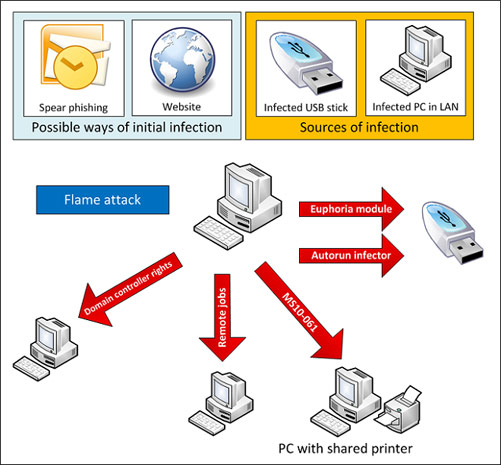
Flame malware snoops on PCs across the Middle East, makes Stuxnet look small-time

Image

Much ado was made when security experts found Stuxnet wreaking havoc, but it’s looking as though the malware was just a prelude to a much more elaborate attack that’s plaguing the Middle East. Flame, a backdoor Windows trojan, doesn’t just sniff and steal nearby network traffic info — it uses your computer’s hardware against you. The rogue code nabs phone data over Bluetooth, spreads over USB drives and records conversations from the PC’s microphone. If that isn’t enough to set even the slightly paranoid on edge, it’s also so complex that it has to infect a PC in stages; Flame may have been attacking computers since 2010 without being spotted, and researchers at Kaspersky think it may be a decade before they know just how much damage the code can wreak.

No culprit has been pinpointed yet, but a link to the same printer spool vulnerability used by Stuxnet has led researchers to suspect that it may be another instance of a targeted cyberwar attack given that Iran, Syria and a handful of other countries in the region are almost exclusively marked as targets. Even if you live in a ‘safe’ region, we’d keep an eye out for any suspicious activity knowing that even a fully updated Windows 7 PC can be compromised.

Flame malware snoops on PCs across the Middle East, makes Stuxnet look small-time originally appeared on Engadget on Mon, 28 May 2012 17:07:00 EDT. Please see our terms for use of feeds.

Permalink Wired | sourceKaspersky Securelist | Email this | Comments

Read more here:
Flame malware snoops on PCs across the Middle East, makes Stuxnet look small-time

Autonomous Road Train Project Completes First Public Road Test


theodp writes “Covered earlier on Slashdot, but lost in the buzz over the Google driverless car is Project Sartre (Safe Road Trains for the Environment), Europe’s experiment with ‘vehicle platooning,’ which has successfully completed a 125 mile road test on a busy Spain motorway. Three Volvos drove themselves by automatically following a truck in the presence of other, normal road users. The Register reports that on-board cameras, radar and laser tracking allow each vehicle to monitor the one in front, and wirelessly streamed data from the lead vehicle tells each car when to accelerate, break and turn.”


Share on Google+

Read more of this story at Slashdot.

Continue reading here:
Autonomous Road Train Project Completes First Public Road Test