Google shuts down features and services for ‘winter cleaning’

Seasons change and web services shut down — such in life. Google today announced some “difficult decisions” regarding a number of properties, particularly Calendar, which will see the end of several “less popular” features on the 4th of next month. On the list of blacked out capabilities are the ability to make reservable times through the service’s Appointment slots. Smart Rescheduler and Add Gadget by URL are also set to go black on that date, while the ability to check one’s calendar and create events via SMS are coming to an end today. On January 30th, meanwhile, it will no longer be possible to set up new devices with Google Sync. That date also marks the end of Google Sync for Nokia S60 and SyncML — and today, the company’s discontinuing Google Calendar Sync. Also on the chopping block are Google’s Issue Tracker API and Punchd. More info on all the shutdowns can be found in the source link. Filed under: Internet , Software , Google Comments Via: The Next Web Source: The Official Google Blog

Read the original:
Google shuts down features and services for ‘winter cleaning’
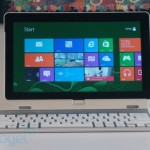
Acer Iconia W700 review: a Core i5 Windows 8 slate that doesn’t skimp on battery life

Until PC makers figure out what consumers want in their Windows 8 PCs, they’ll be throwing different designs at the proverbial wall to see what sticks. One thing’s for sure, though: laptop / tablet hybrids have already made it. So far, we’ve seen a mix of models, some with low-power Atom processors, and others with laptop-grade Core i5 CPUs inside. Basically, a choice between amazing horsepower and long battery life. In Acer’s lineup, specifically, we’ve already had a chance to play with the Iconia W510 , an Atom-powered device with a keyboard dock. Now we’re taking a look at the Iconia W700 ($800 and up), an 11-inch tablet that’s essentially an Ultrabook with no keyboard attached. Based on that brief summary you’d think it had the same form factor as the smaller W510, but you’d be wrong. Whereas the W510 has a keyboard dock with a built-in battery, the W700 has a cradle with a modular kickstand you can use you to prop up the tablet in landscape or portrait mode. There’s no battery inside the dock, and the keyboard is a standalone product; you’ll have to pack it separately if you decide you need it on a trip. So is there any advantage to having a design with so many different pieces? And how does that Core i5 processor fare, anyway? Let’s see. Gallery: Acer Iconia W700 review Continue reading Acer Iconia W700 review: a Core i5 Windows 8 slate that doesn’t skimp on battery life Filed under: Laptops , Tablets , Acer Comments

Visit site:
Acer Iconia W700 review: a Core i5 Windows 8 slate that doesn’t skimp on battery life

How to bring down mission-critical GPS networks with $2,500

Enlarge / The phase-coherent signal synthesizer with its top cover removed. The $2,500 device can be used to severely disrupt mission-critical GPS equipment used by the military and private industry. Nighswander et al. Scientists have devised a series of novel and inexpensive attacks that can severely disrupt mission-critical global positioning systems relied on by the military and a variety of industrial players, including airlines, mining companies, and operators of hydroelectric plants and other critical infrastructure. Unlike previous GPS attacks, the one developed by a team of scientists from Carnegie Mellon University and a private navigation company exploits software bugs in the underlying receivers. That allows the attacks to be stealthier and more persistent than earlier exploits, which primarily relied on signal jamming and spoofing. Prototype hardware that cost only $2,500 to build is able to cause a wide variety of GPS devices within a 30 mile radius to malfunction. Because many of those devices are nodes on special networks that make GPS signals more precise, the attacks have the effect of disrupting larger systems used in aviation, military, and critical infrastructure. The PCSS, or phase-coherent signal synthesizer, that they developed simultaneously receives and transmits civil GPS signals. It carries out many of the same things done by spoofers used in earlier GPS attacks. But instead of merely providing false information designed to compromise the accuracy of the GPS readings, it includes data that exploits weaknesses in the firmware of nearby receivers, many of which use the Internet to share their readings with other machines. The success of the PCSS is the result of an almost complete lack of authentication in the devices that send and receive GPS signals. Read 11 remaining paragraphs | Comments

View article:
How to bring down mission-critical GPS networks with $2,500

Police Can Timestamp Any Audio Recording From Background Interference Alone

A team of forensic researchers from the Metropolitan Police in London, UK, claim to be able to accurately timestamp any audio recording —using just the background electrical hum present in any digital recording. More »

Read More:
Police Can Timestamp Any Audio Recording From Background Interference Alone

Seattle announces its own gigabit Internet service

This map only shows some parts of the city that Seattle Gigabit aims to serve. Gigabit Seattle One day after Google’s executive chairman, Eric Schmidt, proclaimed Google Fiber was ” not an experiment ,” the Emerald City decided that it too wants in on some of that sweet gigabit speed . On Thursday, Seattle Mayor Mike McGinn announced  the city reached an agreement with Gigabit Squared and the University of Washington to bring 1 Gbps connections, taking advantage of the city’s own underused fiber. Seattle abandoned its plan for a municipal network last summer. A connected city wireless network, which would obviously be slower, is also in the works. “The plan will begin with a demonstration fiber project in twelve Seattle neighborhoods and includes wireless methods to deploy services more quickly to other areas,” the city wrote in an online statement . Read 5 remaining paragraphs | Comments

View original post here:
Seattle announces its own gigabit Internet service