Evoz: Baby Monitoring 2.0 Comes Of Age

Very soon (as in: in the next few days), I’ll become a father for the first time. And of course, as every existing parent seems to know, babies cost money. One of those unbearable things young parents need to purchase without further ado, is a baby monitoring system.

Me and my wife already bought one, but while we were evaluating existing systems I couldn’t help but notice that even the more advanced ones on the market today seem little more than glorified walkie-talkies.

A couple of weeks ago, knowing that I would soon become a dad, Jyri Engestrom nudged me and said he had stumbled upon a fledgling company, Evoz, that set out to build a baby monitoring system for the always-connected generation, and that I should check it out.

A couple of emails with the startup in question later, yesterday I finally got a live demo from the company’s founder Avishai Shoham. The verdict? It’s freaking amazing.

Imagine if you had an iPhone or iPod touch to spare, and that you’d simply install it in a charger in your young child’s room like you would any baby monitor.

Now imagine that an always-on application installed on the device would let you call in from anywhere in the world to hear how your baby is sleeping (or exactly how hard he or she is crying, or if you’re lucky, laughing or playing). Imagine that you could also opt to receive ‘quiet’ alerts by SMS or email whenever your kid cries for longer than, say, 5 minutes, so you can give the babysitter a quick call to see what’s up after e.g. a meeting or dinner.

Imagine that the app also automatically collects data on the sleeping and crying behavior of your child, and that you could analyze that data to see if he or she matches the behavior of children of the same age. And that you could just as easily get in touch with a network of baby health experts or sleep consultants if you have any questions or concerns.

Evoz lets you do all that, and more. The company isn’t quite ready to launch yet, but intends to roll out its service more broadly in the next few months. Shoham tells me the company will eventually support multiple mobile platforms. Also in the works: a proprietary hardware unit so you don’t necessarily need a spare iOS or Android device to monitor your baby (prototypes are already in the wild, however, and you can see what it looks like in the image above).

Early adopters with young children (aged 18 months or less) that own at least 2 iOS devices (iPod touch, iPhone, iPad) and don’t mind testing out an unpolished product and provide feedback to the team can apply for early access to Evoz Monitors here.

Please note that you’re required to fit the above criteria to get in – only 20 fast responders will be allowed access to the private beta service.

Investors, take note: Evoz is in the midst of raising a first round of funding, Shoham says, which will be led by Dave McClure and 500 Startups.

More here:
Evoz: Baby Monitoring 2.0 Comes Of Age

Volunteering Overseas: A Socially Conscious Action That Only Looks Like It Helps

Cracked.com has a post titled 6 Socially Conscious Actions That Only Look Like They Help. One of the listed actions is “volunteering overseas.” The site is meant to stir the pot a bit and push buttons, but they do a pretty good job with it and I have reproduced what they wrote with pictures and captions included. Yes, it is a simple look at the issue and I have said many times that I am not

Maximum wind and wave power limited by free kinetic energy and maximum wind power extraction would be as bad as doubling atmospheric CO2

Earth System Dynamics journal – Estimating maximum global land surface wind power extractability and associated climatic consequences

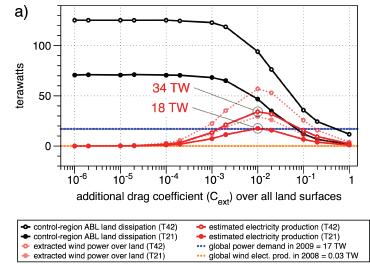
The availability of wind power for renewable energy extraction is ultimately limited by how much kinetic energy is generated by natural processes within the Earth system and by fundamental limits of how much of the wind power can be extracted. Here we use these considerations to provide a maximum estimate of wind power availability over land. We use several different methods. First, we outline the processes associated with wind power generation and extraction with a simple power transfer hierarchy based on the assumption that available wind power will not geographically vary with increased extraction for an estimate of 68 TW. Second, we set up a simple momentum balance model to estimate maximum extractability which we then apply to reanalysis climate data, yielding an estimate of 21 TW. Third, we perform general circulation model simulations in which we extract different amounts of momentum from the atmospheric boundary layer to obtain a maximum estimate of how much power can be extracted, yielding 18–34 TW. These three methods consistently yield maximum estimates in the range of 18–68 TW and are notably less than recent estimates that claim abundant wind power availability. Furthermore, we show with the general circulation model simulations that some climatic effects at maximum wind power extraction are similar in magnitude to those associated with a doubling of atmospheric CO2. We conclude that in order to understand fundamental limits to renewable energy resources, as well as the impacts of their utilization, it is imperative to use a “top-down” thermodynamic Earth system perspective, rather than the more common “bottom-up” engineering approach.

Full 12 page report

17 Terawatts of electrical wind power would be 50-95% of the maximum land based wind possible with significant climate effects. There would be temperature and rain differences.

New Scientist has coverage

Of the 47 TW of energy that we use, about 17 TW comes from burning fossil fuels. So to replace this, we would need to build enough sustainable energy installations to generate at least 17 TW. And because no technology can ever be perfectly efficient, some of the free energy harnessed by wind and wave generators will be lost as heat. So by setting up wind and wave farms, we convert part of the sun’s useful energy into unusable heat.

“Large-scale exploitation of wind energy will inevitably leave an imprint in the atmosphere,” says Kleidon. “Because we use so much free energy, and more every year, we’ll deplete the reservoir of energy.” He says this would probably show up first in wind farms themselves, where the gains expected from massive facilities just won’t pan out as the energy of the Earth system is depleted.

Using a model of global circulation, Kleidon found that the amount of energy which we can expect to harness from the wind is reduced by a factor of 100 if you take into account the depletion of free energy by wind farms. It remains theoretically possible to extract up to 70 TW globally, but doing so would have serious consequences.

Photosynthesis also generates free energy, but without producing waste heat. Increasing the fraction of the Earth covered by light-harvesting vegetation – for example, through projects aimed at “greening the deserts” – would mean more free energy would get stored. Photovoltaic solar cells can also increase the amount of free energy gathered from incoming radiation, though there are still major obstacles to doing this sustainably

If you liked this article, please give it a quick review on ycombinator or StumbleUpon. Thanks

Taken from:
Maximum wind and wave power limited by free kinetic energy and maximum wind power extraction would be as bad as doubling atmospheric CO2

Yellow dye 1 could be the key to immortality [Worm Overlords]

While red food dye may still be a problem in young humans, for roundworms a commonly used lab dye remarkably increases their longevity. Basic Yellow 1, aka Thioflavin T is used in laboratories around the world. Apparently, for the commonly experimented on C. elegens, it provides a substantial lifespan boost. Healthy nematodes treated with the dye lived 50% longer, and those bread to have symptoms mimicking Alzheimer’s showed slowed disease progress. More

Hasbro’s My3D to turn iPhones into glorified ViewMasters starting Sunday

It’s about time the ViewMaster got an upgrade. What’s that? It’s not a ViewMaster? Well, you could have fooled us, but either way, the thing’s finally going on sale exclusively at Target April 3rd, and everywhere else starting in June. As you might have already heard, Hasbro’s intro into the crowded 3D arena, simply titled My3D, does take a card from the old ViewMaster deck, but instead of enlisting cardboard discs, this thing uses your iPhone or iPod touch to bring you 3D entertainment. If your kid’s not already hooked on 3D, the $35 viewer could be a decent starter — then again, for $35 you could take yourself out to a nice lunch, give the rug rat a cardboard box, and call it a day. Full PR after the break.

Continue reading Hasbro’s My3D to turn iPhones into glorified ViewMasters starting Sunday

Hasbro’s My3D to turn iPhones into glorified ViewMasters starting Sunday originally appeared on Engadget on Sat, 02 Apr 2011 04:39:00 EDT. Please see our terms for use of feeds.

Permalink

Minicaster: the pocket-sized hardware-based H.264 live streaming encoder

It’s not that you need a hardware-based H.264 live streaming encoder hanging around in your fifth pocket, but if you’re looking to capture more of life’s moments, why not? Scheduled for a proper introduction at NAB Show 2011, the Minicaster is capable of encoding and delivering a number of streams while also recording at the same time, and those settings can be tweaked directly on the unit itself. The company recommends using it with Wowza Media Server, and if you’re looking to become the world’s next Ustream star, investing in one of these may not be such a bad idea. Emphasis on may, given that the asking price is eluding us at the moment.

Continue reading Minicaster: the pocket-sized hardware-based H.264 live streaming encoder

Minicaster: the pocket-sized hardware-based H.264 live streaming encoder originally appeared on Engadget on Sat, 02 Apr 2011 02:27:00 EDT. Please see our terms for use of feeds.

Permalink