
What has no wheels, can go through almost any terrain and is the last vehicle on earth we would want to be run over with? This 1970s era Screw Propelled ZIL-4904, currently rotting in a Russian specialty junkyard. More
What has no wheels, can go through almost any terrain and is the last vehicle on earth we would want to be run over with? This 1970s era Screw Propelled ZIL-4904, currently rotting in a Russian specialty junkyard. More

In China, the development of residential and retail property in certain regions outstrips the government’s ability to keep these buildings occupied. An Australian film crew recently visited China’s vacant real estate and saw these strangely silent cities firsthand. More
 Yogurt, bread, beer, kimchi, wine, cheese, miso, kraut, and vinegar are among the many foods that are produced with the aid of microorganisms. Those are living beasties of a type that we ordinarily try to remove from what we eat. This cookbook is full of fermentation recipes. It presents a unified theory of “live-culture foods,” a way of connecting their different methods in order to understand why fermentation is a Good Thing, and why there should be more of it.
Fermentation is fairly easy to do. It can self-correct many beginner’s errors. It is definitely a slow-food process, but at the same time, a low-effort process since the bugs do most of the work. The recipes here are starter ones, broad in scope, easy to do, just to get you going. The appendix contains a good roundup of sources for a large variety of live cultures. You can find deeper more complex recipes in specific books, but here in one slim volume is a great introduction to how to ferment. At least once, you should make your own yogurt, bread, beer, kimchi, wine, cheese, miso, kraut, and vinegar. Find what you do well and make more of it.
More importantly, ferment something new.
— KK
Wild Fermentation
Sandor Ellix Katz
2003, 200 pages
$17
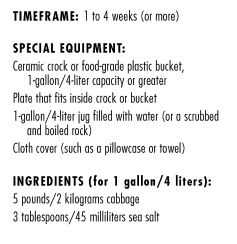
Sample excerpt:
By eating a variety of live fermented foods, you promote diversity among microbial cultures in your body.
*
*
I know of no food that is without some tradition of fermentation.
*
Hamid Dirar has identified eighty distinct fermentation processes in The Indigenous Fermented Food of the Sudan, a book describing an incredible array of ferments that result in consumption of every bit of animal flesh and bone.
Don’t forget to comment over at Cool Tools. And remember to submit a tool!


Original post:
Wild Fermentation

If you’re not already running the Plex Media Server on one of the twenty-three beige boxes networked across your tiny domicile, you may be sorely tempted to install a copy this week, because the iOS app has just received a truly massive update. Where once the XBMC spinoff would have to transcode every video it delivered to your device across the ether, Plex claims it can now either bypass that CPU-intensive process or use an iOS-optimized technique, pumping H.264 video over the air far more efficiently. Second, it can deliver that content from iOS direct to your TV, via either a video-out cable or experimental support for AirPlay. Not bad, right? How’s universal search sound — the ability to type in a word and have the app reach out to local servers, remote servers, and online video services like YouTube and Vimeo too? Yeah, that $4.99 price tag is looking mighty affordable right about now, and there are plenty more improvements to peruse at the links below.
Plex 1.1 for iOS improves streaming over 3G, pipes video to your TV originally appeared on Engadget on Sun, 10 Apr 2011 06:03:00 EDT. Please see our terms for use of feeds.