 Amazon has formed a partnership with Overdrive allowing for Kindle users to borrow eBooks from libraries.
Month: April 2011
An edible color palette
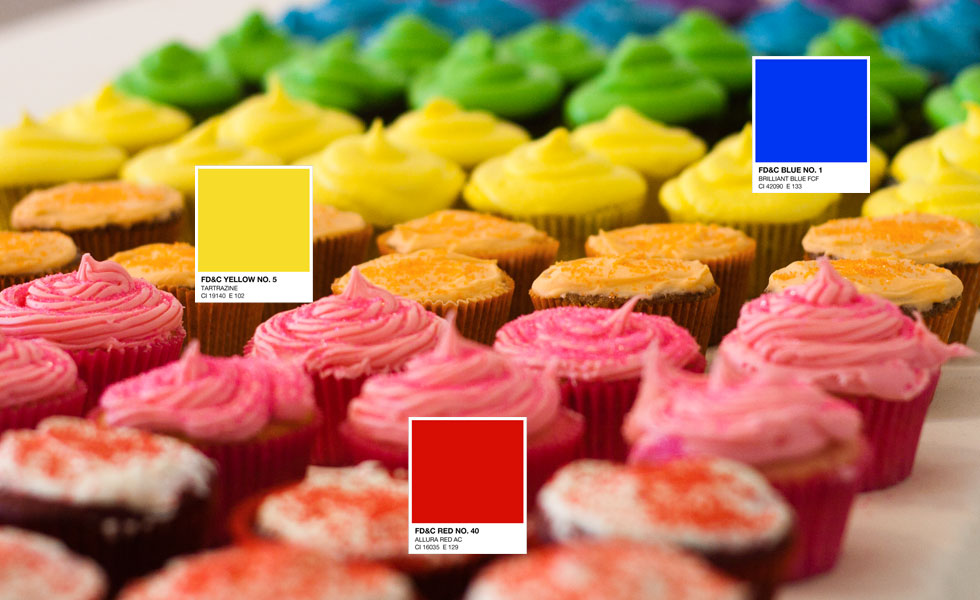
As designers, we know color is important. But when food is your medium, color can be powerful enough to influence taste—and affect health.
Say hello to Blue No. 1, Yellow No. 5, and Red No. 40.
These numbers make up part of an artificial color palette approved by the United States’ Food and Drug Administration. First introduced in 1906, the FDA’s Pure Food and Drug Act (and later the Food, Drug, and Cosmetic Act) was put in place to ensure the safety and wholesomeness of food products. Before this, more than eighty dyes were used to color food, without regulation—the same dye could be used to color both clothing and candy.
Currently, the FD&C color palette features seven colors
The Lions Mane Jellyfish is the largest jellyfish in the world….

The Lions Mane Jellyfish is the largest jellyfish in the world. They have been swimming in arctic waters since before the dinosaurs (over 650 million years ago) and are among some of the oldest surviving species in the world.
The largest can come in at about 6 meters and has tentacles over 50 meters long. Pretty amazing when you think these things have been swimming around for so long.
They have hundreds of poisonous tentacles that it used to catch passing by fish. it then slowly drags in it’s prey and eats it.
Science proves that staring at a screen all day is bad for you [Dangerous Habits]

Proving the words of countless mothers across countless nations, new research shows that spending all day staring at computers and TVs actually is bad for kids, giving them heart problems later in life. More
Indian Students Built Motorcycle That Runs on Oxygen
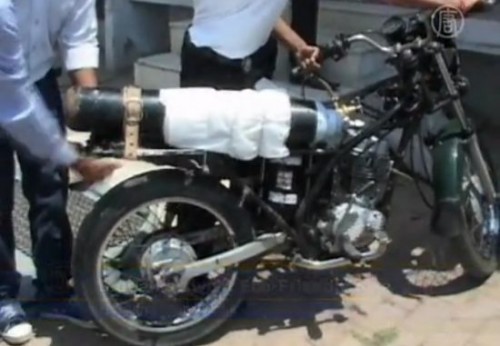
Engineering students in Palwal City, India, built a motorcycle that runs on a tank of compressed oxygen:
“This bike is different from others because the engine doesn’t burn fuel, nor does the temperature rise. The air is compressed and transferred to the engine without any combustion. The piston reciprocates from the air pressure leading to an up-down movement, making the flywheel run and the bike move.”
Students say the basic concept behind the invention is to achieve an equivalent thrust of blast inside the engine without using any combustion.
The bike can run at a speed of six to 12 miles an hour for up to 370 miles using 100 liters of 300 PSI oxygen.
Video at the link.
See original article:
Indian Students Built Motorcycle That Runs on Oxygen
‘3D Towers’ double disk storage capacity, don’t require glasses

Here’s some exciting news for all you data storage enthusiasts and academics out there: researchers in France have found a way to double the storage capacity of magnetic disk drives by constructing “3D towers” of information. The team from SPINTEC created these pillars out of bit-patterned media — separated magnetic nanodots, each of which carries one bit of data. By layering the dots in specific formations, the team created a “multilevel magnetic recording device” with an areal density of two bits per dot — twice what it started with. According to researcher Jerome Moritz, these findings could provide IT companies with a new way to circumvent physical limitations to their data storage capacities, allowing them to build up and over the vaunted one Tbit per square inch barrier. The team’s full findings were recently published in the American Institute of Physics’ Journal of Applied Physics. You can read the full article at the source link or, if you’re afraid of paywalls, just check out the PR below.
Continue reading ‘3D Towers’ double disk storage capacity, don’t require glasses
‘3D Towers’ double disk storage capacity, don’t require glasses originally appeared on Engadget on Fri, 22 Apr 2011 14:09:00 EDT. Please see our terms for use of feeds.
Chinese Typewriters
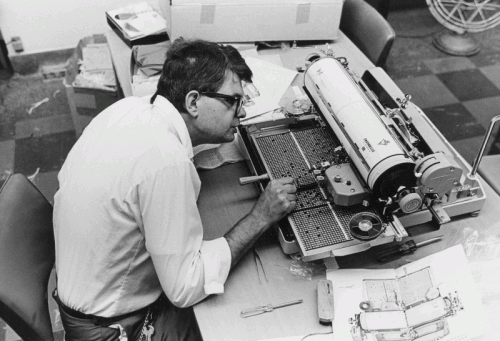
The most agonizingly complex language that I’ve ever tried to learn is OT Hebrew, which (among other challenges) expresses vowel intonations through a vast variety of tick marks, jots, and tittles surrounding the consonants. These are not constant; rather, the meaning of the different markings varies depending upon the order of the letter within the word, order within the syllable, the nature of the preceding consonant and the following consonant, and all possible combinations thereof. But I gather that Hebrew is comparatively simple to Mandarin. As a necessary result of that complexity, Mandarin typewriters are sophisticated machines:
As you can see, the typewriter is extremely complicated and cumbersome. The main tray — which is like a typesetter’s font of lead type — has about two thousand of the most frequent characters. Two thousand characters are not nearly enough for literary and scholarly purposes, so there are also a number of supplementary trays from which less frequent characters may be retrieved when necessary. What is even more intimidating about a Chinese typewriter is that the characters as seen by the typist are backwards and upside down! Add to this challenging orientation the fact that the pieces of type are tiny and all of a single metallic shade, it becomes a maddening task to find the right character. But that is not all, since there is also the problem of the principle (or lack thereof) upon which the characters are ordered in the tray. By radical? By total stroke count? Both of these methods would result in numerous characters under the same heading. By rough frequency? By telegraph code? Unfortunately, nobody seems to have thought to use the easiest and most user-friendly method of arranging the characters according to their pronunciation.
Link via Geekosystem | Photo: Victor Mair
Original post:
Chinese Typewriters
Room-sized spirograph
Drawingmachine by Eske Rex from Core77 on Vimeo.
I love the way this thing looks like a cross between some kind of medieval engineering project and the best playground equipment ever. Made by Eske Rex—a Swedish-born designer who'd never heard of the toy Spirograph—it's based on a piece of 19th-century technical equipment.
Instead, he was inspired by the harmonograph, a mid-19th century mechanical apparatus that produces Lissajous curves, a complex family of shapes studied by mathematicians. While the harmonograph uses one pendulum to control a drawing device and a second to control a canvas, Rex’s design calls for a two-pendulum device with a static canvas.
The Drawingmachine, Eske’s name for his device, which produces art but is also itself considered an installation piece, uses two pendulums supported by large structures that stand at two ends of a similarly large canvas. The pendulums are connected to support systems (drawing arms) that meet in the middle of the canvas at a 90-degree angle and hold a single ballpoint pen, as you can see in the embedded images.
Via The Atlantic

Read More:
Room-sized spirograph
Is it really the next bubble?
A LOT of people, not least my colleague Schumpeter, have been saying lately that the next bubble to burst is going to be in higher education. The idea is that people are spending too much on higher education, taking on too much debt, and failing to get the reward they expect. This bubble is bound to burst, and will leave American colleges and universities with huge over-capacity. One strong advocate of this view is Peter Thiel, a legendary investor in Facebook, who featured in the film, “The Social Network”. He says:
Education is a bubble in a classic sense. To call something a bubble, it must be overpriced and there must be an intense belief in it. Housing was a classic bubble, as were tech stocks in the ’90s, because they were both very overvalued, but there was an incredibly widespread belief that almost could not be questioned — you had to own a house in 2005, and you had to be in an equity-market index fund in 1999.
Probably the only candidate left for a bubble — at least in the developed world (maybe emerging markets are a bubble) — is education. It’s basically extremely overpriced. People are not getting their money’s worth, objectively, when you do the math. And at the same time it is something that is incredibly intensively believed; there’s this sort of psycho-social component to people taking on these enormous debts when they go to college simply because that’s what everybody’s doing.
It is, to my mind, in some ways worse than the housing bubble. There are a few things that make it worse. One is that when people make a mistake in taking on an education loan, they’re legally much more difficult to get out of than housing loans. With housing, typically they’re non-recourse — you can just walk out of the house. With education, they’re recourse, and they typically survive bankruptcy. If you borrowed money and went to a college where the education didn’t create any value, that is potentially a really big mistake.
Schumpeter is fiendishly clever and Mr Thiel is both clever and rich, so there’s plainly something to this bubble theory. But although I’ve only just started to look into it, it seems to me that the argument is not yet rock solid. For a start, the latest available numbers suggest that college enrolment continues to boom and that going to university still pays. According to data from last year’s census, average earnings in 2008 totaled $83,144 for those with an advanced degree (ie, a master’s professional or doctoral degree), compared with $58,613 for those with a bachelor’s degree only. People whose highest level of attainment was a high school diploma had average earnings of $31,283.
Here’s another way of looking at it:
 |
When I put the bubble hypothesis to Norton Grubb, professor of higher education at the University of California, Berkeley, his response in an email was that the bubble hypothesis was “ridiculous”. He went on:
The problem is that there are no other routes to better occupations and higher salaries anymore, except for those who have odd skills (athletes, rock stars, starlets willing to reveal all) – which most of us don't have. Education has not stopped delivering its expected returns, not in terms of income or (un)employment. It has stopped delivering on the promise of a middle-class job = professions and managerial occupations, for which a BA was sufficient inthe 60s, and for which an MA is now necessary.
Dual CPU, Quad GPU System Scores A Record 79k 3DMark Score Thanks To Plenty Of Liquid Nitrogen And Skill

I have two things for overclockers scene. First, I find you guys awesome and inspiring. I haphazardly throw fans into my case and hope for the best. Not you guys. Hells no. You know the proper voltage settings and cooling techniques to max out your system. *High-five*

Second, the pic above is of a rig that just scored a record 79,364 composite 3DMark Vantage score. Modders Vince “K|ngP|n” Lucido and Illya “TiN” Tsemenko used a pair of Intel Xeon X5690 CPUs on an EVGA Classified SR-2 motherboard with Corsair Dominator GT GTX2 memory modules along with four Nvidia GeForce GTX 580 GPU cards — all with liquid nitrogen cooling pots The result was record breaking as they took the CPUs up to 5.62GHz each and overclocked the GPUs to 1,190MHz. Sure, the whole thing isn’t practical and won’t likely increase your Team Fortress 2 skills, but overclocking leads to innovation, which eventually trickles into normal systems that you and I use. [XtremeSystems.org & Corsair Blog]
