Is Sugar Toxic?


Illustration: Kenji Aoki / The New York Times; Prop Stylist: Nell Tivnan.
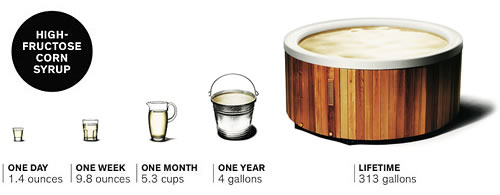
Source: UI.S.D.A. 2009 Estimates

How much do we love sugar? The amount may surprise you – the average
American eat about 3,550 pounds of sugar and 313 gallons of high fructose
corn syrup in a lifetime. And according to Dr. Robert Lustig, UCSF expert
on pediatric hormone disorders and childhood obesity, it’s killing us:

Lustig’s argument, however, is not about the consumption
of empty calories — and biochemists have made the same case previously,
though not so publicly. It is that sugar has unique characteristics,
specifically in the way the human body metabolizes the fructose in it,
that may make it singularly harmful, at least if consumed in sufficient
quantities.

The phrase Lustig uses when he describes this concept is “isocaloric
but not isometabolic.” This means we can eat 100 calories of glucose
(from a potato or bread or other starch) or 100 calories of sugar (half
glucose and half fructose), and they will be metabolized differently
and have a different effect on the body. The calories are the same,
but the metabolic consequences are quite different.

Link

See also Lustig’s fascinating lecture, Sugar:
The Bitter Truth
, about how bad the sweet stuff is for us:

View original post here:
Is Sugar Toxic?

How do you draw a straight line? How do you determine if a circle is really round?

I spent some time this morning watching the fascinating videos that illustrate the amazing mechanisms and geometrical solids discussed in the book How Round is Your Circle? by John Bryant and Chris Sangwin. They show linkages that allow you to draw an exact straight line, non-spherical solids that behave like ball bearings, a way to measure the area of an irregular shape with a coat hanger, and more. It’s fun stuff that’s reminiscent of Martin Gardner’s “Mathematical Recreations” column from Scientific American.

How do you draw a straight line? How do you determine if a circle is really round? These may sound like simple or even trivial mathematical problems, but to an engineer the answers can mean the difference between success and failure. How Round Is Your Circle? invites readers to explore many of the same fundamental questions that working engineers deal with every day–it’s challenging, hands-on, and fun. John Bryant and Chris Sangwin illustrate how physical models are created from abstract mathematical ones. Using elementary geometry and trigonometry, they guide readers through paper-and-pencil reconstructions of mathematical problems and show them how to construct actual physical models themselves–directions included. It’s an effective and entertaining way to explain how applied mathematics and engineering work together to solve problems, everything from keeping a piston aligned in its cylinder to ensuring that automotive driveshafts rotate smoothly. Intriguingly, checking the roundness of a manufactured object is a trickier proposition than one might think. When does the width of a saw blade matter to an engineer’s calculations–or for that matter, the width of a physical line? When does a measurement need to be exact and when will an approximation suffice? Bryant and Sangwin tackle questions like these and enliven their discussions with many fascinating highlights from engineering history. Generously illustrated, How Round Is Your Circle? reveals some of the hidden complexities in everyday things.

How Round is Your Circle?


Follow this link:
How do you draw a straight line? How do you determine if a circle is really round?

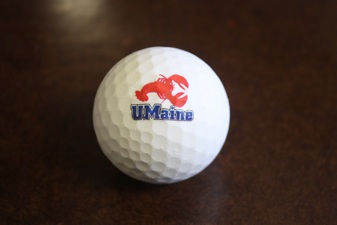
Lobster shell golf balls

I’ve always thought it nuts that many cruise ships have golf ball driving ranges where you hit into the open seas. Isn’t that, um, littering? Seems that University of Maine Researchers agreed, so they’ve developed a biodegradable golf ball from lobster shells. From UMaine News:

 News Files 2011 03 Lobster-Golf-Ball2

Though biodegradable golf balls already exist, this is the first to be made with crushed lobster shells with a biodegradable binder and coating, creating value from waste material.

“We’re using a byproduct of the lobster canning industry which is currently miserably underutilized —

iRobot agrees to provide US Navy with bomb disposal and recon bots in a deal worth up to $230 million

iRobot may still be best known as the creator of the homely Roomba vacuum-cleaning drone, but savvy readers will know the company’s endeavors span a pretty broad range of robot-related activities. One of those has now borne fruit in the shape of a multiyear agreement with the US Navy for the provision of “portable robotic systems” that can identify and dispose of explosives while also performing a bit of reconnaissance work in their spare time. The announcement doesn’t tell us the particular model(s) or number of bots that will be provided, but there is clarification to say that iRobot will be responsible for providing spares, repairs, training, and accessories along with the hardware, with the total revenue for the company potentially swelling to $230 million over the full course of the contract, which lasts through 2015. Our guess is that the “throwable” robot shown off a couple of weeks back would be a good candidate for this task, though we doubt it’ll be thanking us for endorsing it for such perilous work.

iRobot agrees to provide US Navy with bomb disposal and recon bots in a deal worth up to $230 million originally appeared on Engadget on Wed, 13 Apr 2011 10:24:00 EDT. Please see our terms for use of feeds.

Permalink

External batteries benchmarked, the portable juice is loose

A lot of portable PC power cells last for only four or five hours, after which you’ll find yourself chained to a wall socket. Good thing there are external batteries to keep us in current when a plug’s nowhere to be found, and Tom’s Hardware has done some benchmarking on a slew of such devices so you’ll know which one’s suited for you. A Dell Vostro 3300 and an Inspiron Mini 10 running Windows 7 were used to put packs from Amstron, Brunton, Digipower, Electrovaya, Energizer, Lenmar, PowerTraveller and Tekkeon through some real-world paces — we’re talking word processing and web surfing, not fragging and film editing. So if you’re in the market for a mobile power unit, hit the source link and get the down and dirty on which external battery’s best.

External batteries benchmarked, the portable juice is loose originally appeared on Engadget on Wed, 13 Apr 2011 09:59:00 EDT. Please see our terms for use of feeds.

Permalink