Elderly Georgian lady disconnects Armenian internet for half a day… by accident

A 75-year old lady from Georgia (the country, not the state) has perpetrated an impressive feat of international sabotage in what seems to have been an accident of extremely bad luck. While foraging for copper wire near her home in the village of Ksani, the unnamed septuagenarian managed to come across a critical fiber optic cable, one responsible for serving internet connectivity to “90 percent of private and corporate internet users in Armenia” and some in her own country as well. Her swift strike at the heart of said bit-transferring pipeline resulted in all those folks being thrown offline for a solid 12 hours, while the Georgian Railway Telecom worked to find and correct the fault. In spite of her relatively benign motivations, the lady now faces three years in prison for the damage she caused. We’d say all’s well that ends well, but this doesn’t actually seem like a very happy ending at all.

Elderly Georgian lady disconnects Armenian internet for half a day… by accident originally appeared on Engadget on Wed, 06 Apr 2011 15:35:00 EDT. Please see our terms for use of feeds.
Permalink

Video: Epic Games’ Unreal Engine 3 Contines To Impress

Clearly Epic Games knows there’s a number of people out there who are angry at the fact that icky consoles are have held back the development of high-end graphics technology. (See: Crysis 2. Looks fine if all you’re dealing with is the five-year-old Xbox 360, but doesn’t really seem to take advantage of the raw power that’s available on the PC side of thing.) Here we have a slick trailer showing off some of the advanced features offered by Unreal Engine 3.

The one thing I didn’t like was “enhanced bloom.” If there were ever an overused technology it’s bloom. How many things in real life give off more bloom than a super nova?

Read the original post:
Video: Epic Games’ Unreal Engine 3 Contines To Impress

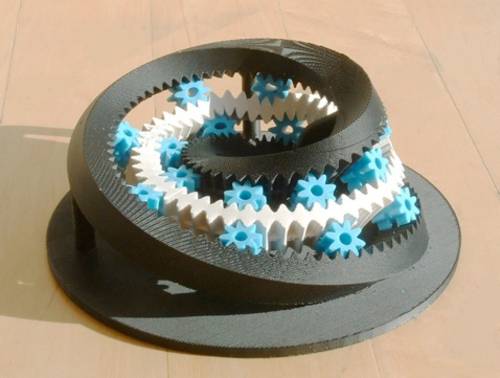
Möbius Gear: a one-sided, toothed gear


UC Berkeley postdoc Aaron M Hoover combined math and imagination to solve the problem of building a one-sided “Möbius gear.” He rendered it and then output molds for it on a 3D printer, cast them, and assembled his freaky, mind-melting beast.

While searching for a suitable project for CS 285 (Procedural Solid Modeling) I was introduced to the Möbius gear by Professor Sequin. I was immediately intrigued by the curious combination of the Möbius mathematical surface popularized by M.C. Escher and functional mechanical gear elements. After some time staring at and puzzling over this image, I convinced myself that this mechanism is indeed possible and that with right tools, a functional prototype could be built. (The entire mechanism essentially boils down to an oddly configured set of planetary gears. One can think of the black portion in the image as the ring with a fixed zero input velocity. A single blue gear is a planet, and the white strip is the sun. Output can be taken either from the sun or the planets (with no regard for practicality!). In practice, however, it’s easiest to actuate the Möbius strip (the white portion).

The Möbius Gear

(via Neatorama)

da Vinci Robot pwns Operation, deems our childhoods forlorn (video)

What happens when a robot with immaculate dexterity comes to grips with a notorious board game from our childhood? Just ask Johns Hopkins University students, who successfully removed the wish bone from an Operation board using the da Vinci Robot. If you’re familiar with the game, you’ll know how incredibly difficult it was to prevent that ear-piercing noise from occurring– even with our tiny fingers. Of course, we should have expected that a robot — especially one capable of folding a tiny paper airplane — would be able to accomplish this feat with such ease. Be sure to peep the pseudo-surgery in video form below the break.

Continue reading da Vinci Robot pwns Operation, deems our childhoods forlorn (video)

da Vinci Robot pwns Operation, deems our childhoods forlorn (video) originally appeared on Engadget on Wed, 06 Apr 2011 09:29:00 EDT. Please see our terms for use of feeds.

Permalink

NASA makes longer, straighter piezoelectric nanowires in microgravity, no flat iron needed

Piezoelectric nanowires are the stuff that make power-generating pants a possibility, and that prodigious potential has drawn the attention of NASA. You see, self-powered spacesuits are awfully attractive to our nation’s space agency, and a few of its finest student researchers have discovered that the current-creating strands of zinc oxide can be made longer and straighter — and therefore more powerful — when freed from gravity’s unrelenting pull. That means nanowires grown in microgravity could lead to higher capacity batteries and the aforementioned juice-generating interstellar garb. Of course, there’s no such end-products yet, but let’s see if NASA can do what others have not: give pants-power to the people.

NASA makes longer, straighter piezoelectric nanowires in microgravity, no flat iron needed originally appeared on Engadget on Wed, 06 Apr 2011 01:57:00 EDT. Please see our terms for use of feeds.

Permalink

The XM25: A Future Weapon Killing Bad Guys Right Now


Come get some! The XM25 is bringing a world of hurt to Afgan baddies right now. The Army is apparently field testing the (ready for the street name?) Punisher in very limited numbers right now. You must click through to see the very first demo of the weapon in action. It shows the fancy targeting system that guides the 25mm burst rounds to their targets, which then penetrates barriers to explode behind enemy combatants. DefenseTech states the Army just signed a $65 million check to ATK for a bunch of XM-25s at an estimated price of $25,000 each. Who says America doesn’t make anything cool anymore?

Follow this link:
The XM25: A Future Weapon Killing Bad Guys Right Now

Mitsubishi Chemical To Commercialize Printable Solar Cells Next Year

Another small step ahead in solar energy: Mitsubishi Chemical has developed printable solar cells with a conversion rate of 9.2% and now plans to commercialize the cells as early as next year, according to Japanese business daily The Nikkei.

The cells are reportedly 90% lighter than the products currently out there and just “several hundred nanometers” thick. Because they are mainly based on carbon, Mitsubishi expects their cells to eventually cost 90% less than their silicon-based counterparts.

Developed in collaboration with the University of Tokyo, the cells can be attached to a variety of objects, but Mitsubishi is already cooperating with Japanese car makers in order to explore ways to use them for electric cars and hybrids.

By 2015, the company wants to see the 9.2% conversion rate of their cells to grow to 15%.

More:
Mitsubishi Chemical To Commercialize Printable Solar Cells Next Year