After the news of Osama bin Laden’s death, reactions were split: there was the USA, USA, Greek Row kegstand contingent, and then those who saw the historical event as something more solemn and less bacchanalian. More
After the news of Osama bin Laden’s death, reactions were split: there was the USA, USA, Greek Row kegstand contingent, and then those who saw the historical event as something more solemn and less bacchanalian. More
 The Nielsen Company has announced that its estimated number of TV households for 2012 is dropping to 114.7 million (96.7 percent), down from 115.9 million (98.9 percent) the year before which is the first time it’s gone down in two decades. While some will say this marks the end of the TV era as we’ve known it, there are a couple of factors to take into account, starting with how the numbers are gathered — Nielsen only counts TVs that are capable of tuning into at least one channel. If you’ve cut the cord and gone all internet / Blu-ray / DVD without putting up an antenna or never upgraded for digital broadcasts (as some rural or low-income homes have not) then your TV doesn’t count. After reviewing the numbers and watching Apocalypto twice we still can’t tell if this means it’s already over for linear TV or if it’s more of a temporary bump due to an uncertain economy like it was in 1992. Of course, the fact that we rented the movie on iTunes may be telling.
Nielsen estimates show first drop in TV ownership in 20 years, Mayans nod approvingly originally appeared on Engadget on Tue, 03 May 2011 14:52:00 EDT. Please see our terms for use of feeds.

At first, the exoplanet 55 Cancri e didn’t look all that impressive: just another large rocky planet circling its star every couple of days. But a recalculation of its orbit has revealed that it’s the galaxy’s densest known planet. More
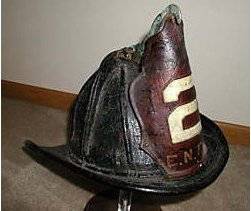
Core77’s David I. Seliger has a nice retrospective on the design of American firefighter helmets from the 1731 helmets designed by Jacobus Turk for the Fire Department of New York to the contemporary thermoplastic models. These modern helmets, Seliger says, have plenty of room for improvement, and “Redesigning the fire helmet – both a marketable product and a symbol deeply ingrained in American culture – to satisfy firefighters’ physical, mental, and emotional needs could be the industrial design challenge of a lifetime.”
Three main types of helmets are currently used in the United States. The “leatherhead” is just that–constructed almost entirely of leather. The leather’s resistance to heat actually rivals that of modern composites. The large brim that dips down in back is designed to keep hose water dripping off of the ceiling out of the face. The leatherheads are used in fighting regular fires.The second type is the structural helmet, a more streamlined version of the leatherhead, constructed of thermoplastics or composites. These helmets are used for structural collapses and extrications. Goggles, instead of a face shield, often sit on the front of the helmet.
The last type is the European-style helmet, which looks like a cross between a motorcycle helmet and something from Star Wars. The design is purportedly much more comfortable and practical. But, as one firefighter put it, “I’ve been involved with fire departments in four states…and in seven years have seen a grand total of two [European-style] helmets… these guys were… universally afraid of being mocked for wearing something new, different or ‘unfashionable.'”
Tradition vs Progress: The Art of the American Fire Helmet


Next Monday, I’m taking a Minneapolis Community Education cooking class called “Foods of Lewis and Clark Expedition”. Will there be elk and hardtack? Am I gonna learn how to cook pemmican with suet? Will we all just sit around and feel hungry for a while, for maximum realism? I have absolutely no idea. But it’s going to be fabulous. And I’ll be sharing what I learn here. In the meantime, though, I wanted to direct your attention to a couple of fascinating posts at cooking blog The Shiksa in the Kitchen.
There, Tori Avey delves into the foods available to Colonial Virginians, and how those people turned those foods into a generalized menu. And then, there's a recipe for apple tansey—a sort-of moderately sweet, crispy apple omelet thing (pictured above). Avey's also given Tudor England the same treatment. As someone who loves both history and food, I’m super excited to find a blog series like this one!
BREAKFAST
In frontier outposts and on farms, families drank cider or beer and gulped down a bowl of porridge that had been cooking slowly all night over the embers… The southern poor ate cold turkey washed down with ever-present cider. The size of breakfasts grew in direct proportion to growth of wealth… It was among the Southern planters that breakfast became a leisurely and delightful meal, though it was not served until early chores were attended to and orders for the day given… Breads were eaten at all times of the day, but particularly at breakfast.
DINNER
Early afternoon was the appointed hour for dinner in Colonial America. Throughout the seventeenth century and well into the eighteenth century it was served in the “hall” or “common room.” While dinner among the affluent merchants in the North took place shortly after noon, the Southern planters enjoyed their dinner late as bubbling stews were carried into the fields to feed the slaves and laborers… In the early settlements, poor families ate from trenchers filled from a common stew pot, with a bowl of coarse salt the only table adornment… The stews often included pork, sweet corn and cabbage, or other vegetables and roots which were available…
SUPPER
Supper was a brief meal and, especially in the South, light and late. It generally consisted of leftovers from dinner… In the richer merchant society and in Southern plantation life, eggs and egg dishes were special delicacies and were prepared as side dishes at either dinner or supper.
Read More:
What they ate in Colonial Virginia

Artist Daniel Bejar had a key copied and then a new key copied from it, and so on, until the information embodied in the original key had been lost. He calls the resulting piece “The Visual Topography of a Generation Gap”: “A copy was made from my original apartment key, then a copy was made from
that copy. This process was repeated until the original keys information was
destroyed, resulting in the topography of a generation.”
“The Visual Topography of a Generation Gap”(#2, Brooklyn, NY)
(Thanks, Fipi Lele!)
Read More:
Sculpture embodies lossy copying using much-copied house-key

This fighter-size UAV is called the Phantom Ray and may have played a part in the recent events in Pakistan. Designed around the Boeing X-45, this UAV recently flew to 7,500 feet at 204 mph and has been spotted making flights in Afghanistan as well as test flights at Edwards AFB.
“The first flight moves us farther into the next phase of unmanned aircraft,” said Craig Brown, Phantom Ray program manager for Boeing. “Autonomous, fighter-sized unmanned aircraft are real, and the UAS bar has been raised. Now I’m eager to see how high that bar will go.”
Considering the power of our current drone air force, this one can only mean we are one step closer to a Skynet-like autonomous defense system.
Read the original post:
Fighter-Size Phantom Ray UAV Flies Into Your Nightmares

Android/Windows: Popular tethering app PdaNet has recently added a feature in version 3.0 that can supposedly block your carrier from seeing your tethering usage. More

Chances of a massive outbreak of Ebola that would either devastate the world or precipitate another Dustin Hoffman action movie just declined slightly. Researchers have found a way to block one of Ebola’s entryways into the body. More