Carl Sagan on the Drake Equation

Professor Frank Drake proposed an equation that could be used to estimate the number of detectable extraterrestrial civilizations in the Milky Way galaxy. The equation was deemed important for his work at the National Radio Astronomy Observatory in Green Bank, West Virginia (which I’ve driven by many times — their huge telescope is quite a sight!). In essence, Drake decided to define a series of limiting factors, so that we could take the total number of observable stars, then scope way down to get to some estimate for how many might have civilizations that we could contact. The resulting Drake Equation is one of the most exciting bits of math I’ve ever seen. Wikipedia explains it like so:

The Drake equation states that:

N = R^ast cdot f_p cdot n_e cdot f_ell cdot f_i cdot f_c cdot L !

where:

N = the number of civilizations in our galaxy with which communication might be possible;

and

R* = the average rate of star formation per year in our galaxy
fp = the fraction of those stars that have planets
ne = the average number of planets that can potentially support life per star that has planets
f = the fraction of the above that actually go on to develop life at some point
fi = the fraction of the above that actually go on to develop intelligent life
fc = the fraction of civilizations that develop a technology that releases detectable signs of their existence into space
L = the length of time for which such civilizations release detectable signals into space.

If that’s too mathy for you, just watch Carl Sagan explain it in this eight-minute video:

Where it really gets interesting (and frustrating) is when you start to figure how many of these detectable civilizations are actually currently broadcasting during a time period when we might actually contact them or receive their broadcast (adjusted, of course, for the massive lag time to get the broadcast from point A to point B). Sagan touches on part of this problem in his discussion, but doesn’t get into the details. Read more about all this at Wikipedia.

Read More:
Carl Sagan on the Drake Equation

Chinese prisoners forced to produce virtual gold, real profits for their guards

The virtual goods economy of massively multiplayer online games may be thriving, but it’s also stimulating an undesirable side-effect: exploitation. A former detainee at a prison in Heilongjiang province, China, has told the Guardian about how he was habitually forced into playing MMOs like World of Warcraft for the collection of loot, which the prison guards would then resell online for as much as ¥6,000 ($924) per day. Such totals would be the product of up to 300 inmates working 12-hour daily shifts, though predictably they saw none of the profits themselves. The unnamed source was at a “re-education through labor” camp where the usual toil would involve actual, rather than virtual, mining. The profitability of the online market has seemingly inspired prison bosses to move with the times, however, with business being so brisk that the computers “were never turned off.” A Chinese government edict from 2009 is supposed to have introduced a requirement that online currencies only be traded by licensed entities, but it's believed that the practice of using prisoners in this fashion continues unabated.

Chinese prisoners forced to produce virtual gold, real profits for their guards originally appeared on Engadget on Thu, 26 May 2011 05:14:00 EDT. Please see our terms for use of feeds.

Permalink

Anonymous pre-paid credit-cards and money-laundering

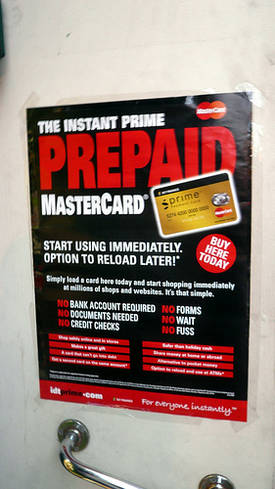
Th $107 billion prepaid credit-card business has attracted money-launderers, according to US customs officers; what’s more, the anonymous cards are exempt from border regulations that require you to disclose when you bring $10,000 in or out of the country:


Visually, the cards are barely distinguishable from credit or debit cards and the most versatile let users reload them remotely without having to reveal their identity, using cash, moneygrams, PayPal and other online payment services.

Some cards can process tens of thousands of dollars a month. Just load them up in Connecticut or Texas with, say, the proceeds of cocaine sales and collect the cash in local currency from an ATM in Medellin, Colombia or elsewhere in Latin America.

“I’m not so sure we have a sophisticated understanding of how to deal with this,” said Richard Stana, who oversaw a report on prepaid access for the General Accounting Office, the U.S. Congress’ research arm. “It’s just a whole new way of doing business.”

Prepaid cards attract money launderers

(via Consumerist)


Visit link:
Anonymous pre-paid credit-cards and money-laundering

Google Unveils Wallet And Offers: An Open Platform For Mobile Payments

We’re here at Google’s massive HQ in New York City (they own an entire block) for what Google was calling a “partner event” but everyone knew was really an “NFC event”. Sure enough, Stephanie Tilenius, Google’s VP of Commerce, has taken the stage to announce Google Wallet and Google Offers.

Right off the bat, Tilenius wanted to make it clear that this would be an open platform. She invited “payment networks, carriers, banks, join us in creating tomorrow’s shopping experience”. And some of those partners are already on board. Citi, Mastercard, FirstData, and Sprint are the initial partners.

Read More

See the original article here:
Google Unveils Wallet And Offers: An Open Platform For Mobile Payments

Google Wallet mobile payment service, Google Offers announced

It may not be as big a surprise as Google hoped it would be at this point, but the company has now officially announced its NFC-based Google Wallet mobile payment service, complete with backing from a number of retail and financial partners including Subway, Macy’s, Walgreens, Toys ‘R Us, First Data, Citibank and MasterCard — plus Sprint on the carrier side. In the case of MasterCard, that partnership means Google Wallet will be fully compatible with the PayPass contactless payment system that’s already widely in place. Trials are beginning immediately, with a full release planned for this summer — initially, it will only support the Sprint Nexus S 4G, but support for more phones is promised “over time.” What’s more, as far as Google is concerned, mobile payments are just the beginning for Google Wallet. It eventually sees everything from boarding passes to tickets to IDs to keys being stored on your phone.

Also announced is Google Offers, which will deliver an “offer of the day” to your inbox, and let you seek out other offers from retailers. Of course, it also ties into Google Wallet, and you’ll be able to both redeem offers and receive loyalty rewards from retailers with just a tap of your NFC-enabled phone.

Developing…

Gallery: Google Wallet

Gallery: Google Offers

Continue reading Google Wallet mobile payment service, Google Offers announced

Google Wallet mobile payment service, Google Offers announced originally appeared on Engadget on Thu, 26 May 2011 12:08:00 EDT. Please see our terms for use of feeds.

Permalink

The best Oprah emails to Opera (the browser)

RE_FWD_2010_11_10.jpg

Espen André Øverdahl at the browser company Opera writes,

Today is the last Oprah show in the history of television. To us in Opera this is really sad news. This show has brought us great joy throughout the years. We’ve been receiving lots of mail from Oprah fans, asking us questions, complaining or simply just opening up, telling us about their lives. We’ve tried to answer these emails the best we can. As a tribute to Oprah and her fans, we’ve been digging in our mailbox in order to give you Opera’s ‘Best of Oprah mails to Opera” best of.

Oprah Winfrey: We will miss you (thanks, Andrea James).


See the article here:
The best Oprah emails to Opera (the browser)