Corsair’s speedy, flaming red Force GT SSD goes on sale this month for $149 and up

Corsair’s Force GT solid-state drives caught our eye earlier this year, and their fire engine-red shells were only half the reason. These bad boys also promise up to 85,000 random write IOPS and are rated for impressive read / write speeds of 550 MBps and 525 MBps — a shade higher than the specs being bandied-about when Corsair showed it off back in March. The drive also supports SATA 3, is backward-compatible with SATA 2, and ships with a 3.5-inch adapter that’ll work with both desktops and laptops. Look for it this month in two sizes: 60GB ($149) and 120GB ($279). No word, alas, on the 240GB version that was strutting its stuff on the show floor in Hanover, Germany. PR after the break.

Continue reading Corsair’s speedy, flaming red Force GT SSD goes on sale this month for $149 and up

Corsair’s speedy, flaming red Force GT SSD goes on sale this month for $149 and up originally appeared on Engadget on Tue, 05 Jul 2011 05:04:00 EDT. Please see our terms for use of feeds.

Permalink

Report: Apple orders 15 million iPhone 5s


Apple has placed an order for 15 million next-gen iPhones with Taiwan-based manufacturer Pegatron, DigiTimes reported today. The order is based on a September ship date for the new iPhone, which DigiTimes’ sources say is not a major revision from the iPhone 4.

These numbers cast our memories back to when Apple was pushing the first iPhone toward a million sales within months of its launch. These days, Apple is shipping multiple millions per quarter: the first quarter of 2011 saw 16.24 million iPhone sales, topped by the second quarter’s 18.65 million.

The increased sales are not entirely thanks to the new CDMA version of the iPhone, either. Pegatron overhauled its entire factory setup to satisfy a 10-million-iPhone CDMA iPhone 4 order, but less than four million of those have shipped. Since September‘s model is entirely new, we doubt this will be a repeat problem for the company.

The iPhone 5’s body reportedly resembles the iPhone 4, but may receive several internal revisions, including a dual-core A5 processor,

Japanese scientists discover massive rare earth deposits, China bristles

China’s control over the rare earths market hasn’t faced too many challenges over the past few years, but that may be changing, thanks to a major discovery in Japan. Geologists say they’ve uncovered expansive new deposits of rare earth minerals, buried within a seabed some 20,000 feet below the Pacific Ocean surface. Research leader Yasuhiro Kato estimates that the deposits contain anywhere from 80 to 100 billion metric tons of rare earths, which, if commercially viable, could pose a serious threat to China’s global hegemony. Supply shortages and aggressive Chinese export controls have combined to raise global prices in recent years, much to the chagrin of manufacturers who rely upon the metals to produce smartphones, tablets and a wide variety of other gadgets. But with analysts predicting a rare earth surplus within the next few years and Japan’s mining industry now poised for a potential resurgence, the outlook is certainly looking a lot brighter.

Japanese scientists discover massive rare earth deposits, China bristles originally appeared on Engadget on Mon, 04 Jul 2011 21:01:00 EDT. Please see our terms for use of feeds.

Permalink

Spam is way down, but new malware is really tough

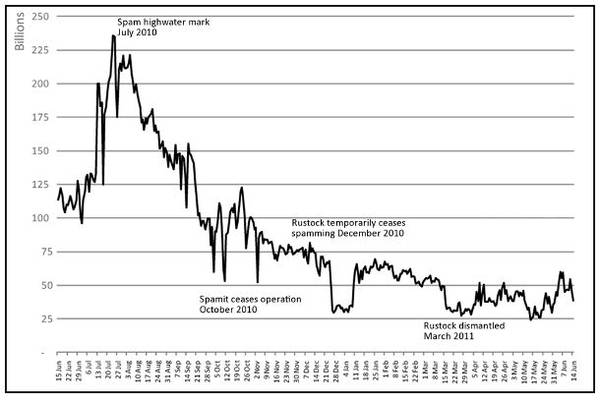
Brian Krebs looks at the remarkable drop in spam that the Internet has experienced this year (25-50 billion spams/day today, down from a peak of 225 billion spams/day last July), and at the vicious new malware that’s appearing as spam-crooks get more desperate. One such vector is TDSS (AKA “TLd-4”), a rootkit that infects your computer, kicks out all the other malware running on it, and then helps hackers distribute malware. Krebs says that there’s plenty of gains to be realized by attacking the financial instruments used by criminals and he’s promised a series on how these work.

The evolution of the TLd-4 bot is part of the cat-and-mouse game played by miscreants and those who seek to thwart their efforts. But law enforcement agencies and security experts also are evolving by sharing more information and working in concert, said Alex Lanstein, a senior security researcher at FireEye, a company that has played a key role in several coordinated botnet takedowns in the past two years.

“Takedowns can have an effect of temporarily providing relief from general badness, be it click fraud, spam, or credential theft, but lasting takedowns can only be achieved by putting criminals in silver bracelets,” Lanstein said. “The Mega-D takedown, for example, was accomplished through trust relationships with registrars, but the lasting takedown was accomplished by arresting the alleged author, who is awaiting trial. In the interim, security companies are getting better and better about working with law enforcement, which is what happened with Rustock.”

Where Have All the Spambots Gone?


Original post:
Spam is way down, but new malware is really tough