Before there was Red Bull, there was Krating Daeng, a sweet energy drink sold in Thailand and a few other countries. Its labels feature two red bulls charging one another.
See the original article here:
Red Bull co-founder dies a billionaire
Before there was Red Bull, there was Krating Daeng, a sweet energy drink sold in Thailand and a few other countries. Its labels feature two red bulls charging one another.
See the original article here:
Red Bull co-founder dies a billionaire
holy_calamity writes “This article talks about software from Microsoft Research that looks like a smarter, more private version of Facebook’s timeline. Lifebrowser uses machine learning techniques to process photos, emails, web history, documents and other data on your computer and automatically create an interactive timeline with an awareness of what’s important and what’s not. Lifebrowser is intended to be a prosthetic for memory. When a user searches their archive for specific information, Lifebrowser presents notable photos and other information to aid recollection.”


Read more of this story at Slashdot.
Originally posted here:
Microsoft's Lifebrowser Is a Prosthetic For Memory
First time accepted submitter arnott writes “Science Applications International Corp. said that it will pay $500.4 million in restitution and penalties under a settlement over its CityTime program with New York City. From the article: ‘Two former SAIC employees have been charged with conspiring to defraud New York, and New York Mayor Michael R. Bloomberg (I) has called on the company to reimburse the city for the more than $600 million it spent on the program over an 11-year period.'”
Read more of this story at Slashdot.
See the article here:
SAIC Settles CityTime Case For $500.4 Million
dtjohnson writes “Iran is being deleted from the world banking system Society for Worldwide Interbank Financial Telecommunication (SWIFT) computers as of Saturday at 1600 UTC. Once the SWIFT codes for Iranian banks are deleted, Iranian banks will no longer be able to transfer funds to and from other worldwide banks, turning Iranian international commerce into a barter operation. SWIFT is taking the action at the request of EU
members to comply with international sanctions against Iran due to its program to develop nuclear weapons. The effect will be to drastically hinder Iran’s ability to execute international business transactions.”
Read more of this story at Slashdot.
An anonymous reader writes “Last year Russian researchers discovered a well-preserved mammoth thigh bone and announced plans to clone a mammoth from the bone marrow within — and they just signed a deal with South Korea’s Sooam Biotech Research Foundation to bring the project to fruition. The Sooam scientists plan to implant the nucleus of a woolly mammoth cell into an elephant egg in order to to create a mammoth embryo, which would then be placed in an elephant womb. ‘This will be a really tough job,’ Soaam reasearcher Hwang In-Sung said, ‘but we believe it is possible because our institute is good at cloning animals.'” Not to be confused with a similar mammoth effort at mammoth-cloning at Kyoto University.
Read more of this story at Slashdot.
More here:
South Korean Scientists Prepare To Clone Wooly Mammoth
 Scaffolding: Construction work at the Lehrter Hauptbahnhof, Berlin. By Tup Wanders, via Wikimedia
So. You have an idea. You’re sold on crowdfunding. Now you’re ready to jump in headfirst. Where do you start? In this part of the crowdfunding series, I will cover how to get ready to launch your project.
There are two sides of launching: Structural work (the boring stuff) and Storytelling work (the exciting stuff).
Structural work refers to the way you set up your project to operate. This includes figuring out how much money you should raise, how long your project should run, how to set up your Reward Tiers, looking into patent protection, etc. It’s boring stuff, but extremely necessary to make sure things run smoothly.
Storytelling work is how you will describe your project to the world. This involves shooting a video, what types of images you should use, writing copy, etc.
There is a lot of ground to cover for both of these aspects, so we’re going to split them into two parts. This part will focus on building your structure.
Note: From here on out, this series will focus mainly on running Kickstarter projects. They are the go to site for product designers, and it only makes sense to talk about how to work within Kickstarter’s parameters. However, there is a lot of overlap in how Kickstarter works and how other crowdfunding sites work, so even if you launch your product on another site, you should still get something out of this.
But before you start…
Every product design Project Creator should first decide what phase they will launch their project from. Lets go back to that development timeline I talked about last time.
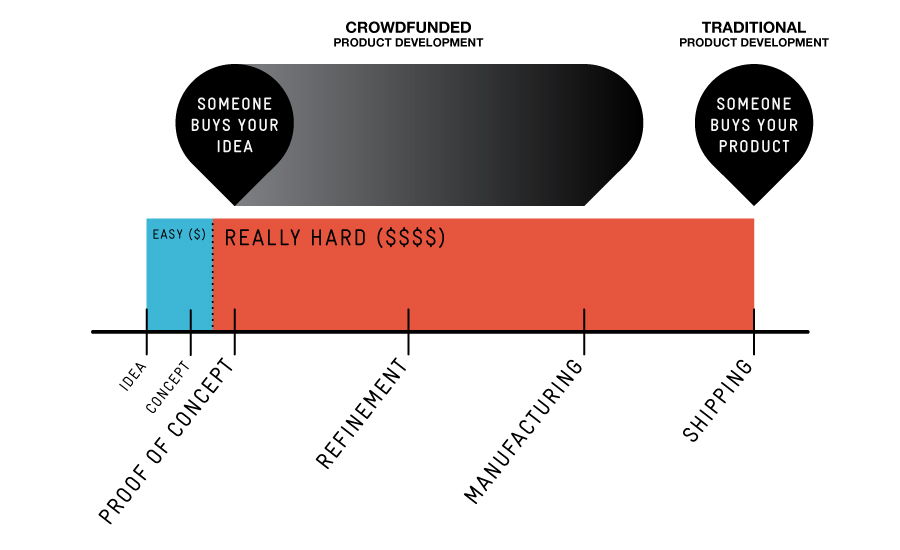 Click for larger image.
I launched my own project somewhere between the Proof of Concept and Refinement phases. At that point, I had a working proof of concept, quotes from vendors, and a pretty good sense of how my Stylus Caps were going to be made. The reason I turned to crowdfunding was that I had gone as far as I could go on my own money. I had a lot of work and several surprises still ahead of me, but looking into crowdfunding was the only way the project was going to continue.
A proof of concept is a prototype that mostly looks and works like the final product will. It exists to tell you that your idea works, that it’s manufacturable, and to communicate to others what your intentions are. It should answer most, if not all, of your questions of how you will proceed with your development. You will also need it to help you demonstrate your idea in the video that will be on your main project page.
Production quotes are cost estimates that you receive from manufacturers that tell you how much it will cost to produce your idea and how long it will take to make it. Its good practice to get multiple quotes and make sure you have trust in the people you will eventually work with. Make sure you put all of those quotes plus any other anticipated costs, including shipping, into a Bill of Materials or BOM, that will give you a detailed look at how much money it will take to make your idea.
So what phase should you launch from? Manufacturing? Refinement? Proof of Concept? Obviously, the further along in development you are, the less chance for delays and surprises you will have.
My recommendation is to do as much as you can on your own dime, before you try to crowdfund your product. The further along in the process you launch, the more predictable the outcome and timing of delivering your project will be.
At minimum, you shouldn’t even consider launching until you have a working proof-of-concept and production quotes. Launching with anything less is asking for a world of pain. You owe it to yourself, your manufacturing partners, and your future Backers, to know if your idea will work and how much it will cost to produce. Once those things are in place, you can think about how to set up your crowdfunding structure.
Taken from:
Crowdfunding Revolution: Prepare to Launch, Pt 1 – Build Your Structure
Scaffolding: Construction work at the Lehrter Hauptbahnhof, Berlin. By Tup Wanders, via Wikimedia
So. You have an idea. You’re sold on crowdfunding. Now you’re ready to jump in headfirst. Where do you start? In this part of the crowdfunding series, I will cover how to get ready to launch your project.
There are two sides of launching: Structural work (the boring stuff) and Storytelling work (the exciting stuff).
Structural work refers to the way you set up your project to operate. This includes figuring out how much money you should raise, how long your project should run, how to set up your Reward Tiers, looking into patent protection, etc. It’s boring stuff, but extremely necessary to make sure things run smoothly.
Storytelling work is how you will describe your project to the world. This involves shooting a video, what types of images you should use, writing copy, etc.
There is a lot of ground to cover for both of these aspects, so we’re going to split them into two parts. This part will focus on building your structure.
Note: From here on out, this series will focus mainly on running Kickstarter projects. They are the go to site for product designers, and it only makes sense to talk about how to work within Kickstarter’s parameters. However, there is a lot of overlap in how Kickstarter works and how other crowdfunding sites work, so even if you launch your product on another site, you should still get something out of this.
But before you start…
Every product design Project Creator should first decide what phase they will launch their project from. Lets go back to that development timeline I talked about last time.
Click for larger image.
I launched my own project somewhere between the Proof of Concept and Refinement phases. At that point, I had a working proof of concept, quotes from vendors, and a pretty good sense of how my Stylus Caps were going to be made. The reason I turned to crowdfunding was that I had gone as far as I could go on my own money. I had a lot of work and several surprises still ahead of me, but looking into crowdfunding was the only way the project was going to continue.
A proof of concept is a prototype that mostly looks and works like the final product will. It exists to tell you that your idea works, that it’s manufacturable, and to communicate to others what your intentions are. It should answer most, if not all, of your questions of how you will proceed with your development. You will also need it to help you demonstrate your idea in the video that will be on your main project page.
Production quotes are cost estimates that you receive from manufacturers that tell you how much it will cost to produce your idea and how long it will take to make it. Its good practice to get multiple quotes and make sure you have trust in the people you will eventually work with. Make sure you put all of those quotes plus any other anticipated costs, including shipping, into a Bill of Materials or BOM, that will give you a detailed look at how much money it will take to make your idea.
So what phase should you launch from? Manufacturing? Refinement? Proof of Concept? Obviously, the further along in development you are, the less chance for delays and surprises you will have.
My recommendation is to do as much as you can on your own dime, before you try to crowdfund your product. The further along in the process you launch, the more predictable the outcome and timing of delivering your project will be.
At minimum, you shouldn’t even consider launching until you have a working proof-of-concept and production quotes. Launching with anything less is asking for a world of pain. You owe it to yourself, your manufacturing partners, and your future Backers, to know if your idea will work and how much it will cost to produce. Once those things are in place, you can think about how to set up your crowdfunding structure.
More:
Crowdfunding Revolution: Prepare to Launch, Pt 1 – Build Your Structure

Sure, you can take us on our word that the new iPad really is that much sharper than its predecessor — or, you can opt for a more scientific approach, and peek at that Retina display under a microscope. Our own Richard Lai slid his 64GB WiFi iPad under a USB scope, going far beyond the naked eye for a close-up look at those gorgeous high-density subpixels. As you can imagine, it’s impossible to distinguish one dot from the next when you’re looking at a cool three million pixels packed tightly within a 9.7-inch slab, but that view clears up quite nicely under a 230x microscope. What you’ll see is that those tiny red, green and blue dots are now significantly smaller, when compared to the iPad 2. That means text that’s easily legible without a pinch, smooth icons and far sharper pictures. There’s a dramatic improvement for sure, but is that new display alone enough to justify the upgrade for you? A quick click through the gallery below should help clear things up.
Richard Lai contributed to this report.
Under the microscope: a closer look at the new iPad originally appeared on Engadget on Fri, 16 Mar 2012 15:31:00 EDT. Please see our terms for use of feeds.
Permalink | | Email this | Comments
See the article here:
Under the microscope: a closer look at the new iPad

Those purchasing third-generation iPads running on Verizon’s LTE network on Friday may be in luck when it comes to carrier compatibility. A MacRumors forum member has discovered that the Verizon iPad can run on AT&T’s 3G network simply by swapping out the iPad’s Micro-SIM and updating the device’s carrier settings.
“I was one of the first to obtain a Verizon iPad and can happily confirm that this is allowed! I used my ATT iPhone 4S sim card and took out the Verizon sim, and data worked! You must apply the AT&T APN carrier settings before this works though,” a user named jsnuff1 wrote. He also included a video (embedded below) to prove his claims.
The discovery is simultaneously surprising and not—as we noted this week, both the Verizon and AT&T iPads are capable of roaming on GSM networks worldwide even though Verizon’s own frequencies are not compatible with GSM networks. It was believed that the Verizon iPad would be locked to Verizon’s CDMA and LTE networks here in the US but only roam on GSM networks when outside of the country, but Apple apparently chose to leave the device unlocked even within the US. The Verizon iPad can’t be used to surf on AT&T’s LTE network, however—it can only make use of AT&T’s 3G, HSPA+, and EDGE networks when the Micro-SIM is swapped out.
It’s worth noting that the AT&T iPad most likely cannot perform the same swap in the reverse due to Verizon’s CDMA network, which AT&T doesn’t support. We have reached out to AT&T for comment and are currently waiting on a response.

Read the comments on this post
Original post:
Verizon iPad found to be compatible with AT&T's 3G network


