Apps to help you save money

This series is brought to you by
TurboTax Federal Free Edition.

Here’s a roundup of some of my favorite money-saving apps for iOS:

SmartyPig. My favorite money saving app is SmartyPig. It’s designed to let create virtual “piggy banks” for specific savings goals. I have piggy banks for my yearly car insurance bill, for Christmas present money, for my kids’ college funds, and for a new computer every three years.

SmartyPig is linked to your checking account, and every month, a specified amount of money is transferred from your bank account to your piggies. As the pigs get closer to their goal, you can see them getting full. When the goal is reached, you can have the cash transferred to your bank account, or redeem it for a retailer gift card such as Amazon and get a bonus. I seem to have the incurable habit of spending all the readily available money in my checking account, so SmartyPig helps me meet my savings goals.

Debt Free. Last year, I foolishly used credit cards to pay for things I’d ordinarily have used cash to purchase: vacation, back-to-school supplies, school books, clothes for my kids, and business travel. It added up fast. As a result, I am now carrying balances on three different credit cards. The total amount I owe is large enough that I can’t pay it off immediately, so I needed to come up with a plan to get out of debt.

I figured there’d be an app for that, so I looked around the iTunes app store and found something called Debt Free. It’s a well constructed app that helps you use the “Snowball method” to pay down your debt (including credit cards, car loans, lines of credit or any other kind of loan).

If you’re not familiar with the Snowball method, here’s how it works:

1. Make a list of all of your outstanding loan balances, sorted from the lowest balance to the highest balance.

2. Write down the minimum payment for each loan.

3. Figure out how much extra you can afford to pay every month. This is your “snowball.”

4. Pay the minimum payment on each loan, and apply the snowball to the loan with the lowest balance.

5. When the lowest balance loan gets paid off, start applying the extra payment to the next lowest loan on your list.

6. Repeat steps 1-5 until you are free of debt.

Debt Free automates the above process. You simply enter information about each card (remaining balance, interest rate, due date and minimum payment) and how much of a snowball you can afford. It crunches the numbers, generates a payment schedule and tells you when you will be debt-free. It will also notify you when a bill is due (even if the app is not running), and send you a detailed report by email.
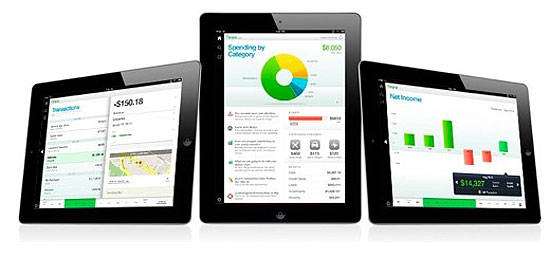
Mint. I’ve been a user of Mint, a personal finance website, for several years, and it has become an essential tool for keeping track of my expenses and organizing information that my accountant needs to prepare my income taxes. The great thing about Mint is the way it pulls data from my checking account, savings accounts, stock brokerages, and credit cards and creates attractive and easy to understand reports and graphs. It’s so much easier to use than Quicken, which I struggled with for over 15 years. As soon as I started using Mint, I zapped Quicken from my hard drive, vowing never to use it again. (I got nervous when I learned that Intuit, the company that publishes Quicken, purchased Mint, but so far Intuit has not mucked with the elegance of Mint.)

Shortly after the iPhone was introduced, Mint created an app for it. And like the Web version, the iPhone app was very useful at providing a snapshot of my income, expenses, and financial status. I didn’t think Mint could get much better, but in October the company created an iPad version (which is free, like all versions of Mint) and it is the best way yet to take stock of your personal finances.
When you launch the iPad app you are presented with a screen that displays the following:

1. A pie chart that shows your spending by category;

2. Alerts about upcoming bills and other important information;

3. A progress bar that shows how much under or over budget you are for the month;

4. A list of your top spending categories for the month.

If you click on any of these items, Mint will drill down to display detailed information about it. If you need to edit a transaction, or change the spending category that Mint has incorrectly assigned to a transaction, you can do that on the iPad app, but I find it easier to make those kinds of changes on the web-based version.

If you haven’t tried out Mint yet, I highly recommend that you do. And if you have an iPad, I’m betting you’ll find the Mint app to be as useful as I do.


note: Mint is owned by Intuit, sponsors of this content series. Intuit had no input into or review of the content of this post.


Visit site:
Apps to help you save money

Microsoft ships SQL Server 2012, refreshes Hadoop on Azure preview


On April 2, Microsoft released SQL Server 2012, the latest version of its SQL Server database platform. The company also announced the availability of a second preview for the company’s Hadoop “big data” service for the Windows Azure cloud.

Many of SQL Server 2012’s new features serve the high end of Microsoft’s customer base. They focus on supporting hybrid IT environments that blend more traditional data center deployments with those in private and public cloud computing environments. These features include SQL Server Data Tools, a new common set of tools for SQL Server and cloud SQL Azure application and database development. The release also contains the Power View web-based ad-hoc data visualization tool, which allows users to generate presentations and reports by pulling data from published SQL Server datasets and other data sources published through Microsoft’s Windows Azure Marketplace.

The new Hadoop preview ups the capacity and reliability of the trial service on Azure. According to a blog post from Microsoft’s SQL Server team, Microsoft has quadrupled the capacity of the preview from its initial invitation-only trial. The company also added disaster recovery features for the Hadoop Distributed File System in the Azure cloud. The new preview includes the promised data connections for Office and SharePoint. There is also support for connections from SQL Server 2012’s Power View and other business analytics tools—as well as support for open-source Hadoop analytics projects such as Mahout. Microsoft customers can sign up for a slot in the Hadoop on Azure trial at hadooponazure.com.

Read the comments on this post

See the article here:
Microsoft ships SQL Server 2012, refreshes Hadoop on Azure preview

US Army grants HP $249 million contract to deploy private cloud services

Image

HP is in the Army now. Today, the Palo Alto company announced that it has received a $249 million contract to provide the Department of Defense and other federal agencies with enterprise level cloud computing services. The new initiative will allow the military to consolidate its existing data centers, and the services will be deployed to a number of commercial and government-owned buildings. HP will also provide the military with Performance-Optimized Data Centers (PODs) for quick deployment into tactical situations. Under the terms of the Army Private Cloud contract, HP will work with ten small businesses and Alabama A&M University to help actualize the private cloud and its requirements. We can only assume that Meg Whitman is glad to start out the month with a bit of walking-around money. You’ll find the full PR after the break.

Continue reading US Army grants HP $249 million contract to deploy private cloud services

US Army grants HP $249 million contract to deploy private cloud services originally appeared on Engadget on Tue, 03 Apr 2012 17:14:00 EDT. Please see our terms for use of feeds.

Permalink | | Email this | Comments

See the original article here:
US Army grants HP $249 million contract to deploy private cloud services

Apple holds the master decryption key when it comes to iCloud security, privacy


Ars recently attempted to delve into the inner workings of the security built into Apple’s iCloud service. Though we came away reasonably certain that iCloud uses industry best practices that Apple claims it uses to protect data and privacy, we warned that your information isn’t entirely protected from prying eyes. At the heart of the issue is the fact that Apple can, at any time, review the data synced with iCloud, and under certain circumstances might share that information with legal authorities.

We consulted several sources to understand the implications of iCloud’s security and encryption model, and to understand what types of best practices could maximize the security and privacy of user data stored in increasingly popular cloud services like iCloud. In short, Apple is taking measures to prevent access to user data from unauthorized third parties or hackers. However, iCloud isn’t recommended for the more stringent security requirements of enterprise users, or those paranoid about their data being accessed by authorities.

Read the rest of this article...

Read the comments on this post

Visit site:
Apple holds the master decryption key when it comes to iCloud security, privacy

Nike Unveils Elite51: Newly-Designed, High-Performance NFL Uniforms

0nikenfl02.jpg

Nike’s sportswear designers were recently assigned a very specific task: Come up with the best performance wear possible to be worn by a highly select group of 1,600 men.

Those men are the professional players belonging to the 32 teams of America’s National Football League, and today Nike presented their new uniforms, signalling their status as the League’s new official apparel manufacturer both on and off the field. The Elite 51 uniforms combine Nike’s manufacturing, materials and research prowess into “a completely integrated system of dress” that is lighter, stronger, and more flexible than previous iterations.

The baselayers have foam impact protection built into “hit zone” areas like the shoulder, hips and tailbone. The thighs are protected by lightweight carbon-fiber plates. The seams are strategically placed and designed to lie flat to avoid chafing the wearer. The fabric used is Nike’s Dri-FIT mesh, designed to wick moisture away from the player.

0nikenfl04.jpg

The outer layer of the uniforms are constructed with Nike’s Flywire technology, originally designed for footwear, which weaves fibers together in a particular way to add support where it’s needed without creating bulk and weight. The jerseys achieve what’s known as a “lockdown” fit, encompassing the bulge of the pads and shrinking back down to the wearer’s body, eliminating any loose inch of clothing that a defender might get their fingers onto.

(more…)

See more here:
Nike Unveils Elite51: Newly-Designed, High-Performance NFL Uniforms

Sprint confirms that LTE phones can enjoy unlimited data on Everything plans

sprint store

The formal unveiling of LG’s Viper this morning may not have piqued your interest, but Sprint loyalists hellbent on maintaining access to an unlimited plan may want to take a second look. Initially pointed out by TechHog, and confirmed to us today by a Sprint spokesperson, the carrier’s impending LTE data network will indeed be included on its existing Everything plans. In other words, the Viper — as well as any other LTE smartphone, Galaxy Nexus included — will be able to surf the LTE superhighway without limits. To date, the “unlimited” nature of Sprint’s data remains a huge differentiator in a world full of hamstrung options, tiers and throttles, and it’ll certainly be used to get the attention of heavy users in the months ago. We also reconfirmed that Atlanta, Baltimore, Dallas, Houston, Kansas City and San Antonio are on track to receive LTE in “midyear 2012,” with “other markets following in the third and fourth quarters.” Huzzah!

Sprint confirms that LTE phones can enjoy unlimited data on Everything plans originally appeared on Engadget on Tue, 03 Apr 2012 18:31:00 EDT. Please see our terms for use of feeds.

Permalink TechHog | | Email this | Comments

See the original post:
Sprint confirms that LTE phones can enjoy unlimited data on Everything plans

Supreme Court Approves Strip Searches For Any Arrestable Offense


sl4shd0rk writes “Taking a page out of the TSA handbook, the Supreme Court has voted to allow strip searches for any offense, no matter how minimal. The article cites these two tidbits from Justice Anthony Kennedy: ‘Every detainee who will be admitted to the general [jail or prison] population may be required to undergo a close visual inspection while undressed,’ and ‘Maintaining safety and order at detention centers requires the expertise of correctional officials.'”


Share on Google+

Read more of this story at Slashdot.

Visit site:
Supreme Court Approves Strip Searches For Any Arrestable Offense

Confidentiality Expires For 1940 Census Records


Hugh Pickens writes writes “In spring of 1940, the Census Bureau sent out more than 120,000 fact-gatherers, known as ‘enumerators,’ to survey the nation’s 33 million homes and 7 million farms. Now as the 72 years of confidentiality expires, the National Archives website buckled under the load as the 1940 census records were released and 1.9 million users hit the archives servers in the first four hours the data went public and at one point, the Archives said, its computers were receiving 100,000 requests per second. Data miners will have the opportunity to pick and chip through more than 3.8 million digital images of census schedules, maps and other sociological minutiae. What will we learn from this mother lode? The pivotal year 1940 ‘marked the beginnings of a shift from a depressed peacetime to a prosperous wartime,’ says David E. Kyvig, author of Daily Life in the United States, 1920-1939. The vast data dump, Kyvig says, will allow historians ‘to look closely at particular communities and how people within them were doing in terms of employment, income and material comforts.’ The 1940 census was the first Census that looked deeper into the details of much of American life. ‘As we see how the country evolved over the subsequent 20 years, where we have aggregate census data … we ought to be able to see more clearly how government spending bettered everyday life, confirmed Keynesian economic theory and revealed that, before the war, the New Deal did too little, rather than too much, to stimulate the U.S. economy.””

Get all 18TB of it while it’s hot.


Share on Google+

Read more of this story at Slashdot.

Link:
Confidentiality Expires For 1940 Census Records
