Tape lives! Supercomputer to be built with 380PB of tape storage

Tape storage isn’t what you’d call cutting-edge technology. Most of us make do with disk, and lust after the speeds of SSD. But tape is still useful when massive amounts of storage are needed, in part because of its low cost. It’s being put to good use at an extreme scale in a new supercomputer.

According to Computerworld, the National Center for Supercomputing Applications (NCSA) is building a storage infrastructure consisting of 380 petabytes of magnetic tape capacity and 25 petabytes of disk storage. It’s all to support the petaflop-scale Blue Waters supercomputer. The NCSA says it is building the system to “predict the behavior of complex biological systems, understand how the cosmos evolved after the Big Bang, design new materials at the atomic level, predict the behavior of hurricanes and tornadoes, and simulate complex engineered systems like the power distribution system and airplanes and automobiles.”

The 25PB of disk will act as online storage for data that must be rapidly accessed, while the tape library is categorized as nearline, sort of a compromise between online storage and backup systems. With 380,000 AMD Opteron 6200 Series x82 processors, the cluster will use 40Gbps Ethernet technology with aggregate throughput of up to a terabyte per second, Computerworld reported.

Read more | Comments

Visit link:
Tape lives! Supercomputer to be built with 380PB of tape storage

Navy plans ship-based LTE for close-quarters communication

Navy plans ship-based LTE

Bandwidth is a precious commodity on military vessels. Ships in the US Navy fleet are generating more data, but the pipe it’s getting pumped through isn’t getting any larger. What’s more, with limited connectivity options on the table, the sea-faring military wing is missing out on all the smartphone and app store fun. Rather than turn green with envy, or turning their dress whites is for camouflage cargo pants, the Navy is beefing up its mobile tech arsenal, beginning with the U.S.S. Kearsarge, U.S.S. San Antonio and U.S.S. Whidbey Island. The ships will serve as test beds for a nautical LTE system, with a range of about 25 miles. The 4G network will serve as a localized platform for wirelessly feeding data to sailors, as well as a way for the enlisted to connect to the outside world. On the backend, the Marines are working on a new satellite broadband service that should be able to provide ships with 300 megabits of shared bandwidth. Satellite internet and off-grid LTE might induce yawns in some, but they’re certainly a major part of modernizing our fighting forces. For more info, check out the source link.

Navy plans ship-based LTE for close-quarters communication originally appeared on Engadget on Thu, 24 May 2012 01:33:00 EDT. Please see our terms for use of feeds.

Permalink CNET | sourceWired | Email this | Comments

Read More:
Navy plans ship-based LTE for close-quarters communication

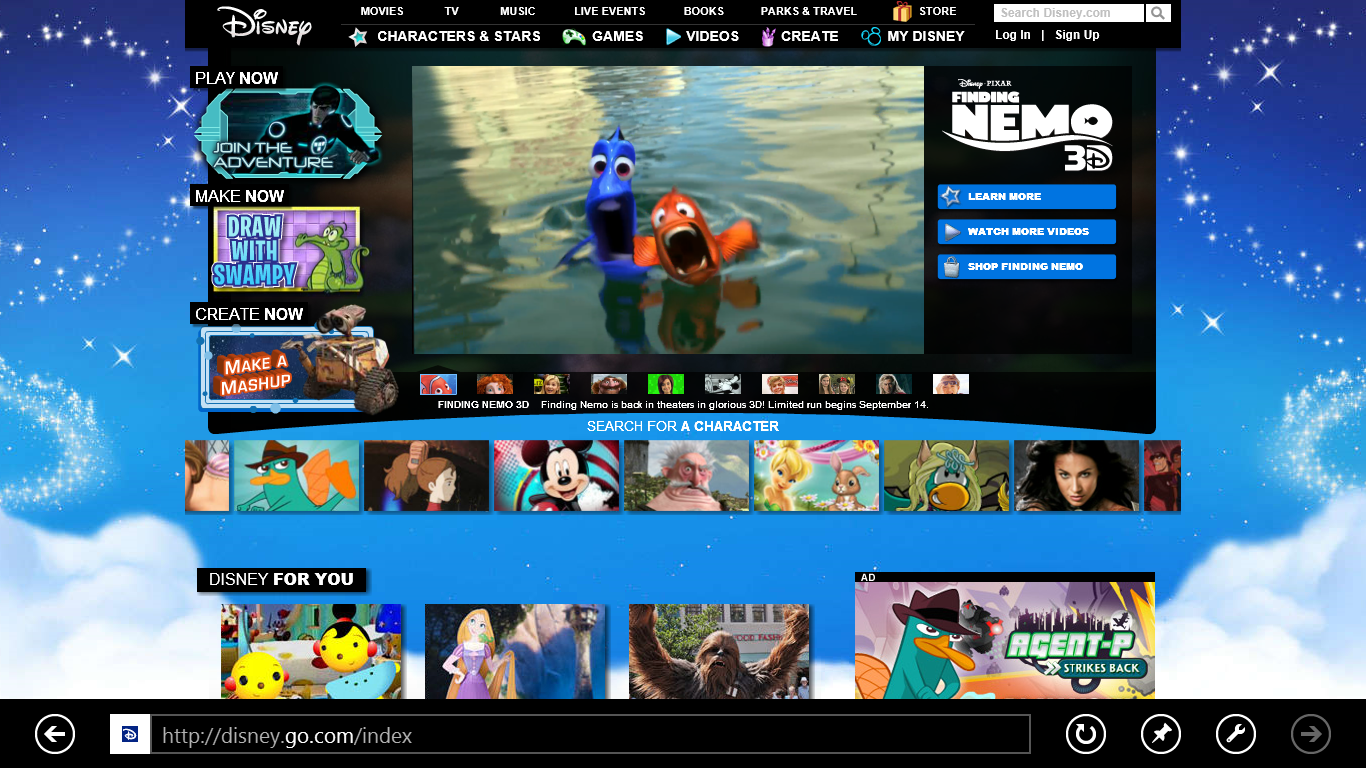
Windows 8 will integrate, include Adobe Flash

Enlarge / The Flash-driven Disney.com in Metro-style Internet Explorer 10.

Internet Explorer 10 in Windows 8 will include a bundled, integrated version of Adobe Flash, and the Metro-style browser will support the use of Flash on a limited number of sites. This news and corroborating screenshots comes from Within Windows and winunleaked.tk.

In Windows 8, Microsoft’s browser will come in two guises. There will be the traditional desktop browser, with its full support of plug-ins and extensions, and there will be the new Metro-style browser that will be plug-in free. But that’s not quite the whole story. The browser will include an integrated and embedded version of Adobe Flash, and because this will be built-in, it won’t be treated as a plug-in.

The result? Even the Metro-style browser will be able to use Flash.

Read more | Comments

Read the original post:
Windows 8 will integrate, include Adobe Flash

Seagate to buy LaCie for $186 million, expand its storage empire

Seagate to buy LaCie, expand storage empire

Seagate and LaCie have gotten friendly before — the former company’s drives are in the LaCie 2big Thunderbolt HDD, for instance — but the storage makers are about to get even cozier. Today, Seagate announced its plans to buy a 64.5-percent share in the French company, which is currently valued at $186 million. The acquisition will combine the two outlets’ product portfolios and, according to the press release, “accelerate Seagate’s growth strategy in the expanding consumer storage market, particularly in Europe and Japan.” The deal should go through by late 2012, and Seagate will bring over LaCie CEO Philippe Spruch to head the consumer storage products division.

Continue reading Seagate to buy LaCie for $186 million, expand its storage empire

Seagate to buy LaCie for $186 million, expand its storage empire originally appeared on Engadget on Wed, 23 May 2012 11:21:00 EDT. Please see our terms for use of feeds.

Permalink | | Email this | Comments

See more here:
Seagate to buy LaCie for $186 million, expand its storage empire

Delorme’s inReach two-way satellite communicator gets iOS support, sends iPhone texts from Timbuktu (video)

Image

If you’re an iPhone or iPad owner, you might have been disappointed that the Delorme inReach two-way GPS communicator launched with app support only for Android users. That’s fine if you’re trekking with a Casio G’zOne Commando, but not so hot if you’re of the Apple mindset and get stranded canoeing down the Amazon. Thankfully, Delorme just posted an iOS version of its Earthmate app that will let your Cupertino-designed gear send either text messages or SOS beacons through a paired-up inReach unit. As before, the handheld relies on its own GPS positioning and embedded locations in messages to keep friends and rescue crews updated anywhere the device can get an Iridium satellite lock-in. It’ll still cost you $250 for the device and $10 per month to stay linked up; even so, there’s a real chance you’ll be texting your friends from your iPhone in Mali, assuming you haven’t had to call a rescue helicopter first.

Continue reading Delorme’s inReach two-way satellite communicator gets iOS support, sends iPhone texts from Timbuktu (video)

Delorme’s inReach two-way satellite communicator gets iOS support, sends iPhone texts from Timbuktu (video) originally appeared on Engadget on Wed, 23 May 2012 08:35:00 EDT. Please see our terms for use of feeds.

Permalink | sourceApp Store | Email this | Comments

Read more here:
Delorme’s inReach two-way satellite communicator gets iOS support, sends iPhone texts from Timbuktu (video)

Chrome Browser Usage Artificially Boosted, Says Microsoft


bonch writes “Chrome was recently called the world’s no.1 browser, but Microsoft is accusing the source, StatCounter, of using flawed methodology. When a user enters a search in Chrome, the browser preloads an invisible tab not shown to the user, and these were being counted by StatCounter. Net Applications, another usage tracking group, ignores these invisible tabs and reports IE at 54%, Firefox at 20.20%, and Chrome at 18.85%.” Whereas the saturation of MSIE is totally organic, right?


Share on Google+

Read more of this story at Slashdot.

Visit link:
Chrome Browser Usage Artificially Boosted, Says Microsoft

ITC judge recommends import ban on Microsoft’s Xbox

An administrative law judge for the International Trade Commission issued a recommendation that the commission ban 4GB and 250 GB Xbox gaming consoles from import to the United States. The recommendation(PDF) was released to the public on Monday, and would punish Microsoft for infringing against some of Motorola’s patents. The patents permit video transmission and compression on the console and between the console and its controllers.

Not all import bans are created equal though. In Judge David Shaw’s statement, he suggested a cease and desist order be placed against Microsoft. It would, “require the respondent to submit an annual report to the Commission regarding the number and value of infringing goods in its domestic inventory,” according to the authors of ITC Remedial Orders in the Real World(PDF). “Failing to do so, or providing false information in the report, may lead to criminal prosecution under 18 U.S.C. § 1001.” The cease-and-desist order is more strict than a standard exclusion order, which would simply require US customs agents to keep tabs on Microsoft’s activities.

Judge Shaw also ordered “that Microsoft post a bond equal to 7 percent of the declared value of unsold Xbox inventory already in the country,” according to Courthouse News.

Read more | Comments

See the original article here:
ITC judge recommends import ban on Microsoft’s Xbox

Researchers power microbots made of bubbles with lasers

Image

They may not be “robots” as most have come to expect, but these so-called microrobots developed by a team of researchers from the University of Hawaii at Manoa do have at least one thing in common with many of their mechanical counterparts: lasers. As IEEE Spectrum reports, the bots themselves are actually nothing more than bubbles of air in a saline solution, but they become “microrobots” when the laser is added to the equation, which serves as an engine of sorts and allows the researchers to control both the speed and direction of the bubbles. That, they say, could allow the bots to be used for a variety of tasks, including assembling microstructures and then disappearing without a trace when the bubble is popped. Head on past the break for a video of what they’re already capable of.

Continue reading Researchers power microbots made of bubbles with lasers

Researchers power microbots made of bubbles with lasers originally appeared on Engadget on Tue, 22 May 2012 21:27:00 EDT. Please see our terms for use of feeds.

Permalink | sourceIEEE Spectrum | Email this | Comments

See original article:
Researchers power microbots made of bubbles with lasers