US 3G and 4G networks face off once more, Verizon just squeaks out win over AT&T

US 3G and 4G networks face off once more, Verizon just squeaks out an edge over AT&T

Competition for the US cellular speed crown is certainly fiercer than it was last year, when Verizon’s 4G LTE let it walk over the competition unimpeded. With AT&T’s LTE in the running, though, have the ranks changed? No, but only just barely: as PCMag discovered in its annual countrywide testing, Verizon mostly trumped its fellow telecom giant in upload speeds and reliability. AT&T could once more claim to be best in a category with the fastest downloads, although it’s counterbalanced by having a considerably smaller LTE network. For everyone outside of T-Mobile and its still very respectable HSPA+ network, it’s better luck next year. We’ll be most intrigued then, quite frankly — in addition to 2013 giving us a genuinely functional Sprint LTE network, that’s when we could see a blistering-fast T-Mobile LTE-Advanced produce an upset victory.

US 3G and 4G networks face off once more, Verizon just squeaks out win over AT&T originally appeared on Engadget on Mon, 18 Jun 2012 23:56:00 EDT. Please see our terms for use of feeds.

Permalink | sourcePCMag | Email this | Comments

View post:
US 3G and 4G networks face off once more, Verizon just squeaks out win over AT&T

The Microsoft Surface, A 10.6-Inch Windows 8 Tablet From Microsoft

gallery_5_large

“It embodies hardware and software working together. People want to work and play,” Steve Ballmer said today amid much fanfare at Milk Studios in downtown Los Angeles. Microsoft has officially entered the ring with Apple.

Microsoft views the Surface as a “stage for Windows 8.” It’s 9.3mm thin, has full size USB 2.0 ports, a massive kickstand and weighs only 1.5 lbs. The casing is made out of magnesium (specifically, a material Microsoft calls VaporMg) and screen is covered in the Gorilla Glass 2 and optically bonded, a feature Microsoft brags was specifically made for the Surface. The Surface is directly aimed at consumers, and with that, the iPad.

Windows 8 is at the core of Surface. As such, it’s Metro device but also has access to all the Windows, not to mention Xbox features. This is clearly the product Microsoft had in mind when it announced the Xbox SmartGlass feature at E3 earlier in the month.

Microsoft also announced several accessories for the Surface including a clever 3mm thick cover that features a full (albeit super-slim) keyboard. Since it’s held on by magnets, it will likely be called a copy of the iPad’s SmartCover, too. The backside of the Surface even features a massive, unit-wide kickstand.

There will be two hardware options for Microsoft’s Surface, with both an ARM option and, for the full Windows experience, an Intel chip.

But like most hardware, it’s nothing without the right software. Ballmer was very clear at the beginning of the announcement event that this tablet’s strength is the Windows ecosystem. This tablet runs Windows 8, and with that, both Metro and the traditional desktop environment. Every application that runs on Windows, save perhaps Skyrim and the like, should run on a x86 Surface.

Still, if Microsoft is attempting to take on Apple, it will need to court a new crop of developers. The iPad’s strength comes from its legions of small 3rd party devs that for the most part completely ignore all things Microsoft. Up until this product, there wasn’t another tablet platform with the same sort of penetration numbers as the iPad. But with the Surface, Microsoft is essentially giving developers a massive user base as the applications will hit both mobile and desktop units — and Metro’s dedication to the touchscreen makes the deal even sweeter.

The new Windows RT-powered Surface will sport either 32 or 64GB of storage depending on the purchaser’s preference, while the more traditional Intel variant will come with either 64 or 128GB. Microsoft declined to dive into specifics about their new tablet’s release, though they were quick to note that the Surface tablets would be priced “competitively” when they make it to market.

Click to view slideshow.

Read the article:
The Microsoft Surface, A 10.6-Inch Windows 8 Tablet From Microsoft

How to blow $6 billion on a tech project

The Army’s cancelled Ground Mobile Radio cost $6 billion to fail.

In 1997, the Defense Department began its quest for the perfect family of radios: software-defined radios that, like computers, could be reprogrammed for different missions and could communicate with everything the US military used. Digital signal processing could adaptively use available radio spectrum based on the needs of the moment, turning soldiers, tanks, planes, and ships into nodes of a broadband radio-based network.

The goal was to solve radio problems like this one in Afghanistan, detailed by the Center for Public Integrity in January 2012. Soldiers who watched an ambush forming on a ridge nearby found themselves limited by the hugely variable needs of their many radio systems:

They had short-range models for talking with the reconstruction team; longer-range versions for reaching headquarters 25 miles away; and a backup satellite radio in case the mountains blocked the transmission. An Air Force controller carried his own radio for talking to jet fighters overhead and a separate radio for downloading streaming video from the aircraft. Some of these radios worked only while the troopers were stationary; others were simply too cumbersome to operate on the move.

Read more | Comments

Continue reading here:
How to blow $6 billion on a tech project

WordPress Plugin SlideDeck Adds Multiple Content Sources And Custom HTML

slidedeck logo

SlideDeck is a WordPress plugin that’s supposed to make it easy for publishers to add “content sliders” (basically a gallery/slideshow interface for browsing content) to their sites, and it’s already attracting some positive notice from tech bloggers. Today Digital Telepathy, which makes the plugin (as well as the Hello Bar), is releasing a preview version of its latest update.

CEO Chuck Longanecker and Product Director Jason Amunwa say version 2.1 has three major new features, all built in response to user requests. First, SlideDeck users can now incorporate multiple content sources into a single SlideDeck — so if you want your slider to incorporate photos from Instagram and videos from YouTube. Users can also customize the appearance of each slide and further customize things by embedding their own HTML. For example, Amunwa says this allows publishers to add elements like Google Maps into their slides.

Collectively, Longanecker says the new feature should make SlideDeck more palatable to a more technical and design-savvy users. With SlideDeck 2, he says the company took a “gamble” by trying to create a plug-and-play product that was, on the hand, easy to install, but on the other hand, didn’t allow for any real customization. The idea, as Amunwa put it, was to make good design accessible to “people who wouldn’t normally have access to it.” However, there was interest from developers and designers too — hence the new features aimed at them.

SlideDeck 2.0 has been downloaded 250,000 times, so Longanecker estimates that it has at least 150,000 users. If you want to see some live customers, check out Astaire magazine or Brown Sugar Kitchen.

Digital Telepathy still does some work as a design agency, but he says it’s becoming more and more product-focused, and in the next few months we can expect to see more launches, all tied to the larger goal of “improving the design of the Web.”

See the original post:
WordPress Plugin SlideDeck Adds Multiple Content Sources And Custom HTML

Face.com acquired by Facebook for an estimated $80 million+, facial tagging clearly at the forefront

Facecom acquired by Facebook for an estimated $80 million, facial tagging clearly at the forefront

Facebook already dropped the “the,” so why not oversimplify and drop the “book,” too? All jesting aside, Facebook is continuing its recent buying spree with the acquisition of Face.com for an estimated $80 – $100 million. The Israeli-based startup is being entirely scooped up by Zuckerberg’s social network — talent and technology included — and it’s fairly obvious that the company’s heralded facial recognition IP is what Facebook is truly after. To date, Facebook’s desktop tagging recognition is ho hum at best, and it’s practically an afterthought on the mobile front; ‘course, with Camerao. now being released, it’s high time the company got serious about tagging on the go. For those wondering, Face’s blog post on the matter seems to make clear that third-parties currently using its API will continue to be supported, and while there aren’t specific plans being laid out, we’re told that the “next steps are going to be exciting for all of us.” In related news, it’s tremendously unlikely that Barnes & Noble lets go of book.com in order to give Facebook the pleasure of owning both ends of the URL spectrum.

Face.com acquired by Facebook for an estimated $80 million+, facial tagging clearly at the forefront originally appeared on Engadget on Mon, 18 Jun 2012 14:59:00 EDT. Please see our terms for use of feeds.

Permalink AllThingsD | sourceFace | Email this | Comments

More:
Face.com acquired by Facebook for an estimated $80 million+, facial tagging clearly at the forefront

Intel christens its ‘Many Integrated Core’ products Xeon Phi, eyes exascale milestone

Intel christens its 'Many Integrated Core' products Xeon Phi, eyes exascale milestone

Been wondering when the next big leap in high performance computing would hit? Well, Intel would like you to believe the time is now and the name of that revolution is the Xeon Phi. Formerly codenamed Knights Corner, the Many Integrated Core product is pushing the field of supercomputers into the era of the exaflop by squeezing a teraflop of performance into a package small enough to plug into a PCIe slot. The Phi brand will, at first at least, be applied to specialized coprocessors designed for highly parallel tasks. The chips are built using Intel’s 22nm manufacturing process and 3-D TriGate transistors, piling in more that 50 cores in an effort to combat the inroads made by GPU companies like NVIDIA in the supercomputing space. For more info check out the presentation (PDF) and blog post at the source links.

Intel christens its ‘Many Integrated Core’ products Xeon Phi, eyes exascale milestone originally appeared on Engadget on Mon, 18 Jun 2012 15:18:00 EDT. Please see our terms for use of feeds.

Permalink Intel | sourceIntel (PDF), Technology@Intel | Email this | Comments

Original post:
Intel christens its ‘Many Integrated Core’ products Xeon Phi, eyes exascale milestone

Purported Xbox 720 To Cost $299 With Blu-ray Support, Kinect 2 And Virtual Reality In Time For Holiday 2013

v0zbY

The current gen Xbox may be a year past its halfway point but a purported “leaked” document dating back to August 2010 from a Microsoft presentation details the next gen Xbox 720 in great detail.

Features for the next Xbox, according to the document, will include native Blu-ray playback, full support for HD and 3-D, and beefed up hardware (graphics and processor) under the hood. Other bits and pieces from the doc include PVR functionality, a low power mode setting during media playback and what amounts to an always-on mode. Gates did say years ago that the Xbox would eventually become the nerve center for any living room. And based on recent events, it’s not entirely out of the realm of possibility that Microsoft is making a play to turn the Xbox into a stand-alone set-top box for all things video. After all, they do offer Hulu, Netflix and ESPN. Also, future Microsoft devices will have universal access to content whether you’re on the Xbox, your smartphone or tablet. Duh, right?

The most interesting part of the leaked 56-page document – which has since been taken down – is something called Fortaleza, Portuguese for “Fortress”. Given the environment of traditional cable providers, the next logical step for the Xbox and others is to create and dictate what content they provide for their respective platforms. At this point, that could be anything but the document details Fortaleza as a way of consuming content through VR. A set of wireless glasses that supposedly won’t arrive until 2014 will connect to the Xbox 720 over Wi-Fi and give the player/user access to all manner of content in a virtual world. Future versions will apparently connect over a cellular connection for persistent connectivity – most likely 4G.

Whether Microsoft announces the 720 at next year’s E3 is anyone’s guess.

via Gizmodo

See more here:
Purported Xbox 720 To Cost $299 With Blu-ray Support, Kinect 2 And Virtual Reality In Time For Holiday 2013

Verizon intros FiOS Quantum, officially priced up to 300Mbps

Verzion intros FiOS Quantum, officially priced up to 300Mbps

What’s faster than FiOS internet service? FiOS Quantum evidently, as Verizon’s latest high-speed internet service gets an official name and pricing. Effectively doubling every tier — except the entry-level 15/5 — each can be acquired with or without a custom bundle, double or triple play, and range in price from $65 to $175 a month — except the 300 down / 65 up which is only available by itself for $210 a month. Willing to commit for two years? Well, then you can save yourself a few extra bucks a month. Existing customers won’t have to pay an upgrade fee to take advantage of the new speed, but their bill will probably go up about $10 to $15 a month — depending on what other changes they might make to their bundle. The real question is can one even take advantage of these crazy speeds, but we for one would love to find out.

Continue reading Verizon intros FiOS Quantum, officially priced up to 300Mbps

Verizon intros FiOS Quantum, officially priced up to 300Mbps originally appeared on Engadget on Mon, 18 Jun 2012 00:01:00 EDT. Please see our terms for use of feeds.

Permalink | sourceVerizon | Email this | Comments

Original post:
Verizon intros FiOS Quantum, officially priced up to 300Mbps

Market for zero-day vulnerabilities incentivizes programmers to sabotage their own work

In this Forbes editorial, Bruce Schneier points out a really terrible second-order effect of the governments and companies who buy unpublished vulnerabilites from hackers and keep them secret so they can use them for espionage and sabotage. As Schneier points out, this doesn’t just make us all less secure (EFF calls it “security for the 1%”) because there are so many unpatched flaws that might be exploited by crooks; it also creates an incentive for software engineers to deliberately introduce flaws into the software they’re employed to write, and then sell those flaws to governments and slimy companies.

I’ve long argued that the process of finding vulnerabilities in software system increases overall security. This is because the economics of vulnerability hunting favored disclosure. As long as the principal gain from finding a vulnerability was notoriety, publicly disclosing vulnerabilities was the only obvious path. In fact, it took years for our industry to move from a norm of full-disclosure — announcing the vulnerability publicly and damn the consequences — to something called “responsible disclosure”: giving the software vendor a head start in fixing the vulnerability. Changing economics is what made the change stick: instead of just hacker notoriety, a successful vulnerability finder could land some lucrative consulting gigs, and being a responsible security researcher helped. But regardless of the motivations, a disclosed vulnerability is one that — at least in most cases — is patched. And a patched vulnerability makes us all more secure.

This is why the new market for vulnerabilities is so dangerous; it results in vulnerabilities remaining secret and unpatched. That it’s even more lucrative than the public vulnerabilities market means that more hackers will choose this path. And unlike the previous reward of notoriety and consulting gigs, it gives software programmers within a company the incentive to deliberately create vulnerabilities in the products they’re working on — and then secretly sell them to some government agency.

No commercial vendors perform the level of code review that would be necessary to detect, and prove mal-intent for, this kind of sabotage.

The Vulnerabilities Market and the Future of Security

(via Crypto-gram)


See the original post:
Market for zero-day vulnerabilities incentivizes programmers to sabotage their own work

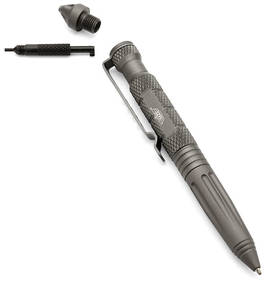
Tactical stabbing pen adds handcuff key and other stuff


ThinkGeek’s Uzi Tactical Defender Pen goes beyond the usual “if it’s stabby and matte black, it’s tactical” realm, adding in a DNA-Catcher (a snaggy bit), a hidden handcuff key, a glass-breaker, and a writes-upside-down-and-underwater cartridge. It’s not even black.


Are you expecting the unexpected? Does expecting the unexpected make the unexpected expected? Either way, the Uzi Tactical Pen turns a mere pen into a life saving tool. The DNA Catcher on the crown of the pen is very sharp and can be used to deliver a very nasty jab to an attacker, causing extreme pain and giving you a sample of their DNA to use when you go to the police. Not expecting to get attacked? The crown also doubles as a glass breaker if you ever get trapped in your vehicle… If things get really bad, you can always rely on the hidden handcuff key inside the top of this pen. This badass writing utensil is made of high-grade aircraft aluminum and writes upside down or under water. If you can find a situation where you use all of this pen’s features and live to tell the tale, we probably owe you some sort of prize.

Uzi Tactical Defender Pen

(via Red Ferret)


See more here:
Tactical stabbing pen adds handcuff key and other stuff