Internet killing porn

Louis Theroux, who produced a documentary on the US porn industry 15 years ago, has revisited the industry, and found it in severe decline. The proliferation of free Internet porn and the rise of amateur pornography has combined to take nearly all the money out of the system. He writes about it in The Guardian:


At one of the top LA agencies for performers, LA Direct, the accountant Francine Amidor laments the “devastating” impact of piracy. “There’s less work, and there’s an abundance – because of the economy – of performers. There aren’t enough people shooting to give everybody a day’s work.”

I put it to Amidor that she owes it to the young aspirants who still make their way to the LA Direct offices to explain the consequences of their decision. She demurs. “Because then I would talk three quarters of the girls out of the business and then we wouldn’t be in business.”

Fees for scenes, not surprisingly, have taken a hit. “Some girls get $600 [£390] for a scene now,” the retired performer JJ Michaels tells me. “It might be $900-$1,000 for a big-name girl. It used to get up to $3,000.” For guys, rates can be $150 or lower.

How the internet killed porn


View article:
Internet killing porn

World IPv6 Launch Day Underway


A number of readers have written in with stories related to today’s permanent rollout of IPv6 by several major organizations. From the looks of it, for the 1% or so of end users with IPv6 support, everything is going smoothly. For those not so lucky to have IPv6 already, an anonymous reader writes with (mostly) good news: 60% of ISPs intend to enable IPv6 by the end of 2012. For business users, darthcamaro provides some words of caution: “…the Chief Security Officer of VeriSign doesn’t think IPv6 should be turned on by a whole lot of people. The problem is network security devices in many cases don’t scan IPv6. So if you turn IPv6 on, you’re screwed.
‘If you don’t have that visibility into IPv6, you should probably consider explicitly disabling IPv6 on your systems until you can take a very concerted approach to enabling IPv6 in a secure manner,’ McPherson said.”


Share on Google+

Read more of this story at Slashdot.

Continue reading here:
World IPv6 Launch Day Underway

Your iPhone calendar isn’t private—at least if you use the LinkedIn app

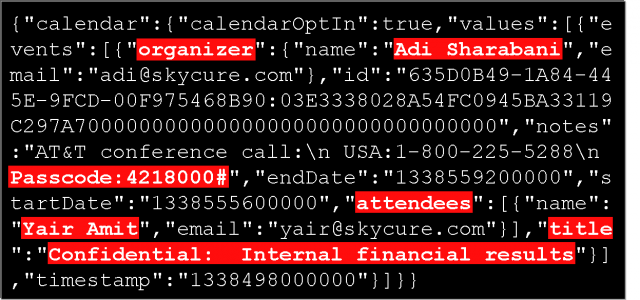
Researchers have found that the LinkedIn iPhone app transmits all manner of data from your iPhone’s calendar to LinkedIn’s servers, and without notifying the user, either.

Today’s not a good day to be a LinkedIn user—doubly so if you use LinkedIn’s iPhone or Android app. Researchers have discovered that the app scrapes users’ Calendar items and sends the data back up to its servers, even when those Calendar items were created outside of the LinkedIn app. The scraped data includes participant lists, subject of the entry, time of the meeting, and any attached meeting notes (such as dial-in details and passcodes).

The LinkedIn app manages to gain access to your Calendar items because it has a feature that allows you to view your calendar from within the app itself. According to security researchers Yair Amit and Adi Sharabani, the app then transmits this information to LinkedIn’s servers without any clear indication to the user that this is hapening—a throwback to the Path controversy that revealed the social networking app (among many others) had been transmitting users’ contact lists to a remote server without explicit user consent.

Amit and Sharabani plan to present their report at a cyber security conference in Tel Aviv on Wednesday. In their report seen by Ars, they note that the information being collected by the LinkedIn app has no apparent relevance to the app’s functionality, though they don’t believe LinkedIn has included this functionality maliciously. “However, we are concerned by the fact it collects and sends-out sensitive information about its users, without a clear indication and consent,” the researchers wrote.

Read more | Comments


More here:
Your iPhone calendar isn’t private—at least if you use the LinkedIn app

IPv6 lands today, do you copy?

IPv6 lands today, do you copy

June 6th has arrived, which means that participating ISPs, hardware manufacturers and search engines must stick to their word and permanently enable the IPv6 address system — not least as an encouragement for others to do the same. The ultimate purpose? To allow trillions of users to have their own IP address, instead of just a paltry few billion permitted by the IPv4 standard that continues to run in parallel. The risk? That the Internet collapses and we all get the day off work. Evidently that hasn’t happened, no doubt thanks to Google and others having tested the system during pilot programs, and indeed Vint Cerf’s explanatory video seems to be working fine after the break.

Continue reading IPv6 lands today, do you copy?

IPv6 lands today, do you copy? originally appeared on Engadget on Wed, 06 Jun 2012 03:47:00 EDT. Please see our terms for use of feeds.

Permalink | sourceGoogle, WorldIPv6launch.org | Email this | Comments

Continue reading here:
IPv6 lands today, do you copy?

Army scientists juice battery voltage, hike life up to 30 percent

army-scientists-juice-battery-voltage-up-to-30-percent

With the modern US soldier turning into a walking gadget, the army has some heavy reasons to lower battery weights. Its own scientists might have the answer, claiming 30 percent energy density jumps could happen using additives they developed. Those “sacrificial agent” materials would bond with electrodes to allow five volts instead of the four they’ve been stuck on, permitting a “quantum leap” in efficiency and weight. We’ll have to see if that’ll come to pass, but given the sheer volume of tech that soldiers are strapping on these days, it couldn’t be too soon. To see a video of how it works, zap past the break.

Continue reading Army scientists juice battery voltage, hike life up to 30 percent

Army scientists juice battery voltage, hike life up to 30 percent originally appeared on Engadget on Wed, 06 Jun 2012 04:53:00 EDT. Please see our terms for use of feeds.

Permalink | sourceUS Army | Email this | Comments

Read the original:
Army scientists juice battery voltage, hike life up to 30 percent

Like XP or Vista: how will businesses treat Windows 8?

Setting up the Windows Assessment and Deployment Kit. Can Windows 8’s new business features justify its jarring UI overhaul?

Windows 8 Release Preview

Businesses hated Windows Vista. It required new drivers, and new security features like User Account Control caused problems with older applications. Computers that shipped before Vista often lacked the RAM and graphics hardware to take full advantage of the new operating system’s capabilities. It made extensive changes to how the operating system was customized and deployed. Businesses hated Windows Vista so much that they overwhelmingly chose to stay on Windows XP. Even after these problems were largely resolved, it took a new operating system to get companies to start upgrading.

Windows 7 is a big step up from XP, both in terms of security and features. For businesses who are in the middle of or have already completed Windows 7 migrations, can Windows 8 offer them enough incentive to consider upgrading again, or do its interface changes doom it to share Vista’s fate?

New business-oriented features in Windows 8

Back in the days of the Consumer Preview, Microsoft put out a PDF detailing the most pertinent Windows 8 features for small and large businesses (that PDF is still a good resource for the Release Preview and will remain so for the release version of Windows 8, so read up if you’re interested). Some of these have relatively broad appeal for businesses, while others will be more useful for particular niches.

Read more | Comments

Follow this link:
Like XP or Vista: how will businesses treat Windows 8?

Eulerian Video Magnification

This one is pretty amazing: a team of MIT researchers have created a
technique to amplify small changes in a video clip that enables us to
see minute changes that otherwise would’ve been unnoticeable (see 3:20
where they made a person’s arterial pulse visible). They called it Eulerian
Video Magnification
:

Our goal is to reveal temporal variations in videos that are difficult
or impossible to see with the naked eye and display them in an indicative
manner. Our method, which we call Eulerian Video Magnification, takes
a standard video sequence as input, and applies spatial decomposition,
followed by temporal filtering to the frames. The resulting signal is
then amplified to reveal hidden information. Using our method, we are
able to visualize the flow of blood as it fills the face and also to
amplify and reveal small motions. Our technique can run in real time
to show phenomena occurring at temporal frequencies selected by the
user.

Hit play or go to Link [YouTube]

Read More:
Eulerian Video Magnification

Google starts warning users of state-sponsored computer attacks

Google unveiled a service that automatically displays a warning to users who may be the target of state-sponsored phishing or malware attacks.

Company representatives aren’t saying precisely what criteria is used to determine when a particular attack is sponsored by a government actor, because that information could be used to evade detection. They went on to say very generally that the company relies on “detailed analysis” and victim reports that “strongly suggest the involvement of states or groups that are state-sponsored.”

The warning comes in the form of a red banner just above the Google search bar that reads: “Warning: we believe state-sponsored attackers may be attempting to compromise your account or computer.” It includes a link to information users can use to help lock down their computers, smartphones and Google accounts.

Read more | Comments

Continue reading here:
Google starts warning users of state-sponsored computer attacks

Mophie’s Juice Pack PRO aims to keep iPhone 4 / 4S protected and powered during wild adventures

Mophie's Juice Pack PRO aims to keep iPhone 4  4S protected and powered during wild adventures

Staying true to its peripheral nature, Mophie’s outed yet another iPhone companion: the Juice Pack PRO. Although the new power-boosting case doesn’t carry as much juice as that Powerstation (not surprising, really), it does offer similar ruggedized aesthetics — which should come in handy the next time you decide to take your Cupertino handset on a hazardous trip. Mophie notes the Juice Pack PRO can more than double the iPhone 4 / 4S life with its 2,500mAh battery, but the company’s also placing a hefty amount of focus on the add-on’s water splash, sand, impact and shock protection features — these, naturally, earned the PRO a MIL-STD 810G (Military Standard) rating on the testing grounds. If all that makes this Juice the one for you, then gather up $129.95 and head over to the Mophie site to snag one for yourself.

Continue reading Mophie’s Juice Pack PRO aims to keep iPhone 4 / 4S protected and powered during wild adventures

Mophie’s Juice Pack PRO aims to keep iPhone 4 / 4S protected and powered during wild adventures originally appeared on Engadget on Tue, 05 Jun 2012 21:23:00 EDT. Please see our terms for use of feeds.

Permalink | sourceMophie | Email this | Comments

Read the article:
Mophie’s Juice Pack PRO aims to keep iPhone 4 / 4S protected and powered during wild adventures