Bio-chemical circuits may make you a man of a machine

Bio-chemical circuits may make you a man of a machine

You’d be more than forgiven for not knowing who Klas Tybrandt is. The doctoral student at Linköping University is hardly a household name, but his latest creation may garner him some serious attention. The Swedish scientist has combined special transistors he developed into an integrated circuit capable of transmitting positive and negative ions as well as biomolecules. The advantage here is that, instead of simply controlling electronics, the circuits carry chemicals which can have a variety of functions, such as acetylcholine which the human body uses to transmit signals between cells. Implantable circuits that traffic in neurotransmitters instead of electrical voltages could be a key step in taking making our cyborg dreams a reality. We’re already counting down the days till we’re more machine than man.

Bio-chemical circuits may make you a man of a machine originally appeared on Engadget on Thu, 31 May 2012 06:26:00 EDT. Please see our terms for use of feeds.

Permalink | sourcePhys.org | Email this | Comments

See the original article here:
Bio-chemical circuits may make you a man of a machine

How a trio of hackers brought Google’s reCAPTCHA to its knees

The background noise added to the audio version of Google’s reCAPTCHA didn’t include high frequencies, making it easy for histograms like this one to pinpoint the six distinct words included in each challenge.

Google revamped its reCAPTCHA system, used to block automated scripts from abusing its online services, just hours before a trio of hackers unveiled a free system that defeats the widely used challenge-response tests with more than 99 percent accuracy.

Stiltwalker, as the trio dubbed its proof-of-concept attack, exploits weaknesses in the audio version of reCAPTCHA, which is used by Google, Facebook, Craigslist and some 200,000 other websites to confirm that humans and not scam-bots are creating online accounts. While previous hacks have also used computers to crack the Google-owned CAPTCHA (short for Completely Automated Public Turing test to tell Computers and Humans Apart) system, none have achieved Stiltwalker’s impressive success rate.

“The primary thing which makes Stiltwalker stand apart is the accuracy,” wrote Adam, one of the three hackers who devised the attack, in an e-mail. “According to the lead researcher from the Carnegie Mellon study, the system we attacked was believed to be ‘secure against automatic attack,'” he added, referring to this resume from a Carnegie Mellon University computer scientist credited with designing the audio CAPTCHA.

Read more | Comments

Visit link:
How a trio of hackers brought Google’s reCAPTCHA to its knees

Gigabyte makes 975g X11 official, claims ‘world’s lightest’ 11.6-inch notebook (update: hands-on video)

Gigabyte makes 975g X11 official, claims 'world's lightest' 11.6-inch notebook

Well hello there again, Gigabyte X11. Hot on the heels of yesterday’s leak, Gigabyte’s just made its 11.6-inch X11 laptop (or is that an Ultrabook?) official. At 975g (2.15 pounds) it claims the title of “lightest notebook on earth” — and weighs even less on Mars. Design-wise, you’re looking at a 16.5mm (0.65 inches) to 3mm (0.19 inches) thin Macbook Air-like body made of real carbon fiber (!) with an aluminum hinge. Under the hood you’ll find unspecified third generation Intel Core processors (read Ivy Bridge), 4GB of DDR3 RAM, Mobile Intel HM77 Express chipset with Intel HD Graphics 4000, a 128GB SSD, WiFi b/g/n and Bluetooth 4.0.

Ports include power, USB 2.0 and mini DisplayPort on the left side plus microSD, combo audio and USB 3.0 on the right. While the specs also mention gigabit Ethernet, there’s no sign of it anywhere in the press shots. The display is a 1366×768-pixel LED-backlit affair dotted with a 1.3 megapixel webcam. A chiclet keyboard, buttonless trackpad and 4730mAh 7.4V Li-ion polymer battery (likely sealed) complete the package. There’s no word on availability, but prices will range from $999 to $1299 with Windows 7 Home Premium and Professional in tow. Expect more information when we get our hands on this sexy beast at Computex next week.

Update: Our colleagues over at Engadget Chinese just got to spend some time with this svelte black slab. Take a look at the gallery below and hit the break for the hands-on video.

In addition, Gigabyte’s announcing two 14-inch laptops — the U2442 and U2440 — which feature third generation Intel Core processors and NVIDIA GeForce graphics. Unfortunately, we’re still busy drooling all over the X11 gallery, so we’ll direct you to the full PR after the break for the complete details.

Andy Yang contributed to this report.

Continue reading Gigabyte makes 975g X11 official, claims ‘world’s lightest’ 11.6-inch notebook (update: hands-on video)

Gigabyte makes 975g X11 official, claims ‘world’s lightest’ 11.6-inch notebook (update: hands-on video) originally appeared on Engadget on Thu, 31 May 2012 03:35:00 EDT. Please see our terms for use of feeds.

Permalink | | Email this | Comments

Originally posted here:
Gigabyte makes 975g X11 official, claims ‘world’s lightest’ 11.6-inch notebook (update: hands-on video)

Second-gen IOIO in the works: embraces the wireless revolution, cuts cost

Second-gen IOIO in the works, embraces the wireless revolution

Ytai Ben-Tsvi’s IOIO board is quite the hit with the Android-hacking DIY crowd. But, that doesn’t mean there isn’t room for improvement on the $50 dev board. A second-gen version is in the works that adds the ability to connect to a computer as a USB device (not just as a host) or via Bluetooth, without the need for a intermediary controller like an Arduino. Perhaps most exciting for those interested in tinkering with DIY Android phone accessories, is the plan to cut the price of the new IOIO. How much less the next version will cost isn’t clear yet, but even just $5 could make a major difference. For more details check out Ytai’s blog post at the source link.

Second-gen IOIO in the works: embraces the wireless revolution, cuts cost originally appeared on Engadget on Wed, 30 May 2012 17:55:00 EDT. Please see our terms for use of feeds.

Permalink Make | sourceYtai Ben-Tsvi | Email this | Comments

View the original here:
Second-gen IOIO in the works: embraces the wireless revolution, cuts cost

Microsoft Launches Office 365 For Government

office_365_logo

Google scored an important win over Microsoft a few weeks ago when it won a $35 million U.S. government contract to bring its cloud-based office solution to the Department of the Interior. Microsoft’s legacy solutions, of course, remain a staple in government offices, but as more and more agencies want to move their productivity and collaboration services to the cloud, Microsoft is running the risk of losing out in this lucrative market. Today, however, the company is launching a new service that should give more of its government customers, which tend to have very strict data security and privacy regulations, the option to move to the cloud. Microsoft’s new Office 365 for Government is, in the company’s own words, “a new multi-tenant service that stores US government data in a segregated community cloud.”

Google touted its ISO 27001 certification for Google Apps for Business last week, which Office 365 for Government also qualifies for. Just like its predecessor, the Business Productivity Online Suite Federal, Microsoft’s new service also supports a plethora of other certifications, including SAS70 Type II, the US Health Insurance Portability, Accountability Act (HIPAA) and the US Federal Information Security Management Act (FISMA). Microsoft also plans to support Criminal Justice Information Security policies soon. The service will soon offer support for IPv6 as well.

The major difference between Microsoft’s enterprise solution and this government cloud is that the government data lives on its own segregated infrastructure. Besides this – and the additional certifications – Microsoft’s government solution includes virtually the same services as the enterprise version, including Exchange Online, Lync Online, SharePoint Online and Office Professional Plus. Given that Microsoft’s enterprise solution is also now FISMA certified, this new service is mainly meant for agencies that have requirements beyond this certification.

Read the original post:
Microsoft Launches Office 365 For Government

Faster than your router? Verizon doubles FiOS speeds to 300Mbps

Internet access as fast as a superhero.

Verizon today said it will double its highest FiOS Internet speeds to 300 megabits per second. That’s faster than any cable offering, and faster than many of the wireless routers powering our homes. (If only FiOS was available in more places…)

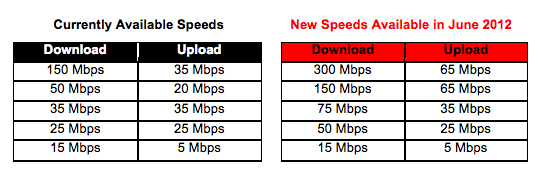
The new speeds will be available in June, and offer a big boost to both upload and download times across most FiOS service levels. The biggest increase percentage-wise comes in the 50Mbps tier, which will triple to 150Mbps, as you can see in this chart provided by Verizon:

The vast majority of existing Verizon customers will be eligible for the upgrades. Unfortunately, Verizon may be stopping any major expansions of its FiOS infrastructure, so if cable and its 100Mbps max speed is your best option today it will likely stay your best option. But for existing customers, Verizon will provide free equipment upgrades (including faster routers) when necessary.

Read more | Comments

Read More:
Faster than your router? Verizon doubles FiOS speeds to 300Mbps

Rise Of The Machines: IP Traffic Set To Quadruple By 2016, Thanks To An Influx Of Devices

terminator-3-poster-0

Every year, Cisco issues its Visual Networking Index (VNI) to forecast the amount of data traffic that will be used worldwide. The latest VNI forecast shows a massive uptick in data usage, from the 369 Exabytes of IP traffic used worldwide in 2011 to approximately 1.3 zettabytes in 2016. According to Cisco, that rapid growth in data traffic will be driven by a proliferation of connected devices, ever-increasing broadband connectivity, and greater adoption of IP video worldwide.

Let’s put that into perspective: According to Cisco, the amount of data in 2016 will be more than all the IP traffic transferred between 1984 and 2012. And the rate of increase Cisco forecasts between 2015 and 2016 alone (330 exabytes) is nearly equal to all the data transferred last year.

So what’s driving that explosion in traffic? For one thing, an increase in the total number of devices that are connected to the Internet. With the proliferation of smart phones, tablets, connected TVs and other smart devices (think broadband-enabled washing machines, refrigerators and the like), folks are no longer just connecting to the Internet via PCs.

In fact, the number of network connections is expected to grow from 10.3 billion in 2011 to 18.9 billion by 2016. That represents nearly 2.5 connections for each person on Earth. More importantly, those devices are chipping away at PC dominance for amount of data transferred. In 2011, PCs accounted for about 94 percent of all consumer Internet traffic. That’s expected to fall to 81 percent by 2016, according to Cisco.

The total number of Internet users is poised to reach 3.4 billion by 2016, with ever-increasing broadband speeds increasing the average data usage among them. Cisco forecasts that the average fixed broadband speed will nearly quadruple, from 9 Mbps in 2011 to 34 Mbps in 2016.

As has been the case for the last several years, the fastest growing traffic type will continue to be IP video, which is expected to make up 86 percent of all data traffic by 2016. Cisco forecasts that the amount of video delivered via IP will reach 3 trillion minutes per month in five years, which amounts to about two years (833 days) worth of video transferred every second. That growth is predicated on the number of IP video viewers doubling over the next five years, from 792 million viewers in 2011 to 1.5 billion by 2016.

The massive growth in video online means that the influence of peer-to-peer file sharing will continue to decrease over time. While P2P files made up 77 percent of global consumer Internet traffic in 2011, that is forecast to fall to about 54 percent by 2016. That doesn’t mean actual file-sharing will decrease — in fact, traffic is expected to grow from 4.6 exabytes per month in 2011 to 10 exabytes in 2016. However, as a percentage of data usage, P2P traffic will grow much slower than video.

Anyway, so here’s the caveat: Cisco has a lot riding on this tremendous growth in Internet data usage because Cisco sells a bunch of networking equipment. So it’s a good thing for Cisco if network operators see this report and decide they need to buy a bunch of new gear.

That said, Cisco’s VNI forecasts have actually been pretty conservative relative to the amount of traffic that eventually showed up. In its initial VNI forecast of 2007, Cisco expected 28.4 exabytes of traffic per month in 2011, and that forecast ended up being low. Actual data transferred was 7 percent higher, or 30.7 exabytes per month.

More:
Rise Of The Machines: IP Traffic Set To Quadruple By 2016, Thanks To An Influx Of Devices

Rise Of The Machines: IP Traffic Is Poised To Quadruple By 2016, Driven By An Influx Of New Devices

terminator-3-poster-0

Every year, Cisco issues its Visual Networking Index (VNI) to forecast the amount of data traffic that will be used worldwide. The latest VNI forecast shows a massive uptick in data usage, from the 369 Exabytes of IP traffic used worldwide in 2011 to approximately 1.3 zettabytes in 2016. According to Cisco, that rapid growth in data traffic will be driven by a proliferation of connected devices, ever-increasing broadband connectivity, and greater adoption of IP video worldwide.

Let’s put that into perspective: According to Cisco, the amount of data in 2016 will be more than all the IP traffic transferred between 1984 and 2012. And the rate of increase Cisco forecasts between 2015 and 2016 alone (330 exabytes) is nearly equal to all the data transferred last year.

So what’s driving that explosion in traffic? For one thing, an increase in the total number of devices that are connected to the Internet. With the proliferation of smart phones, tablets, connected TVs and other smart devices (think broadband-enabled washing machines, refrigerators and the like), folks are no longer just connecting to the Internet via PCs.

In fact, the number of network connections is expected to grow from 10.3 billion in 2011 to 18.9 billion by 2016. That represents nearly 2.5 connections for each person on Earth. More importantly, those devices are chipping away at PC dominance for amount of data transferred. In 2011, PCs accounted for about 94 percent of all consumer Internet traffic. That’s expected to fall to 81 percent by 2016, according to Cisco.

The total number of Internet users is poised to reach 3.4 billion by 2016, with ever-increasing broadband speeds increasing the average data usage among them. Cisco forecasts that the average fixed broadband speed will nearly quadruple, from 9 Mbps in 2011 to 34 Mbps in 2016.

As has been the case for the last several years, the fastest growing traffic type will continue to be IP video, which is expected to make up 86 percent of all data traffic by 2016. Cisco forecasts that the amount of video delivered via IP will reach 3 trillion minutes per month in five years, which amounts to about two years (833 days) worth of video transferred every second. That growth is predicated on the number of IP video viewers doubling over the next five years, from 792 million viewers in 2011 to 1.5 billion by 2016.

The massive growth in video online means that the influence of peer-to-peer file sharing will continue to decrease over time. While P2P files made up 77 percent of global consumer Internet traffic in 2011, that is forecast to fall to about 54 percent by 2016. That doesn’t mean actual file-sharing will decrease — in fact, traffic is expected to grow from 4.6 exabytes per month in 2011 to 10 exabytes in 2016. However, as a percentage of data usage, P2P traffic will grow much slower than video.

Anyway, so here’s the caveat: Cisco has a lot riding on this tremendous growth in Internet data usage because Cisco sells a bunch of networking equipment. So it’s a good thing for Cisco if network operators see this report and decide they need to buy a bunch of new gear.

That said, Cisco’s VNI forecasts have actually been pretty conservative relative to the amount of traffic that eventually showed up. In its initial VNI forecast of 2007, Cisco expected 28.4 exabytes of traffic per month in 2011, and that forecast ended up being low. Actual data transferred was 7 percent higher, or 30.7 exabytes per month.

More here:
Rise Of The Machines: IP Traffic Is Poised To Quadruple By 2016, Driven By An Influx Of New Devices

You Don’t Know Jack shines on Facebook

Names and faces blurred to protect my stupid friends (and that one smart one).
Jellyvision

Many of the most popular “social” games on Facebook are really the opposite of social, when you get down to it. Truly social games—the kind you play together on a couch or on a multi-player server—have you working with friends towards some common objective or working against them in a battle of skill. With many Facebook games, however, the “socializing” portion boils down to visiting a virtual dollhouse to gain a few meaningless points or spamming your friends’ walls to ask them to send you a virtual present. Meanwhile, the game is constantly bugging you to spend real money on some valueless in-game trinket or begging you to share some meaningless achievement with friends that almost assuredly have no interest. Having fun yet?

And then there’s You Don’t Know Jack, which launched on Facebook today as quite possibly the best version yet of Jellyvision’s popular, irreverent trivia series. Instead of exploiting Facebook for annoying viral marketing or addictive and vacant micro-transaction hell, the new game serves as proof that Facebook can be used to add real social competition to strong, proven game design.

If you remember the classic You Don’t Know Jack PC games from the ’90s, or have the recent console-and-PC revamp, then you know what to expect with the Facebook version. There’s still the same sharply written and voice-acted questions, the same mix of high culture and current event topics with pop culture trashiness and sophomoric humor, and the same absurdist send-ups of the staid, Jeopardy-style quiz show format. Many of the questions require you to unpack some truly obscure references just to understand what’s being asked, and trying to keep up with the never-a-dull-moment pacing is a large part of the fun.

Read more | Comments

See original article:
You Don’t Know Jack shines on Facebook