US carriers agree to build stolen phone database, blacklist hot handsets

US carriers agree to build stolen phone database, blacklist hot handsets

What’s the best way to deter a thief? Ruin the spoils, of course. Verizon, AT&T, T-Mobile and Sprint have agreed to a broad outline that will culminate in the creation of a central database for stolen cellphones. The goal? To block lifted units from functioning on US shores. Over the next six months, each firm will build out its own stolen device database for integration into a larger, central database, said a Wall Street Journal source, with regional carriers joining the effort over the following two years.

“We are working toward an industry wide solution to address the complexity of blocking stolen devices from being activated on ours or another network with a new SIM card,” said a T-Mobile spokesperson, “This is not a simple problem to solve.” The quartet of wireless providers hope to imitate the success UK carriers have seen with similar efforts. With any luck, the program will put an end to massive phone-heists and the awkward public relations stunts that imitate them.

US carriers agree to build stolen phone database, blacklist hot handsets originally appeared on Engadget on Mon, 09 Apr 2012 23:29:00 EDT. Please see our terms for use of feeds.

Permalink | sourceWall Street Journal | Email this | Comments

Read more here:
US carriers agree to build stolen phone database, blacklist hot handsets

No human interaction required: AT&T iPhone unlock can be done via iTunes (Updated)


Hate going into AT&T stores and interacting with real humans? Worry not, as unlocking your AT&T iPhone is turning out to be a simpler process than expected for some users. The process can still be performed in-store by AT&T personnel, but it can also be done at home with the help of AT&T chat, Apple, and iTunes.

We reported on Friday that AT&T would begin unlocking iPhones for qualified customers beginning Sunday, April 8. That was yesterday, and readers have begun reporting back with their experiences. As it turns out, all you really need is an active Internet connection and your iPhone’s IMEI number to get started (you can get it from your iPhone under Settings > General > About). After logging into AT&T’s website with your account credentials, you can then bring up AT&T’s Wireless Support Chat where you can request your device be unlocked.

As long as you meet the criteria—your phone isn’t associated with an active-term commitment, you’re out of contract, and your account is in good standing—AT&T will likely approve the request. But then it comes down to Apple, which has to push your unlock code to your e-mail address before you can proceed (this happens within 72 hours, but many users have said it took an hour or less). Once you receive the code, you must perform a backup and restore of the device through iTunes while tethered to a computer.

As with most processes that are user-facing, the unlock process doesn’t always work smoothly. AT&T’s own documentation on the process points to this Apple support document on troubleshooting unlock issues, though there are a number of forum threads dedicated to discussing the nuances of performing the unlock procedure as well. Do you have any extra tips to offer for those who have yet to go through the process?

Update: We have begun hearing that AT&T is making users call to initiate the unlock process instead of using the website chat feature. Still less effort than going into a retail outlet, but human interaction is somewhat required.

Read the comments on this post


Visit link:
No human interaction required: AT&T iPhone unlock can be done via iTunes (Updated)

NC State researcher finds more efficient way to cool devices, looks to cut costs too

NC State researcher finds more efficient way to cool devices, looks to cut costs too

Does your electronic device have you a bit hot under the collar these days? A researcher at NC State has developed a faster and less expensive method for cooling gadgets — especially those that tend to crank the heat up. Dr. Jag Kasichainula, an Associate Professor of Materials Science and Engineering, authored a paper on the research that implements a “heat spreader’ composed of a copper-graphene composite and an indium-graphene interface film to cool devices. Because the two materials exhibit a high thermal conductivity, they allow the device to cool more efficiently while distributing said heat — 25 percent quicker than the pure copper in many pieces of tech. And if that wasn’t enough, the research also details the process for creating the composite using electrochemical deposition. “Copper is expensive, so replacing some of the copper with graphene actually lowers the overall cost.,” Kasichainula notes. If you’re itching to read a full rundown of the findings, the full text can be accessed via the source link below.

NC State researcher finds more efficient way to cool devices, looks to cut costs too originally appeared on Engadget on Mon, 09 Apr 2012 17:42:00 EDT. Please see our terms for use of feeds.

Permalink NC State University | sourceSpringerLink (Full text) | Email this | Comments

Read More:
NC State researcher finds more efficient way to cool devices, looks to cut costs too

NYC Considering Installing Enormous Touchscreens Instead Of Pay Phones

pay

The Big Apple is looking into upgrading its existing pay phones, and a pilot study is underway that replaces everyone’s favorite anachronism with something a little more 21st-century: giant touchscreens. According the NY Post, the city will unveil 250 revamped phone booths next month that have been revamped with 32-inch touchable displays. These access points would be set up for Skype and other video services, email, wi-fi access, and *11 numbers.

It’s ambitious, and depending on the execution could be a big step forward for public communication points. On the other hand, city dwellers are likely to be skeptical of the devices; smartphone owners will find no use for them, and pay phone users won’t know what to make of them. Are they really going to Skype their dealer?

I kid, but it really is kind of a strange proposition. These enormous screens (32 inches is quite large for a phone booth) will of course make whatever one is doing very public, though they helpfully double as ad screens when not in use. And part of the draw of payphones is the simplicity of their operation. You put in your money, you dial your number, and that’s that. Replacing a system that has the familiarity of decades is no simple task, and this huge screen might be overshooting the mark.

On the other hand, it could also be a great method to provide public wi-fi and information about local businesses — like London’s Smart Bins.” Tourists will almost certainly find them useful. And the smaller 22-inch subway ones will be helpful for navigating the city and announcing trains. But who is the average user of pay phones, and will they find this new system useful? Details are scarce now and only seeing and trying the new booths will tell.

The booths are being installed at no cost to the city, and after the pilot program, 36 percent of ad revenue will be handed over to them. And don’t worry, the screens are waterproof and dustproof, and will be cleaned regularly. No word on whether they’re hack-proof, however, though I can guess.

[image: ishane on Flickr]

Continued here:
NYC Considering Installing Enormous Touchscreens Instead Of Pay Phones

Windows-on-iPad service goes legit as Microsoft licensing demands are met


A hosted Windows and Microsoft Office service for the iPad and Android tablets that violated Microsoft’s software licensing rules has apparently gone legitimate, with a new structure that complies with Microsoft guidelines for providing virtual desktops.

As we reported a month ago, the gaming company OnLive has been providing a virtualized instance of Windows 7, complete with Microsoft Office 2010, without properly licensing the service. The service is available to any user for free, with the option for a a $5-per-month paid upgrade, a pricing scheme that had virtual desktop competitors crying foul. The competitors said it’s impossible to offer a properly licensed virtual desktop service at such low prices without taking a loss.

Read the rest of this article...

Read the comments on this post

Read More:
Windows-on-iPad service goes legit as Microsoft licensing demands are met

Checking for Mac Flashback infestation? There’s an app for that


Our post from Friday about how to check your Mac for a Flashback malware infection has been wildly popular so far. And with good reason, too, since a second security firm has now backed up the numbers indicating that more than half a million Macs have been infected. That’s slightly more than 1 percent of all 45 million Macs in the world—still a relatively small number, but a worrisome one for Mac users, as the tally of infected machines continues to grow.

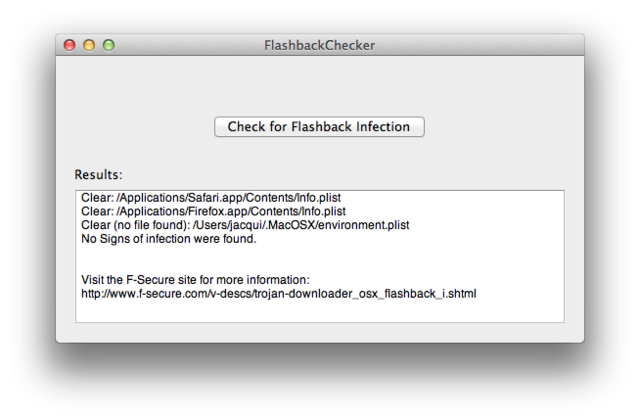
But for those of us who are kept on electronic umbilical cords in order to help our family members with computer questions, asking them to open the Terminal and start typing in foreign commands can be daunting. That’s why Ars reader and programmer Juan Leon put together a quick Flashback checker that can be run on its own to see whether the Mac in question is infected. The download is posted to github and can run on Mac OS X10.5 and above; Leon also posted the source code for those interested in checking it out.

The downloadable app runs the same three Terminal commands that we outlined in our how-to last week—it either says “No signs of infection were found” or spits back further information if necessary. There is also a link to F-Secure’s instructions for removal, but if you have less-technical family members whose Macs are infected, you’ll likely need to step in and help before they have to start mucking with the Terminal.

Update: Leon says he didn’t include removal code in his app because it would require authentication, and we don’t want to start getting into that right now what with a malware infection making the rounds.

Read the comments on this post

See the original post:
Checking for Mac Flashback infestation? There’s an app for that

The Lumia 900 Becomes Amazon’s Best Selling Phone, Topping The RAZR MAXX And Galaxy Nexus

amazon

And we’re off! Even though the Nokia Lumia 900 launched yesterday and was largely unavailable thanks to the Easter Bunny, the phone quickly skyrocketed to the top of Amazon’s best sellers list. The phone hovered around the 5th spot yesterday but jumped to the first and second spot today with the black version preferred over the cyan edition. This puts the Nokia’s large Windows Phone over top of Android’s star players, the Droid RAZR MAXX and Galaxy Nexus.

Part of the instant popularity likely comes from Amazon’s price of $50 with a two-year service plan. That’s $50 less than AT&T’s price and $150 less than the previously most popular phone from Amazon, the Droid RAZR MAXX.

The other factor could be that for some reason AT&T and Nokia launched the phone in the US on Easter Sunday. Brian X. Chen of of the NYT’s Bits blog found most NYC-based AT&T stores and resellers were understandably closed, making the phone rather difficult to find in person. Launching a pivotal phone on a Sunday is strange but launching it on a major national holiday is downright idiotic.

Amazon has long been friendly to Windows Phone. Out of the top 100 best rated cell phones, the top three are slightly older Windows Phones with Verizon’s HTC Trophy occupying the top spot. Judging by the Lumia 900′s current high rating, Nokia’s Windows Phone could soon join the rest of the family on that list as well.

See more here:
The Lumia 900 Becomes Amazon’s Best Selling Phone, Topping The RAZR MAXX And Galaxy Nexus

No human interaction required: AT&T iPhone unlock can be done via iTunes


Hate going into AT&T stores and interacting with real humans? Worry not, as unlocking your AT&T iPhone is turning out to be a simpler process than expected for some users. The process can still be performed in-store by AT&T personnel, but it can also be done at home with the help of AT&T chat, Apple, and iTunes.

We reported on Friday that AT&T would begin unlocking iPhones for qualified customers beginning Sunday, April 8. That was yesterday, and readers have begun reporting back with their experiences. As it turns out, all you really need is an active Internet connection and your iPhone’s IMEI number to get started (you can get it from your iPhone under Settings > General > About). After logging into AT&T’s website with your account credentials, you can then bring up AT&T’s Wireless Support Chat where you can request your device be unlocked.

As long as you meet the criteria—your phone isn’t associated with an active-term commitment, you’re out of contract, and your account is in good standing—AT&T will likely approve the request. But then it comes down to Apple, which has to push your unlock code to your e-mail address before you can proceed (this happens within 72 hours, but many users have said it took an hour or less). Once you receive the code, you must perform a backup and restore of the device through iTunes while tethered to a computer.

As with most processes that are user-facing, the unlock process doesn’t always work smoothly. AT&T’s own documentation on the process points to this Apple support document on troubleshooting unlock issues, though there are a number of forum threads dedicated to discussing the nuances of performing the unlock procedure as well. Do you have any extra tips to offer for those who have yet to go through the process?

Read the comments on this post

More:
No human interaction required: AT&T iPhone unlock can be done via iTunes