Amazon stores 1,700 human genomes in the cloud

Amazon stores 1,700 human genomes in the cloudNot content with speeding up web browsing and hosting federal data, Amazon Web Services are now helping in the fight against disease. Bezos’ crew is donating a chunk of free cloud storage to the 1000 Genomes project, which aims to make it easier for scientists to search for genetic variations linked to diseases. These gene-hunters can also use Amazon’s Elastic Cloud Compute service to analyze data and discover patterns, although those functions won’t come gratis. The DNA sequences of 1,700 mostly anonymous Homo sapiens from around the world have already been logged, but the project needs another 1,000 samples before it meets statistical requirements. Perhaps a free USB gene sequencer and a Prime subscription might entice fresh volunteers?

Amazon stores 1,700 human genomes in the cloud originally appeared on Engadget on Sat, 31 Mar 2012 09:07:00 EDT. Please see our terms for use of feeds.

Permalink | | Email this | Comments

Read More:
Amazon stores 1,700 human genomes in the cloud

JAXA Creates Camera That Can See Radiation

New submitter Ben_R_R writes “The Japan Aerospace Exploration Agency has created a camera that can ‘see’ radioactive contamination by detecting gamma rays emitted by radioactive cesium and other substances. The camera has been tested in the disaster evacuation zone around Fukushima. The image captures levels of radiation in six different colors and overlays the result over an image captured with a wide angle lens.”


Share on Google+

Read more of this story at Slashdot.

Visit site:
JAXA Creates Camera That Can See Radiation

VISA, MasterCard Warn of 'Massive' Breach At Credit Card Processor


concealment writes with news that VISA and MasterCard have been warning banks of an incident at a U.S. card processor that may have compromised as many as 10 million credit card numbers. From the article:
“Neither VISA nor MasterCard have said which U.S.-based processor was the source of the breach. But affected banks are now starting to analyze transaction data on the compromised cards, in hopes of finding a common point of purchase. Sources at two different major financial institutions said the transactions that most of the cards they analyzed seem to have in common are that they were used in parking garages in and around the New York City area.”
According to the Wall Street Journal, the breached company is Global Payments Inc.


Share on Google+

Read more of this story at Slashdot.

Originally posted here:
VISA, MasterCard Warn of 'Massive' Breach At Credit Card Processor

Denmark’s 50 percent wind commitment and a path to fully renewable power


Denmark has committed to generating 50 percent of its electricity from wind sources by the year 2020, by which time the country hopes to have reduced CO2 emissions by 34 percent compared to 1990 levels. This renewed commitment to wind forms the central pillar in an energy bill that commits to obtaining 35 percent of the country’s energy from renewable sources by that time. And Denmark actively aims to lower energy consumption, with 2020 usage 12 percent lower than that of 2006.

“Denmark will once again be the global leader in the transition to green energy,” said Martin Lidegaard, Denmark’s Minister for Climate, Energy and Building. “This will prepare us for a future with increasing prices for oil and coal. Moreover, it will create some of the jobs that we need so desperately, now and in the coming years.”

The bill passed with a near-unanimous 171 votes out of the parliament’s 179 seats.

Read the rest of this article...

Read the comments on this post

Originally posted here:
Denmark’s 50 percent wind commitment and a path to fully renewable power

Ukrainian police shut down forum for malware writers


Ukrainian authorities have shut down a website for creators of viruses and other types of malware, in an effort to shut some of the windows to cybercrime available in the country. The forum, called VX Heavens, let creators of malicious software exchange tips and tricks, and offered tutorials and samples of malicious code for its readers.

VX Heavens posted a note regarding the takedown, saying that despite its many years of operation and “professional quality information on systems security and computer virology,” it could not continue to operate until the authorities close the case. Several sources including Naked Security and The Register say the site primarily catered to old-school hackers and had little to do with the kind of high-stakes financial fraud that Ukrainian authorities have yet to fully tackle. Still, the site supported people who worked on various types of malware (VX is shorthand for “Virus eXchange”), and Ukrainian criminal code forbids creating “malicious programs with an intent to sell or spread them.”

Cybersecurity experts and government entities have long seen Ukraine as a locus for Internet crime, and recent moves by authorities might show that the country is attempting to rectify that reputation. In 2009, the FBI stationed a temporary supervisory special agent to help the government deal with cybercrimes that have cost millions of dollars in damages, not least to US financial companies.

Read the comments on this post

Read More:
Ukrainian police shut down forum for malware writers

Paper: the iPad sketchbook app from the brains of Courier (video)

Image

Go figure — Microsoft’s Courier project lives again… as an exclusive app on Apple’s iPad. FiftyThree, a company that features folks who previously worked on the aforesaid Courier initiative, has just put forth a monumental effort dubbed Paper. The app, which is available for free in the App Store, is a sophisticated sketchbook with a highly unique user interface that’s seemingly designed with the budding artist in mind. Put simply, the company feels that this app is “where ideas begin,” enabling users to capture mental light bulbs as sketches, diagrams, illustrations, notes or drawings before sharing them across the web.

Of course, “free” only gets you in the door; in-app purchases ($2 per brush, for example) keeps the creators in business, but it’s unclear at this point if a paid edition will be offered for those who aren’t much on cherry-picking what they do and don’t want to pony up for. Not surprisingly, the app ships with native support for the new iPad’s Retina display, and while fingers are welcome, a capacitive stylus is recommended. Eager to see more? Peek the video just after the break, and get your download on in the source link.

Continue reading Paper: the iPad sketchbook app from the brains of Courier (video)

Paper: the iPad sketchbook app from the brains of Courier (video) originally appeared on Engadget on Fri, 30 Mar 2012 02:11:00 EDT. Please see our terms for use of feeds.

Permalink BGR | sourceApp Store, FiftyThree | Email this | Comments

Link:
Paper: the iPad sketchbook app from the brains of Courier (video)

Emergency Lockpicks

Afraid of being locked out of the house? Most of us just carry a spare
key in our wallets, but not the members of TOOOL
(The Open Organization of Lockpickers). No sir, they’ve got this: The
Emergency Lock-Pick Card, a laser cut steel card in the size of a credit
card.

Make Magazine has the details: Link

Read More:
Emergency Lockpicks

Google Using ReCAPTCHA To Decode Street Addresses

smolloy writes “Apparently some users of reCAPTCHA have recently begun seeing photographs appear in their CAPTCHA puzzles — photos that look very much like zoomed in house numbers taken from Google Streetview. It appears that Google has decided to put the reCAPTCHA system to help clean up Google streetview images, and ‘according to a Google spokesperson, the system isn’t limited to street addresses, but also involves street names and even traffic signs.’ A large collection of these has appeared on the Blackhatworld website.”


Share on Google+

Read more of this story at Slashdot.

Originally posted here:
Google Using ReCAPTCHA To Decode Street Addresses

Microsoft reveals how your old slate will get all of Windows 8’s charms (video)

Image

Being able to touch, click and press your way around an operating system with a variety of hardware configurations, while not alienating potential upgraders, is no mean feat. That said, Microsoft thinks it might have the solution. By introducing a new mode, a 20 pixel buffer will be designated to working with those edge swipes we’ve heard about. It’ll also go towards preventing accidental hits around the, typically less sensitive, edges of older screens. It does mean that you’ll be losing a little real estate, but perhaps a small trade-off for being able to keep your Windows 7 touchscreen device. Going forward, Microsoft will be working with hardware providers to ensure new gear really shows off the new features of Win 8, but for now, legacy users can look forward to a better experience. Hit the source below for the full rundown.

Continue reading Microsoft reveals how your old slate will get all of Windows 8’s charms (video)

Microsoft reveals how your old slate will get all of Windows 8’s charms (video) originally appeared on Engadget on Thu, 29 Mar 2012 13:31:00 EDT. Please see our terms for use of feeds.

Permalink The Verge | sourceMSDN | Email this | Comments

Visit link:
Microsoft reveals how your old slate will get all of Windows 8’s charms (video)

EyeWire: a videogame to help scientists trace the neurons in a retina


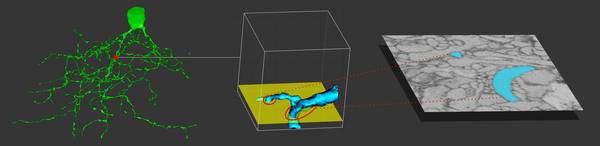
Robert sez, “The gamified EyeWire project, now in open beta, is about using human computation to help trace the neurons in a retina. Tracing the neurons will help nail down the computation that goes on inside the retina leading up to the optic nerve, and lead to better methods of brain mapping. Come and help explore the eye’s jungle!”

Game 1: Reconstructing Neurons
The first step of the challenge is to reconstruct the tree-like shapes of retinal neurons by tracing their branches through the images. You will accomplish this by playing a simple game: helping the computer color a neuron as if the images were a three-dimensional coloring book. The collective efforts of you and other players will result in three-dimensional reconstructions of neurons like this. Playing the game does not require any specialized knowledge of neuroscience — just sharp eyes and practice. If you like, you can stop reading this page, and proceed to detailed instructions for the game here or simply start playing. On the other hand, if you’d like to know more about the scientific plan, read on.

Game 2: Identifying Synapses
Reconstructing neurons involves tracing their branches, which are like the “wires” of the retina. This by itself is not enough for finding connectomes; we also need to identify synapses. This kind of image analysis will be accomplished through another game that will be introduced on this website in the near future. The identification of synapses will involve subtleties, due to limitations of the dataset, as will be discussed in detail later on.

Rules of Connection
Playing either of the above games will produce information that will be valuable for understanding how the retina functions. How exactly will the information be used? To answer this question, we should confront the issue of variability. We expect that every retina will be wired somewhat differently. In that case, would mapping the connections in one retina tell us anything that is applicable to other retinas? We expect that retinal connectomes will obey invariant rules of connection, and it is these rules that really interest researchers. Many of the rules are expected to depend on neuronal cell types, i.e., of the form “Cell type A receives synapses from cell type B.” Some such rules are already known, but the vast majority remain undiscovered.

EyeWire – Help Map the Retinal Connectome

(Thanks, Robert!)


Continue reading here:
EyeWire: a videogame to help scientists trace the neurons in a retina