Box OneCloud learns from Dropbox and iCloud, allows simpler document editing on-the-go (video)

Image

If you’re an avid Box user, what we’re about to say is apt to have a great, positive impact on your life. For everyone else — well, chances are you aren’t about to swap out of whatever cloud ecosystem you’re already entrenched in. In an effort to create a somewhat unique take on iCloud and Dropbox, Box has introduced OneCloud for iOS, a self-proclaimed “enterprise mobile framework to bring together your mobile content and the mission-critical apps designed to work with it.” For now, it’ll support over 30 iOS programs, four of which add “round-trip” integration; in other words, OneCloud will enable you to open a document in QuickOffice, edit it, and save it back without ever having to manually switch programs. To its credit, this is about as close as one could come to being genuinely productive on a device that tends to have productivity a bit lower on the priority rungs, but the video after the break still shows just how clunky the whole operation is. For our money, an ultralight laptop still makes more sense for business professionals on the go, but it’s certainly not a bad backup to have around for making tweaks in a pinch.

Continue reading Box OneCloud learns from Dropbox and iCloud, allows simpler document editing on-the-go (video)

Box OneCloud learns from Dropbox and iCloud, allows simpler document editing on-the-go (video) originally appeared on Engadget on Wed, 28 Mar 2012 10:42:00 EDT. Please see our terms for use of feeds.

Permalink The Verge | sourceBox, App Store | Email this | Comments

Read More:
Box OneCloud learns from Dropbox and iCloud, allows simpler document editing on-the-go (video)

Microsoft’s ‘HTTP Speed + Mobility’ aims to make the web faster, could be the next big ping

Image

We’re generally satisfied with our internet performance, but we wouldn’t say no to a speed boost. A Microsoft blog post reveals plans to enable just that, with the company’s proposed “HTTP Speed + Mobility” approach to HTTP 2.0. Have you thought about what life would be like with a faster internet? MS says Y-E-S! “There is already broad consensus about the need to make web browsing much faster,” the company proclaimed. Juicy. The suggested protocol will, well, focus on achieving greater speed, but Microsoft hasn’t detailed exactly how it will accomplish that, beyond mentioning that it’s based on the Google SPDY protocol, which on its own aims to reduce latency and congestion by prioritizing requests and removing the limit on simultaneous streams over a single TCP connection. For its part, MS says it will be expanding on SPDY to “address the needs of mobile devices and applications,” which we presume would be in Google’s best interests as well. It’s safe to say that Microsoft’s being a bit more forthcoming during its meetings with the Internet Engineering Task Force (IETF) this week — the organization responsible for creating HTTP 2.0 — so perhaps we’ll be hearing more about this fabled faster internet before we turn anew to Q2.

Microsoft’s ‘HTTP Speed + Mobility’ aims to make the web faster, could be the next big ping originally appeared on Engadget on Tue, 27 Mar 2012 17:27:00 EDT. Please see our terms for use of feeds.

Permalink Webmonkey | sourceMicrosoft | Email this | Comments

Read the original:
Microsoft’s ‘HTTP Speed + Mobility’ aims to make the web faster, could be the next big ping

MIT Solar Towers Beat Solar Panels By Up To 20x


An anonymous reader writes “A team of MIT researchers has come up with a very different approach to solar collectors: building cubes and towers that extend solar cells upward in three-dimensional configurations. The results from the structures they’ve tested show power output ranging from double to more than 20 times that of fixed flat panels with the same base area (abstract, full pre-print). The biggest boosts in power were seen in the situations where improvements are most needed: in locations far from the equator, in winter months and on cloudier days.”


Share on Google+

Read more of this story at Slashdot.

Taken from:
MIT Solar Towers Beat Solar Panels By Up To 20x

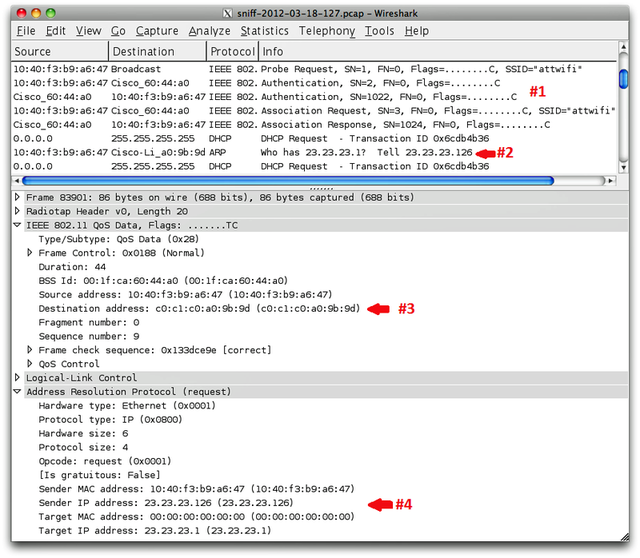
Anatomy of a leak: how iPhones spill the ID of networks they access


An Ars story from earlier this month reported that iPhones expose the unique identifiers of recently accessed wireless routers, which generated no shortage of reader outrage. What possible justification does Apple have for building this leakage capability into its entire line of wireless products when smartphones, laptops, and tablets from competitors don’t? And how is it that Google, Wigle.net, and others get away with publishing the MAC addresses of millions of wireless access devices and their precise geographic location?

Some readers wanted more technical detail about the exposure, which applies to three access points the devices have most recently connected to. Some went as far as to challenge the validity of security researcher Mark Wuergler’s findings. “Until I see the code running or at least a youtube I don’t believe this guy has the goods,” one Ars commenter wrote.

According to penetration tester Robert Graham, the findings are legit.

Read the rest of this article...

Read the comments on this post

View the original here:
Anatomy of a leak: how iPhones spill the ID of networks they access

OnStar’s Family Link tracking package launching in mid-April (updated: hands-on)

Image
Looks like OnStar’s finally ready to go live with the Family Link program it was talking up last summer. The service, which lets family members track vehicles for the low, low price of $3.99 (on top of an existing OnStar package), is set to begin a phased rollout next month. Family Link revolves around two primary, similarly named features: Vehicle Locate and Vehicle Location Alert. The first lets concerned relatives view the vehicle’s location on a map and the second sends an alert at a chosen interval, letting the vehicle’s location be known via text or email. The initial roll out will be open to select subscribers in April, with more invitations hitting in June and a more complete rollout later in the year.

We went hands-on with the service at an OnStar demo in New York City, tracking vehicles in both New Jersey and Detroit. Family Link was able to locate a connected truck in Detroit in a mere five seconds, zeroing in on the vehicle’s precise location at OnStar HQ in Michigan (note: we had tracked another vehicle in New Jersey a few minutes before — that time with a roughly 20 second delay). It’s not designed for constant tracking — you won’t see the car icon moving down the map as you drive — but it appears to be an excellent solution for keeping tabs on your kids as they drive OnStar-equipped vehicles. We also took a look at those handy text vehicle location alerts, that OnStar will push directly to any mobile device or email address at user-selected intervals. Jump past the break to see our hands-on with both Family Link components.

Zach Honig contributed to this report.

Continue reading OnStar’s Family Link tracking package launching in mid-April (updated: hands-on)

OnStar’s Family Link tracking package launching in mid-April (updated: hands-on) originally appeared on Engadget on Tue, 27 Mar 2012 11:01:00 EDT. Please see our terms for use of feeds.

Permalink | | Email this | Comments

Read More:
OnStar’s Family Link tracking package launching in mid-April (updated: hands-on)

What Does Google Get Out of Voice?

itwbennett writes “Assuming Google isn’t offering Voice out of the goodness of their hearts, what’s the payoff? One likely, if cynical, possibility is that Google Voice is ‘just another feeder for their vast database on you,’ writes Kevin Purdy in a recent plog post. Or maybe Google just wants to get better at speech-to-text, and collecting your voice messages is just one big voice mining effort. ‘They already did it with GOOG-411, the free phone directory service that mined voices across the country to launch Google Voice’s current transcription offering,’ says Purdy. For its part, Google says it has no plans to monetize Voice beyond the international calling and number porting fees that it currently charges.”


Share on Google+

Read more of this story at Slashdot.

More:
What Does Google Get Out of Voice?

Don’t bother buying Adobe Photoshop CS6 for your 32-bit Mac

Don't bother buying Photoshop CS6 for your 32-bit Mac

Look, how many bits you choose to process in the privacy of your own home is entirely your business, but don’t expect the latest Photoshop to work on anything less than a 64-bit multi-core Mac running a minimum of Snow Leopard. Adobe’s update brings a compute-heavy ‘Mercury Graphics Engine’ as well as better 3D and video manipulation, with the sacrifice of 32-bit support unless you’re running Windows — although even then certain features will be limited. The message is clear: jump on the upgrade treadmill or sacrifice 65 user-feedback-inspired features and a new crop tool.

Don’t bother buying Adobe Photoshop CS6 for your 32-bit Mac originally appeared on Engadget on Tue, 27 Mar 2012 06:33:00 EDT. Please see our terms for use of feeds.

Permalink CNET | sourceAdobe | Email this | Comments

More here:
Don’t bother buying Adobe Photoshop CS6 for your 32-bit Mac

Drug Turns Immune System Against All Tumor Types


sciencehabit writes, quoting an article in Science: “A single drug can shrink or cure human breast, ovary, colon, bladder, brain, liver, and prostate tumors that have been transplanted into mice, researchers have found. The treatment, an antibody that blocks a ‘do not eat’ signal normally displayed on tumor cells, coaxes the immune system to destroy the cancer cells.”

The abstract and full paper are freely available. It seems fairly promising: “In mice given human bladder cancer tumors, for example, 10 of 10 untreated mice had cancer that spread to their lymph nodes. Only one of 10 mice treated with anti-CD47 had a lymph node with signs of cancer. Moreover, the implanted tumor often got smaller after treatment — colon cancers transplanted into the mice shrank to less than one-third of their original size, on average. And in five mice with breast cancer tumors, anti-CD47 eliminated all signs of the cancer cells, and the animals remained cancer-free 4 months after the treatment stopped.”


Share on Google+

Read more of this story at Slashdot.

See original article:
Drug Turns Immune System Against All Tumor Types

XBMC 11.0 released with new Ubuntu-based live CD and iOS support


The developers behind the XBMC project have released a major new version of the program. XBMC 11, which is codenamed Eden, brings better performance, broader platform support, theming enhancements, and a number of other improvements. The developers have also created a new XBMC live CD environment based on Ubuntu.

XBMC is a highly portable open source media center application with a sophisticated library management system. It indexes the user’s video content and provides an intuitive remote-friendly user interface for browsing and playing media. XBMC and its derivatives, such as Boxee and Plex, are popular among home theater PC users.

Read the rest of this article...

Read the comments on this post

See the article here:
XBMC 11.0 released with new Ubuntu-based live CD and iOS support

Comcast: Xbox 360 On Demand streams won’t count against data caps


It looks as if Comcast is preparing to move from a limited beta test to a wide release for its long-promised Xbox Live streaming video app, with some details appearing on the company’s support pages. Probably the biggest revelation about the service is that streaming Comcast’s On Demand videos through the Xbox 360 will not count towards customers’ 250GB monthly data limit.

Comcast says the Xbox app gets special treatment because the video is “being delivered over our private IP network and not the public Internet.” This gives the service a potentially large advantage over not just other video streaming apps like Netflix and Hulu Plus, but also over Comcast On Demand content streamed through the company’s website and mobile apps, both of which count against the data limits.

Streaming video can eat up limited data rather quickly, though you’d have to stream around 100 hours of Netflix per month before having a chance of bumping up against Comcast’s 250GB limit (assuming you didn’t use the Internet for anything else). Canadian ISP Shaw announced last year that its “Movie Club” service wouldn’t count towards users’ monthly data caps, because it is delivered though existing cable infrastructure.

Elsewhere in its Xbox FAQ, Comcast clarifies that cable subscribers who use a different Internet service provider won’t be able to stream content through their Xbox 360, and that the service requires an Xbox Live Gold subscription as well as at least one cable box elsewhere in the home. The FAQ also notes that Comcast has no plans to follow Verizon’s lead in offering live TV content through the Xbox 360, but offered that the “service will evolve over time.”

Read the comments on this post

See the original article here:
Comcast: Xbox 360 On Demand streams won’t count against data caps