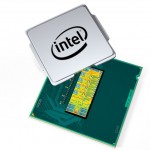
Intel’s next-generation CPUs will arrive slightly later than expected. Intel During the company’s third quarter earnings call yesterday, CEO Brian Krzanich announced that production of Intel’s next-generation Broadwell CPUs would be delayed slightly due to manufacturing issues. CNET reports that a “defect density issue” in the new 14nm manufacturing process was causing lower-than-expected yields, and that Intel’s first round of fixes didn’t improve the yields by the expected amount. Krzanich expressed “confidence” that the issue had been fixed and that it was just a “small blip in the schedule,” and that the CPUs would begin mass production in the first quarter of 2014 rather than the fourth quarter of 2013 as expected. Broadwell’s successor, codenamed Skylake and due in 2015, will apparently not be affected by the delay. Broadwell is a “tick” on Intel’s CPU roadmap, a refined version of the current Haswell architecture built on a new manufacturing process. Intel typically doesn’t introduce a new architecture and a new manufacturing process simultaneously to reduce the likelihood and severity of manufacturing issues like these. Even with the delay, Intel will still be producing 14nm chips while most of its chipmaking competitors (including TSMC and Samsung) are rolling out their 20nm processes. Intel hasn’t gone into much detail on what Broadwell will bring to the table, but smart money says that it will further reduce power usage over Haswell while also increasing CPU and integrated GPU performance incrementally. The company announced at its Intel Developer Forum this year that it was seeing a ” 30 percent power improvement ” over Haswell in early production samples, a number which may stand to improve as the process matures and yields get better. Read 1 remaining paragraphs | Comments
More:
Intel’s next-generation Broadwell CPUs delayed due to yield problems
 For nearly a decade now, TrueCrypt has been one of the trusty tools in a security-minded user’s toolkit. There’s just one problem, though. No one knows who created the software, and worse still, no one has ever conducted a full security audit on it—until now. Since last month, a handful of cryptographers have newly discussed problems and alternatives to the popular application, which lead on Monday to a public call to perform a full security audit on TrueCrypt. As of Tuesday afternoon, that fundraiser reached over $16,000, making a proper check more likely. Much of those funds came from a single $10,000 donation from an Atlanta-based security firm. “We’re now in a place where we have nearly—but not quite enough—to get a serious audit done,” wrote Matthew Green , a well-known cryptography professor at Johns Hopkins University, on Twitter. Read 3 remaining paragraphs | Comments


 Blackberry released a statement on Friday saying that it expects to report an operating loss of almost $1 billion in the coming days. According to The Wall Street Journal , Blackberry overestimated the number of new phones it would sell and is facing an “inventory charge of as much as $960 million and a restructuring charge of $72 million.” Specifically, the company said that it would likely report a loss of $950 million to $995 million for the second quarter. Earlier this week we reported that Blackberry was planning to lay off up to 40 percent of its employees, taking the company from 12, 700 full-time employees to about 7, 620 employees. The WSJ reported today that 4, 500 people will be laid off, lower than earlier estimates. (Is that a silver lining we see?) The Canadian company also reported today that it only sold 3.7 million smartphones in the last quarter, most of which were older phones. To stem the bleeding, Blackberry said that going forward, its “smartphone portfolio will transition from 6 devices to 4; focusing on enterprise and prosumer-centric devices, including 2 high-end devices and 2 entry-level devices.” As Quartz writer Christopher Mims wrote , it’s probably too late for Blackberry to turn around its share of the enterprise market given the latest moves made by Apple and Samsung to get their hardware into the hands of businesspeople. Read 1 remaining paragraphs | Comments

