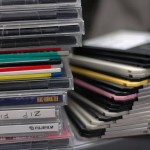
Files on nearly 200 floppy disks belonging to Star Trek creator recovered

(credit: churl ) According to a press release from DriveSavers data recovery, information on nearly 200 floppy disks that belonged to Star Trek creator Gene Roddenberry has been recovered. The information on the disks belongs to Roddenberry’s estate and has not been disclosed to the general public. DriveSavers notes, however, that Roddenberry used the disks to store his work and “to capture story ideas, write scripts and [take] notes.” VentureBeat reports that the disks, containing 160KB of data each, were likely used and written in the ’80s. The circumstances of the information recovery are particularly interesting, however. Several years after the death of Roddenberry, his estate found the 5.25-inch floppy disks. Although the Star Trek creator originally typed his scripts on typewriters, he later moved his writing to two custom-built computers with custom-made operating systems before purchasing more mainstream computers in advance of his death in 1991. Read 2 remaining paragraphs | Comments

Excerpt from:
Files on nearly 200 floppy disks belonging to Star Trek creator recovered

Beating graphene to push supercapacitors closer to batteries

(credit: Oak Ridge National Lab ) Most people think of batteries when they consider energy storage, but capacitors are an alternative in some use cases. Capacitors are used in almost all electronic devices, often to supply temporary power when batteries are being changed to prevent loss of information. In addition to everyday devices, they are also used in more obscure technologies, including certain types of weapons. Understanding the supercapacitor Unlike batteries, capacitors use static electricity to store energy. In their simplest form, they contain two conducting metallic plates with an insulating material (dielectric) placed in between. A typical capacitor charges instantly but usually cannot hold a great deal of charge. Supercapacitors can at least partly overcome this shortcoming. They differ from the typical capacitor in that their “plates” provide significantly larger surface area and are much closer together. The surface area is increased by coating the metal plates with a porous substance. Instead of having a dielectric material between them, the plates of a supercapacitor are soaked in an electrolyte and separated by an extremely thin insulator. Read 11 remaining paragraphs | Comments

Excerpt from:
Beating graphene to push supercapacitors closer to batteries

YouTube mad at T-Mobile for throttling video traffic

(credit: Aurich Lawson) T-Mobile USA’s recently instituted practice of downgrading video quality to 480p in order to reduce data usage now has a prominent critic: YouTube. “Reducing data charges can be good for users, but it doesn’t justify throttling all video services, especially without explicit user consent,” a YouTube spokesperson said, according to a  Wall Street Journal article today . T-Mobile’s “Binge On” program automatically reduces the quality of video while allowing many video services to stream without counting against customers’ high-speed data limits. Video services that cooperate with T-Mobile by meeting the company’s “technical criteria” have their videos exempted from customers’ data caps. Netflix, HBO, Hulu, and many others worked with T-Mobile to get the exemption. Read 10 remaining paragraphs | Comments

Read More:
YouTube mad at T-Mobile for throttling video traffic

OneDrive for Business to get unlimited storage for enterprise customers

Amid the brouhaha surrounding Microsoft’s decision to backtrack on its offer of unlimited OneDrive storage for home Office 365 subscribers , one issue remained unaddressed: what about the related OneDrive for Business storage that’s offered to enterprise Office 365 subscribers? The company has finally laid out its plans for these users, and unlimited storage is back for at least some. Enterprise and government customers on the E3, E4, and E5 plans, education customers, and OneDrive for Business Plan 2 and SharePoint Online Plan 2 customers will all see their storage allocation increased provided that the organization has at least five subscribers. This move to unlimited storage will be phased in two parts. The first part will be an automatic increase from the current 1TB to a new 5TB per user, expected to complete by the end of March 2016. Subsequently, customers will be able to request additional storage. Read 3 remaining paragraphs | Comments

View the original here:
OneDrive for Business to get unlimited storage for enterprise customers

Copyright case over “Happy Birthday” is done, trial canceled

With less than a week to go before a trial, a class-action lawsuit over the copyright status of “Happy Birthday” has been resolved. Details of the settlement, including what kind of uses will be allowed going forward, are not clear. A short order (PDF) filed yesterday by US Chief District Court Judge George King says that all parties have agreed to a settlement, and it vacates a trial which was scheduled to start on December 15. The key turning point came in September , when King ruled that Warner/Chappell’s copyright transfer was invalid because there was no proof it was ever properly transferred from the Hill sisters, who claimed to have written the song. The trial would have addressed damages issues. Also looming was a late copyright claim by Association for Childhood Education International (ACEI), a children’s’ charity affiliated with the Hill sisters. ACEI came forward in November to say that if Warner/Chappell didn’t own the song, it did. The settlement revealed yesterday resolves all claims by the plaintiffs, Warner/Chappell, and ACEI. Read 4 remaining paragraphs | Comments

Read More:
Copyright case over “Happy Birthday” is done, trial canceled

Getting a Linux box corralled into a DDoS botnet is easier than many think

Enlarge (credit: Aurich Lawson and Getty) Getting a Linux server hacked and made part of a botnet is easier than some people may think. As two unrelated blog posts published in the past week demonstrate, running a vulnerable piece of software is often all that’s required. Witness, for example, a critical vulnerability disclosed earlier this year in Elasticsearch , an open source server application for searching large amounts of data. In February, the company that maintains it warned it contained a vulnerability that allowed hackers to execute commands on the server running it. Within a month, a hacking forum catering to Chinese speakers provided all the source code and tutorials needed for people with only moderate technical skills to fully identify and exploit susceptible servers. A post published Tuesday by security firm Recorded Future deconstructs that hacker forum from last March. It showed how to scan search services such as Shodan and ZoomEye to find vulnerable machines. It includes an attack script written in Python that was used to exploit one of them and a separate Perl script used to make the newly compromised machine part of a botnet of other zombie servers. It also included screenshots showing the script being used against the server. The tutorial underscores the growing ease of hacking production servers and the risk of being complacent about patching. Read 5 remaining paragraphs | Comments

See the article here:
Getting a Linux box corralled into a DDoS botnet is easier than many think

“Nemesis” malware hijacks PC’s boot process to gain stealth, persistence

Malware targeting banks, payment card processors, and other financial services has found an effective way to remain largely undetected as it plucks sensitive card data out of computer memory. It hijacks the computer’s boot-up routine in a way that allows highly intrusive code to run even before the Windows operating system loads. The so-called bootkit has been in operation since early this year and is part of “Nemesis,” a suite of malware that includes programs for transferring files, capturing screens logging keystrokes, injecting processes, and carrying out other malicious actions on an infected computer. Its ability to modify the legitimate volume boot record makes it possible for the Nemesis components to load before Windows starts. That makes the malware hard to detect and remove using traditional security approaches. Because the infection lives in such a low-level portion of a hard drive, it can also survive when the operating system is completely reinstalled. “The use of malware that persists outside of the operating system requires a different approach to detection and eradication,” researchers from security firm FireEye’s Mandiant Consulting wrote in a blog post published Monday . “Malware with bootkit functionality can be installed and executed almost completely independent of the Windows operating system. As a result, incident responders will need tools that can access and search raw disks at scale for evidence of bootkits.” Read 5 remaining paragraphs | Comments

Follow this link:
“Nemesis” malware hijacks PC’s boot process to gain stealth, persistence

HGST beats Seagate to market with helium-filled 10TB hard drive

Western Digital’s HGST division has released the world’s first helium-filled 10TB hard drive for everyday use—assuming you have about £600 burning a hole in your pocket, anyway. Meanwhile, despite reiterating that it would have a 10TB drive on the market this year, Seagate hasn’t yet moved past the 8TB mark. The Ultrastar He10 is notable for two reasons: it’s hermetically sealed and filled with helium, which is still a rather novel idea; and it has seven platters crammed into a standard-height 25.4mm (1-inch) hard drive. PMR vs. SMR. With SMR, there’s almost no guard space between tracks, which increases density but can reduce write speed (if you want to rewrite a track in the middle, you may also have to rewrite the adjacent tracks as well). (credit: Seagate) The platters themselves are impressive, too: instead of using shingled magnetic recording (SMR) to boost areal density, these platters use conventional perpendicular magnetic recording (PMR). PMR has been the standard hard drive recording tech since 2005, when it replaced longitudinal recording. The move to PMR has increased the maximum platter density by an order of magnitude—from about 100Gb per square inch to 1000Gb—but now, alas, we’re beginning to hit the limits of PMR. Read 6 remaining paragraphs | Comments

See original article:
HGST beats Seagate to market with helium-filled 10TB hard drive

DirecTV will broadcast live 4K content by “early next year”

(credit: Adam Melancon ) Even if 4K TVs were popular Black Friday and Cyber Monday steals, there continues to be a lack of 4K content to watch on them. DirecTV wants to provide a solution: the company’s SVP of Video and Space Communications Phil Goswitz confirmed at New York’s TranSPORT conference that DirecTV will launch a live 4K broadcasting service sometime in “early 2016.” At the conference, Goswitz explained that the company currently has the ability to transmit up to 50 new UHD channels, and live sports transmissions are already being tested as part of next year’s rollout. DirecTV already has the hardware in place, and according to Goswitz, the company wants to get ahead of cable companies and provide viewers with 4K content they can’t get from their cable companies. “I think the belief that there are technology challenges is a bit of a misinformed myth,” he said. “I think technology throughout the entire ecosystem is ready. But I think content is king; the plane is ready to take off and there is no king on board.” Goswitz went on to say that DirecTV is “moving into working with partners” to create more 4K content. Currently Netflix and YouTube have some 4K video ready to stream, but most companies continue to focus on hardware. Roku and TiVo recently came out with updated set-top boxes ready for 4K streaming, but they still have to work with the finite amount of 4K content available. Read 1 remaining paragraphs | Comments

See more here:
DirecTV will broadcast live 4K content by “early next year”

Thunderbird “a tax” on Firefox development, and Mozilla wants to drop it

Mozilla would like to drop Thunderbird from its list of projects. (credit: Andrew Cunningham) You might know Mozilla primarily for its Firefox browser, but for many years the company has also developed an e-mail client called Thunderbird. The two projects use the same rendering engine and other underlying technology, but Mozilla Executive Chairwoman Mitchell Baker has announced that Mozilla would like to stop supporting Thunderbird, calling its continuing maintenance “a tax” on the more important work of developing Firefox. “Many inside of Mozilla, including an overwhelming majority of our leadership, feel the need to be laser-focused on activities like Firefox that can have an industry-wide impact,” Baker writes. “With all due respect to Thunderbird and the Thunderbird community, we have been clear for years that we do not view Thunderbird as having this sort of potential.” Mozilla doesn’t plan to drop Thunderbird immediately, however—the current maintenance schedule will continue and Thunderbird users can continue to use the product. But the end goal for Mozilla, according to Baker, is to find “the right kind of legal and financial home” for the Thunderbird project, and “[separate] itself from reliance on Mozilla development systems and in some cases, Mozilla technology.” In other words, the company would like to give Thunderbird to people who will take care of it, freeing the Firefox team from having to worry about it. Read 1 remaining paragraphs | Comments

Read More:
Thunderbird “a tax” on Firefox development, and Mozilla wants to drop it