Apple’s iOS 8 supports widgets in Notification Center

It’s been a long time coming, but Apple is finally adding support for widgets to iOS. On stage at its Worldwide Developers Conference , the company’s senior VP of Software Engineering, Craig Federighi, revealed that devs can now start building widgets within the Notification Center on iOS 8 . Unlike Google’s take on widgets with Android , Apple’s equivalent won’t have them living on the home screen of your smartphone or tablet. Instead, iOS widgets will share the drop-down hub with app notifications. Still, there’s a lot of potential here, as it’s going to let those of you with an iOS device have more interactivity and quick access to your favorite applications. iOS 8 will be available this fall. Filed under: Cellphones , Software , Mobile , Apple Comments

More:
Apple’s iOS 8 supports widgets in Notification Center

Apple will let you log into other apps with TouchID

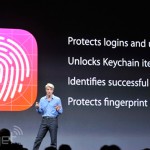
Guess what folks! With iOS 8 Touch ID will finally be useful for something besides unlocking your phone and buying apps. During the big keynote at WWDC 2014 Apple announced the debut of an API for TouchID. That means other apps will be able to use the fingerprint scanner on your iPhone for authentication. Your actual fingerprint data is still stored securely on the hardware, and is never actually exposed to developers. That means you could quickly and easily order a bombproof case for your precious phone just by holding your thumb across the home button and never worry that a bug in the Amazon app could expose your fingerprint to nefarious actors. That should relive some of the pain associated with keeping all your various accounts secure — which, as you’ve been told countless times, should all have unique passwords with a mixture of letters, numbers and special characters. Android users may have in-app access to LastPass , but simply scanning your thumbprint seems that much easier. Filed under: Mobile , Apple Comments

Read the original:
Apple will let you log into other apps with TouchID

Acer shows off ‘Extend’ app allowing you to control your phone from your PC

For every promising concept we see, there’s one that gets scrapped before ever making it to market. That’s what happened with Acer’s ” Extend ” dock, an accessory that would have allowed you to connect your smartphone to a clamshell-style dock with a display, keyboard and a spare battery to recharge your handset. Turns out, lots of people already carry laptops, and don’t necessarily need to transform their phones into a de facto tablet or netbook. What they do need, though, is to move stuff on and off their phone, or pick up on their PC where they left off on their handset. Enter Acer — again. The company has totally re-thought its Extend concept, so that rather than use a dock, you just have to install an app on your Windows PC, allowing you to control the phone. To connect your phone, you can either use a standard USB cable, or connect wirelessly, assuming your PC and phone are on the same network. Once your phone’s homescreen appears in a phone-shaped emulator box, you can do things like drag and drop files on and off the devices. You can also, say, share a YouTube video on your phone to Acer Extend, and have it open in whatever your default browser is. Ditto for other kinds of content, like PDF files and Microsoft Office documents. If you were desperate, you could also potentially use this to bypass your company’s VPN, and access blocked sites over 3G. In the demo we saw here at Computex, the emulator ran consistently smoothly. Acer says this isn’t an accident: It’s aiming for frame rates of at least 24 fps for each device. The catch, though, is that the performance here depends partly on the phone, and apparently not every device is up to snuff. To meet that 24-fps minimum, then, Acer is only releasing the app for some of its phones — namely, flagships and some mid-range devices. So if you happen to be the lucky (?) owner of a Liquid E2 , you’re going to be left out on this one. Zach Honig contributed to this report. Filed under: Cellphones , Software , Mobile , Acer Comments

See the article here:
Acer shows off ‘Extend’ app allowing you to control your phone from your PC

Google is building 180 satellites to spread internet access worldwide

Google’s plans for satellite-based internet access just got a little more concrete. The Wall Street Journal hears that the search firm is planning to build 180 “small, high capacity” satellites (not pictured here) that will go into low orbit and provide internet connections to underserved areas. While details aren’t forthcoming about the machines, there may be more on the way; reportedly, the company could “double” its vehicle count if all goes well. A spokeswoman didn’t confirm or deny the efforts, but did note that having an internet link “significantly improves people’s lives.” The initiative might be very expensive, with tipsters estimating a cost between $1 billion to $3 billion. However, the satellites could eventually pay for themselves. They would really be an extension of the thinking behind the balloons from Project Loon — getting more people online increases the number of people who can see ads, improving Google’s bottom line. Any orbital internet service would most likely serve as a complement to Project Loon, providing data in far-flung, sparsely populated regions while the balloons handle places with greater demand. [Image credit: NASA/GSFC/Landsat, Flickr ] Filed under: Internet , Google Comments Source: Wall Street Journal

See the original article here:
Google is building 180 satellites to spread internet access worldwide

Huawei’s WiFi is ten times faster than yours

Don’t look now, but the speedy WiFi router you just bought may already be old hat. Huawei has tested WiFi based on a future standard (802.11ax) that can hit 10.5Gbps — about 10 times faster than what you typically get out of an 802.11ac connection today. The trick, the company says, is making more efficient use of the airwaves. The new technology is smarter at allocating wireless spectrum, juggling data between multiple antennas and cutting back on interference. Huawei doesn’t even have to switch to ultra-high frequencies to make the magic happen; its approach works on the same 5GHz band that many WiFi networks already use. You’re still a long way from picking up a 10-gigabit router at the local electronics shop. Huawei estimates that super-fast routers might not hit the market until 2018, and that’s assuming that both the 802.11ax standard and matching chipsets are ready. Don’t despair at being stuck with “only” single-gigabit wireless for four years, though. An updated 802.11ac spec (802.11ac-2013) is expected to launch in 2015 with 7Gbps speeds, so you’ll soon have plenty of bandwidth to spare. [Image credit: Getty Images] Filed under: Wireless , Networking Comments Via: ISPreview , Slashdot Source: Huawei

Visit link:
Huawei’s WiFi is ten times faster than yours

Got PlayStation Plus? You’re now getting two games every month

Now that Microsoft is offering free games each month to Xbox One owners with Live Gold subscriptions, Sony is in a tough spot — how does it get you to buy a console and sign up for PlayStation Plus? By giving you more games, that’s what. As of June, Plus members get two games per month for every PlayStation platform they use, whether it’s a PS3 , PS4 or Vita . Availability will also be more consistent as of July. From then on, you’ll see the new Plus titles arrive (and old titles phase out) on the first Tuesday of a given month. The usual gotcha for Plus applies. Unlike Microsoft’s program, which lets you hold on to games even after your subscription lapses, Sony’s service requires that you keep shelling out to continue playing any giveaways. It’s not a perfect deal, then, but it’s hard to object to getting additional games at no extra charge. Filed under: Gaming , Sony Comments Source: PlayStation Blog

Continue reading here:
Got PlayStation Plus? You’re now getting two games every month

This is why Apple bought Beats

Ever since the rumors first broke that Apple wanted to buy Beats for $3 billion, the masses have uttered one universal word: Why? Apple Senior VP Eddy Cue and Beats CEO and co-founder Jimmy Iovine sat down with Recode’s Walt Mossberg and Kara Swisher at the Code Conference to discuss the confirmed news. Not wasting any time, the execs got right into it. According to Cue, there were three overall reasons why the company did it: Talent, great headphones (something many folks will debate) and Beats Music. “It was a no-brainer for us, ” said Cue, outlining the three reasons in more detail. First, Cue says the Beats team is sensational, and will be a perfect fit for Apple; additionally, Dr. Dre is an incredible artist with an incredible ear. Second, Cue notes that Beats has great headphones that do a great job at making music sound good. Finally, he also mentioned that this is the “first music subscription service done right.” To Cue, the magic is in the ability to curate songs and listen to playlists. Developing… Filed under: Cellphones , Wireless , Mobile , Apple Comments

View post:
This is why Apple bought Beats

Backers pledge over $1 million to bring Reading Rainbow to the web

Few things in this world are as moving as a potent mix of nostalgia and passion. Don’t just take my word for it: just look at the more than 22, 000 people who backed LeVar Burton’s vision of bringing Reading Rainbow to the web on Kickstarter. That’s more than a million dollars raised in less than a day, and it’s all to help kids realize that theeeeeey can be anythiiiiiiiiing . This isn’t the first time Reading Rainbow has been brought back to life since it left public airwaves in 2009 — Burton and company launched a Reading Rainbow iPad app nearly two years ago. The real issue here is access. Wanting to teach kids the joy of reading is a noble goal, but affecting change on a wider scale requires more than just hardware designed in California and assembled in China. Now that the team has shattered its funding goal, they’re going to make the books and “video field trips” from the app available on the web, and craft a version specifically meant for classrooms. Alas, Reading Rainbow’s public television days have long since passed, so you’ll actually have to pay a subscription fee for all that fine content. LeVar’s looking out for the disadvantaged too, though — the team plans to make that web version available for free in underprivileged schools. Perhaps the best part of the entire campaign (erm, besides getting kids excited about books)? All the Star Trek backer goodies Burton has on offer. On the off-chance you’ve got $10, 000 burning a hole in your wallet, you’ll be able to don Burton’s straight-from-the-set VISOR from Star Trek: The Next Generation (and without the risk of being called to Engineering to diagnose a warp core hiccup). Comments Source: Kickstarter

Excerpt from:
Backers pledge over $1 million to bring Reading Rainbow to the web

Broadcom’s new chip lets your phone use any wireless charging standard

Wonder why only a handful of mobile devices support wireless charging? It’s partly because the standards are horribly fragmented: companies have to choose between technologies like PMA , Rezence and Qi , and it’s not clear which of those will last. Broadcom might put the issue to bed with its new (and awkwardly titled) BCM59350 chip, though. The hardware lets gadgets charge using any existing wireless technology — you won’t have to hunt for specific charging pads. It can also handle up to 7.5W of power instead of the usual 5W, so your gear might charge faster than it would using old-fashioned wires. Broadcom isn’t naming customers or estimating release dates, but test samples have already gone out to “select” partners. It’s doubtful that the chip will resolve confusion over standards; that’s going to require fewer standards or greater compatibility, either of which could take much longer. However, device makers may now be more comfortable including wireless power in their products. It won’t be shocking if it’s much easier to get cable-free charging in your next phone or smartwatch. Filed under: Cellphones , Peripherals , Mobile Comments Source: Broadcom

Taken from:
Broadcom’s new chip lets your phone use any wireless charging standard

Skype Translator will let you chat in real-time with people in other languages later this year

Tonight at Code Conference, Microsoft CEO Satya Nadella brought his Skype team onto the stage to prove that his company’s got the next big thing. Taglined “the pre-beta of magic, ” the service, called Skype Translator, turns your real-time conversation into a Star Trek -like universal communicator. You can speak to someone who speaks a different language; the service adds the other person’s translations for you in subtitle format at the bottom of the screen. It’s not an immediate translation: You’ll need to wait until the other person is done speaking before the service starts whirring away. We’ve seen similar demonstrations in the past, but the key point here is that the beta service is due out by the end of the year, and will be on all devices that run Skype. The company isn’t committing to specific language support yet, but it likely will be a matter of which ones Skype is able to do the best at launch. Filed under: Cellphones , Mobile , Microsoft Comments

View post:
Skype Translator will let you chat in real-time with people in other languages later this year