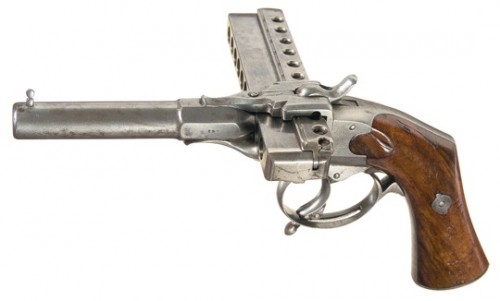
The Harmonica Pistol

Here’s one early solution to the problem of limited magazine capacity. Between 1859 and 1862, a French inventor named Jarre patented several so-called harmonica pistols. As often as the user needed a fresh round, s/he could just push the magazine laterally. The pinfire example pictured above could hold nine 9mm cartridges.

Link via The Firearm Blog (which has pictures of other early high-capacity firearms) | Image: Rock Island Auction Company

Follow this link:
The Harmonica Pistol

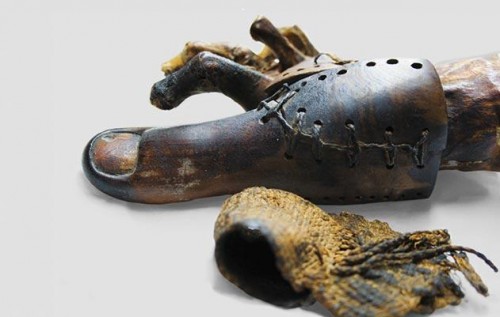
Egyptian Mummy Wore World’s Earliest Known Prosthesis

Archaeologists have recovered a three-jointed set of prosthetic toes attached to a mummy in Egypt. Due to its age, this object is likely the oldest known prosthesis. From a 2007 Live Science article:

Archaeologists speculated the 50- to 60-year-old woman the prosthesis came from might have lost her toe due to complications from diabetes.

The wood and leather prosthesis dates from 1069 to 664 B.C., based on artifacts it was found with in the mummy’s burial chamber. This means it predates what was previously thought of as the earliest known functioning prosthesis, the Roman Capua Leg, a bronze artifact dating from about 300 B.C. The leg was once at the Royal College of Surgeons in London but was destroyed by bombing during World War II.

Link via First Things | Photo: University of Manchester

More:
Egyptian Mummy Wore World’s Earliest Known Prosthesis

US government contractor developing ‘microwave gun,’ Hot Pockets tremble

Ah, the beloved “electronic bomb,” able to disable all technology in its vicinity: variations on the concept go way back, but useful prototypes remain tantalizingly out of reach. Into the breach steps defense contractor BAE Systems, taking a fresh crack with a High-Powered Microwave (HPM) gun intended to disable small boat engines – if successful, the technology may also target ships, UAVs, and missile payloads. The secret-shrouded weapon sounds similar to Boeing’s planned airborne EMP weapon, but lacking the missile delivery systems. BAE seems to be betting big on electromagnetic warfare as a future battlefield tactic, with a manager pitching the sci-fi scene to Aviation Week:
“Unlike lasers, HPM beams don’t need a lot of accuracy. With a fan [of HPM energy] you can target 10-30 small boats. If you can knock out 50-75% of the engines in a swarm, you can then concentrate on the remainder with lasers or kinetic [cannons].”

To develop better defenses against such attacks, the contractor received $150,000 from the Air Force to test-fire microwaves at military computers. No word on whether said defenses involve generous use of tin foil.

US government contractor developing ‘microwave gun,’ Hot Pockets tremble originally appeared on Engadget on Sat, 16 Apr 2011 16:09:00 EDT. Please see our terms for use of feeds.

Permalink

Paper alloy takes shape for biodegradable consumer electronics (write your own origami joke)

So you’re anxiously awaiting your biodegradable car and your biodegradable 3D glasses, waiting for the day when everything you own can return to the loam from which it sprang. But, what about the computer you’re using this very moment? It’s probably made of non-green materials like injection-molded plastic, and slapping some bamboo on it isn’t fooling anyone. Design and engineering firm PEGA comes to your rescue with a new composite material made of recycled paper and polypropylene alloy. Lightweight, durable, and inexpensive to produce, it acts just like typical ABS plastic — and it even comes in the classic soul-killing beige. Maybe this is what Apple’s been waiting for.

Paper alloy takes shape for biodegradable consumer electronics (write your own origami joke) originally appeared on Engadget on Sat, 16 Apr 2011 15:07:00 EDT. Please see our terms for use of feeds.

Permalink
The Mother of All Languages

Do all languages in the world originate from a single “mother tongue“?

By studying phonemes – the consonants, vowels and tonal elements of languages, biologist Quentin D. Atkinson has claimed to discover that human languages originated in Africa:

Dr. Atkinson, an expert at applying mathematical methods to linguistics, has found a simple but striking pattern in some 500 languages spoken throughout the world: A language area uses fewer phonemes the farther that early humans had to travel from Africa to reach it.

Some of the click-using languages of Africa have more than 100 phonemes, whereas Hawaiian, toward the far end of the human migration route out of Africa, has only 13. English has about 45 phonemes.

This pattern of decreasing diversity with distance, similar to the well-established decrease in genetic diversity with distance from Africa, implies that the origin of modern human language is in the region of southwestern Africa, Dr. Atkinson says in an article published on Thursday in the journal Science.

Link

Original post:
The Mother of All Languages

The Mother of All Languages

Do all languages in the world originate from a single “mother tongue“?

By studying phonemes – the consonants, vowels and tonal elements of languages, biologist Quentin D. Atkinson has claimed to discover that human languages originated in Africa:

Dr. Atkinson, an expert at applying mathematical methods to linguistics, has found a simple but striking pattern in some 500 languages spoken throughout the world: A language area uses fewer phonemes the farther that early humans had to travel from Africa to reach it.

Some of the click-using languages of Africa have more than 100 phonemes, whereas Hawaiian, toward the far end of the human migration route out of Africa, has only 13. English has about 45 phonemes.

This pattern of decreasing diversity with distance, similar to the well-established decrease in genetic diversity with distance from Africa, implies that the origin of modern human language is in the region of southwestern Africa, Dr. Atkinson says in an article published on Thursday in the journal Science.

Link

Visit link:
The Mother of All Languages

Intubation bot lets doctors safely shove tubes down unconscious human throats

We’ve seen all manner of medical robots ’round these parts, from bloodbots to surgical cyborgs. And now Dr. Thomas M. Hemmerling from McGill University Health Centre (who also helped develop the McSleepy anesthetic android) has created the world’s first intubation robot. Called the Kepler Intubation System (KIS), it’s a robotic arm with a video laryngoscope that’s controlled via joystick — allowing MDs to get their Dr. Mario on while sliding an endotracheal tube into any passed-out meatbag with minimal fuss and maximum safety. The first procedure using the device on a real, live human was a success, and clinical testing continues. We’re not big on bots shoving anything anywhere (even if it does help us breathe while under the knife), but that’s better than android appendages lobbing grenades our way.

Intubation bot lets doctors safely shove tubes down unconscious human throats originally appeared on Engadget on Sat, 16 Apr 2011 12:47:00 EDT. Please see our terms for use of feeds.

Permalink