Why College Tuition Gets More Expensive Year After Year

Pop quiz: why does college tuition get more and more expensive each year?
Answer: because it can.

Jacob Goldstein of NPR explains the why the “sticker price,”
that is the full price colleges list in their brochures, keep
on increasing
while the “net price” has stayed relatively
constant (the difference is attributable to scholarships and grants):
Link

But what happens if you don’t qualify for those scholarships and grants?
You have to borrow, which explains the crazy growth of student loans that
mirror the growth in college tuition.

Daniel Indiviglio of The Atlantic noted
that student loans have grown 511%
since 1999 – that’s 6 times the
rate of the housing bubble.

Of course the big question is: will the student loan bubble pop just
like the housing bubble? Though there are parallels between the student
loan and housing, Andrew Hacker and Claudia Dreifus of The Atlantic noted
one big difference
:

With mortgage defaults, banks seize and resell the home. But if
a degree can’t be sold, that doesn’t deter the banks. They essentially
wrote the student loan law, in which the fine-print says they aren’t
“dischargable.” So even if you file for bankruptcy, the payments
continue due. Hence these stern word from Barmak Nassirian of the American
Association of College Registrars and Admissions Officers. “You
will be hounded for life,” he warns. “They will garnish your
wages. They will intercept your tax refunds. You become ineligible for
federal employment.” He adds that any professional license can
be revoked and Social Security checks docked when you retire. We can’t
think of any other statute with such sadistic provisions.

See more here:
Why College Tuition Gets More Expensive Year After Year

05-26-12 – Protecting your internet identity: Are you naked online?

Protecting Your Internet Identity: Are You Naked Online?

Two nationally recognized experts, one a cyber expert and the other a legal expert in privacy are available to discuss the greatest risks to your online world today

Ted Claypoole is a Partner of the law firm Womble Carlyle Sandridge and Rice, in Charlotte, North Carolina, and leader of its Privacy and Data Management Team. He co-chairs a Cyberspace Mobile Commerce Subcommittee for the American Bar Association.

Theresa Payton is founder and CEO of Fortalice, LLC, a Charlotte, NC based technology consulting firm. She manages a team of cybercrime fighters who vigilantly watch over governments, businesses and consumers. Her goal is to protect us all from internet predators.

Theresa was the first woman to hold the position of Chief Information Officer at the White House, working under President George W. Bush, and still holds top-level security clearance. Theresa is also co-author of the book “Protecting Your Internet Identity: Are You Naked Online?”

Theresa or Ted are happy to talk to your viewers/listeners/readers about any topic related to cyber crime, internet scams, and protecting your identity online including:

*The biggest mistakes we all make when using social media.

*How to change your online persona when your life changes, like graduating from college or getting married.

*How vulnerable are our cell phones to attack?

*Is government intruding into our personal lives in the name of safety (using subpoenas to get access to our cell records, Facebook accounts, gaming consoles, etc.)?

*Is privacy dead?

ISS Captures SpaceX Dragon Capsule

Today at 9:56AM EDT (13:56 GMT) the robotic arm on the International Space Station successfully captured SpaceX’s Dragon capsule. It’s the first time a commercial craft has connected with the ISS, and the first time a spacecraft made in the U.S. has gone to the station since the retirement of the shuttle. The approach was delayed temporarily as engineers worked out bad sensor readings due to light reflected off the ISS’s Kibo laboratory. “To work around the problem, SpaceX narrowed the field of view for the laser sensor so that it wouldn’t pick up light from the offending reflector. Dragon then returned to the 30-meter checkpoint and moved in for the final approach.” If all goes well today, the capsule will most likely be opened tomorrow. Video of the operation is being broadcast live on NASA TV.


Share on Google+

Read more of this story at Slashdot.

More:
ISS Captures SpaceX Dragon Capsule

PSA: Watch the SpaceX Dragon’s first attempt at docking right now! (video)

Image

SpaceX’s Dragon is rapidly approaching its historic meeting with the International Space Station. It’s due to begin its first docking procedure at 7:30am ET, and NASA is streaming footage from both the ground crew, the ISS and the private craft itself. Once within a safe range, the station will extend its robotic arm and draw the Dragon in to dock — with the hatch being opened tomorrow. We’ve embedded the video after the break so you can watch along at home, popcorn in hand.

[Image credit: SpaceX]

Continue reading PSA: Watch the SpaceX Dragon’s first attempt at docking right now! (video)

PSA: Watch the SpaceX Dragon’s first attempt at docking right now! (video) originally appeared on Engadget on Fri, 25 May 2012 06:01:00 EDT. Please see our terms for use of feeds.

Permalink Mashable | | Email this | Comments

Excerpt from:
PSA: Watch the SpaceX Dragon’s first attempt at docking right now! (video)

Salt Made From Various Types Of Human Tears

Who knew the tears that we cry could be used to make a variety of different salts? The people at We Made This, that’s who!

They’ve bottled our pain, pleasure and culinary sacrifice and created a line of salts suitable for various occasions and functions.

Slap on a label with literary flair and flavor suggestions and you’ve got a product that’s perfect for a store called Huxton Street Monster Supplies, one of the 826 National Stores.

Not familiar with 826 National? Check out this LINK.

(previously on Neatorama-Huxton Street Monster Supplies)

Link –via Super Punch

Continue Reading:
Salt Made From Various Types Of Human Tears

MIT’s needleless injections help you get drugs faster, doesn’t even hurt (video)

Image

Afraid of needles? You may not have to be if a team of MIT scientists get their way. Researchers in the Department of Mechanical Engineering are developing a jet-injection device (similar to this one) that allows professionals to pump you full of meds without poking you with a needle. The key to puncture free pharmaceuticals is pressure — the device uses a Lorenz Force actuator to push medicine out of an opening about the diameter of a mosquito’s proboscis. The nozzle pulls liquids out just as fast and efficiently as it administers them, researchers say, and can even deliver powder-based drugs as if they were a liquid, thanks to a bit of supersonic trickery. This tech could be a boon to healthcare workers who get pricked on the job or patients who get daily insulin shots. Promises of painless inoculations piquing your interest? Hit the video after the break to see how its done.

Continue reading MIT’s needleless injections help you get drugs faster, doesn’t even hurt (video)

MIT’s needleless injections help you get drugs faster, doesn’t even hurt (video) originally appeared on Engadget on Fri, 25 May 2012 04:34:00 EDT. Please see our terms for use of feeds.

Permalink | sourceMIT | Email this | Comments

Visit link:
MIT’s needleless injections help you get drugs faster, doesn’t even hurt (video)

Tape lives! Supercomputer to be built with 380PB of tape storage

Tape storage isn’t what you’d call cutting-edge technology. Most of us make do with disk, and lust after the speeds of SSD. But tape is still useful when massive amounts of storage are needed, in part because of its low cost. It’s being put to good use at an extreme scale in a new supercomputer.

According to Computerworld, the National Center for Supercomputing Applications (NCSA) is building a storage infrastructure consisting of 380 petabytes of magnetic tape capacity and 25 petabytes of disk storage. It’s all to support the petaflop-scale Blue Waters supercomputer. The NCSA says it is building the system to “predict the behavior of complex biological systems, understand how the cosmos evolved after the Big Bang, design new materials at the atomic level, predict the behavior of hurricanes and tornadoes, and simulate complex engineered systems like the power distribution system and airplanes and automobiles.”

The 25PB of disk will act as online storage for data that must be rapidly accessed, while the tape library is categorized as nearline, sort of a compromise between online storage and backup systems. With 380,000 AMD Opteron 6200 Series x82 processors, the cluster will use 40Gbps Ethernet technology with aggregate throughput of up to a terabyte per second, Computerworld reported.

Read more | Comments

Visit link:
Tape lives! Supercomputer to be built with 380PB of tape storage

Navy plans ship-based LTE for close-quarters communication

Navy plans ship-based LTE

Bandwidth is a precious commodity on military vessels. Ships in the US Navy fleet are generating more data, but the pipe it’s getting pumped through isn’t getting any larger. What’s more, with limited connectivity options on the table, the sea-faring military wing is missing out on all the smartphone and app store fun. Rather than turn green with envy, or turning their dress whites is for camouflage cargo pants, the Navy is beefing up its mobile tech arsenal, beginning with the U.S.S. Kearsarge, U.S.S. San Antonio and U.S.S. Whidbey Island. The ships will serve as test beds for a nautical LTE system, with a range of about 25 miles. The 4G network will serve as a localized platform for wirelessly feeding data to sailors, as well as a way for the enlisted to connect to the outside world. On the backend, the Marines are working on a new satellite broadband service that should be able to provide ships with 300 megabits of shared bandwidth. Satellite internet and off-grid LTE might induce yawns in some, but they’re certainly a major part of modernizing our fighting forces. For more info, check out the source link.

Navy plans ship-based LTE for close-quarters communication originally appeared on Engadget on Thu, 24 May 2012 01:33:00 EDT. Please see our terms for use of feeds.

Permalink CNET | sourceWired | Email this | Comments

Read More:
Navy plans ship-based LTE for close-quarters communication

Windows 8 will integrate, include Adobe Flash

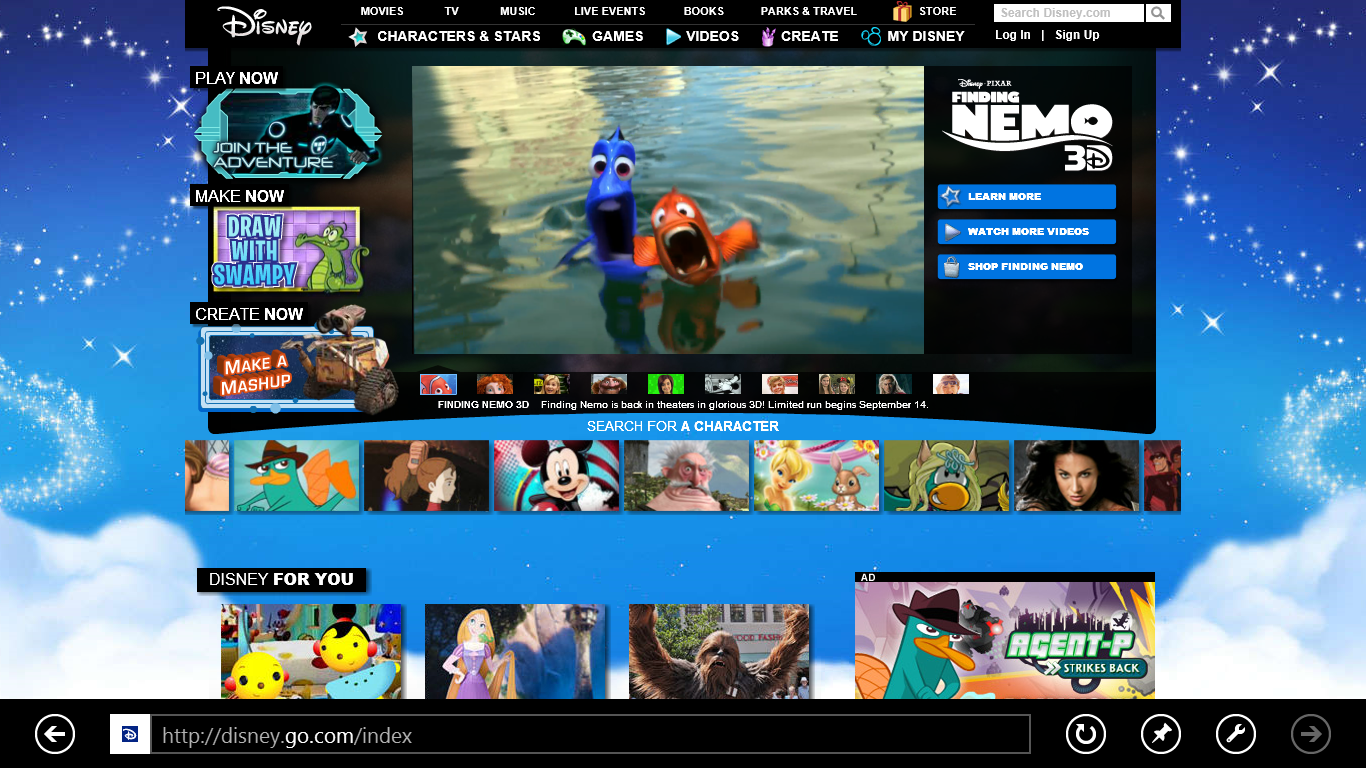
Enlarge / The Flash-driven Disney.com in Metro-style Internet Explorer 10.

Internet Explorer 10 in Windows 8 will include a bundled, integrated version of Adobe Flash, and the Metro-style browser will support the use of Flash on a limited number of sites. This news and corroborating screenshots comes from Within Windows and winunleaked.tk.

In Windows 8, Microsoft’s browser will come in two guises. There will be the traditional desktop browser, with its full support of plug-ins and extensions, and there will be the new Metro-style browser that will be plug-in free. But that’s not quite the whole story. The browser will include an integrated and embedded version of Adobe Flash, and because this will be built-in, it won’t be treated as a plug-in.

The result? Even the Metro-style browser will be able to use Flash.

Read more | Comments

Read the original post:
Windows 8 will integrate, include Adobe Flash