Internet Explorer 10 almost doubles its users thanks to Windows 7 release

Net Marketshare There were no big changes in the browser landscape in March. The top three held their positions, and Windows 8 continues to grow at a sluggish pace. The biggest change? Internet Explorer 10 almost doubled its market share, thanks to the late February release of its Windows 7 version. Net Marketshare Net Marketshare On the desktop, Internet Explorer saw no meaningful change, at 55.83 percent for the month compared to 55.82 last month. Firefox and Chrome both edged up a little, gaining 0.09 and 0.18 points for shares of 20.21 and 16.45 percent respectively. Safari and Opera both nudged downward, losing 0.11 and 0.08 points to drop to 5.31 and 1.74 percent respectively. Net Marketshare Net Marketshare In the mobile space, Safari bounced back, up 6.38 points to 61.79 percent. After a surprising high last month, Opera Mini fell 4.32 points to 8.4 percent. Symbian likewise dropped from an unusual high, losing about two thirds of its February usage. It fell 0.83 points to 0.54 percent. Android Browser was down, losing 0.96 points for a share of 21.86 percent. Read 6 remaining paragraphs | Comments

View article:
Internet Explorer 10 almost doubles its users thanks to Windows 7 release

Bitcoin value triples in a month to all-time high of more than $100

At the end of February, bitcoins hit an all-time trading high of just over $33 . That suddenly looks like chump change, with the value of bitcoins today moving past $100. You can see nearly real-time changes in the value of bitcoins at Coinlab  and track the currency’s steady rise over the past month at Blockchain . We’ve seen the value go up and down today, fluctuating between $99 and $105. The new high is remarkable given that bitcoins were only worth about $13.50 at the beginning of this year. The total value of the nearly 11 million bitcoins in circulation (its ” market cap “) has also soared past $1 billion, after being at less than $50 million one year ago: Read 1 remaining paragraphs | Comments

View post:
Bitcoin value triples in a month to all-time high of more than $100

Frustrated with iCloud, Apple’s developer community speaks up en masse

Aurich Lawson Apple’s iCloud is marketed to us end users as a convenient and centralized way to manage data on all of our Macs and iOS devices: sync contacts and bookmarks, re-download music and apps, back up iOS devices, and sync documents and data for third-party apps as MobileMe did. The last item, syncing of documents and data, is one of the least glossy features of iCloud, but it is one of the most important, and it should be among the most straightforward. Right? Perhaps not. Almost a year after Apple shut down MobileMe for good in favor of iCloud , third-party developers have begun to speak out about the difficulty involved in working with Apple’s cloud service. A piece published at The Verge this week highlights many of those complaints, with quotes coming from well-known developers and anonymous sources alike about the challenges faced by the developer community. From data loss and corruption to unexpected Apple ID use cases, developers have seen it all—but are stymied by the persistence of problems that prevent them from shipping products with working iCloud support. What’s the big problem, exactly? According to Bare Bones Software’s Rich Siegel, there are a number of moving parts to iCloud that all affect how things come out on the other end. Read 10 remaining paragraphs | Comments

See the original post:
Frustrated with iCloud, Apple’s developer community speaks up en masse

Finally, Feds say cops’ access to your e-mail shouldn’t be time-dependent

“When ECPA was enacted, e-mail was primarily a means of communicating information, not storing it,” said Sen. Mike Lee (R-UT) on Tuesday in a statement. Ed Yourdon On Tuesday, the Department of Justice acknowledged for the first time that the notion that e-mail more than 180 days old should require a different legal standard is outdated. This marked shift in legal theory, combined with new House subcommittee hearings and new Senate legislation, might just actually yield real, meaningful reform on the  much-maligned Electronic Communications Privacy Act . It’s an act, by the way, that dates back to 1986. As Ars’ Tim Lee wrote  in November 2012, “ECPA requires a warrant to obtain freshly sent e-mail before it’s been opened by the recipient. But once an e-mail has been opened, or once it has been sitting in the recipient’s e-mail box for 180 days, a lower standard applies. These rules simply don’t line up with the way modern e-mail systems work.” Read 14 remaining paragraphs | Comments

More:
Finally, Feds say cops’ access to your e-mail shouldn’t be time-dependent

Cisco switches to weaker hashing scheme, passwords cracked wide open

Password cracking experts have reversed a secret cryptographic formula recently added to Cisco devices. Ironically, the encryption type 4 algorithm leaves users considerably more susceptible to password cracking than an older alternative, even though the new routine was intended to enhance protections already in place. It turns out that Cisco’s new method for converting passwords into one-way hashes uses a single iteration of the SHA256 function with no cryptographic salt. The revelation came as a shock to many security experts because the technique requires little time and computing resources. As a result, relatively inexpensive computers used by crackers can try a dizzying number of guesses when attempting to guess the corresponding plain-text password. For instance, a system outfitted with two AMD Radeon 6990 graphics cards that run a soon-to-be-released version of the Hashcat password cracking program can cycle through more than 2.8 billion candidate passwords each second. By contrast, the type 5 algorithm the new scheme was intended to replace used 1,000 iterations of the MD5 hash function. The large number of repetitions forces cracking programs to work more slowly and makes the process more costly to attackers. Even more important, the older function added randomly generated cryptographic “salt” to each password, preventing crackers from tackling large numbers of hashes at once. Read 7 remaining paragraphs | Comments

Continue reading here:
Cisco switches to weaker hashing scheme, passwords cracked wide open

Stabilizing the electric grid by keeping generators in sync

Library of Congress When the lights go out, it affects everyone. It’s not only the inconvenience of having the TV shut off unexpectedly—a lot of heavy equipment really dislikes having the power disappear suddenly. For the most part, the power grid is very stable. But sometimes random events and seemingly small operator errors can cascade to create massive power outages. Underlying the stability of a power grid is the need to keep multiple generators operating in a synchronized manner. New research shows (in an annoyingly abstract way) that good network design can take advantage of the tendency for generators to self-synchronize. Counting the beat Depending on where you happen to be in the world, your power outlet supplies alternating current at either 50 or 60 Hz. The precise value doesn’t really matter as long as it stays within a narrow limit. Essentially, this means that the generator supplying the power needs to rotate at a rate producing this frequency. Read 14 remaining paragraphs | Comments

Follow this link:
Stabilizing the electric grid by keeping generators in sync

Dropbox 2.0 brings functional drop-down menus to Mac and Windows

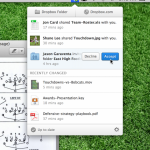
Dropbox for Mac received an update to version 2.0 on Tuesday, bringing with it a number of UI upgrades to the desktop. The most noticeable difference is the revamped and prettified drop-down interface, which now allows you to accept or decline sharing requests right from the menu instead of requiring a trip to the website. The new drop-down interface also displays a list of recently updated files from across your Dropbox-enabled devices, and it gives easy access to both sync settings and the Dropbox website. This is a small but significant change to the way the menu item previously functioned. In the past, there was not much functionality there, but now it’s a place where the user might actually go in order to see which files are being synced. Additionally, the new menu interface makes for much easier file or folder sharing. Select the item in the menu that you want to share and a “Share” button pops up on the right. Clicking it still takes you to the Dropbox website in order to invite other users, but it’s a start in making the desktop software a little more usable. Read 1 remaining paragraphs | Comments

Visit link:
Dropbox 2.0 brings functional drop-down menus to Mac and Windows

EA not altering return policy for furious SimCity buyers

Aurich Lawson / Thinkstock Electronic Arts has indicated that it will not be altering its usual digital refund policy in the wake of SimCity server issues that have led to access problems and scaled-back features for players that are able to log in, days after the game’s North American release. “In general we do not offer refunds on digital download games,” EA tweeted through its official Origin account yesterday, directing people to the company’s  online policy on returns and cancellations . While downloadable games purchased in North America are not be refunded “as a general policy,” EA does offer a “14-day unconditional guarantee” on any physical product sold through the Origin store. European customers, however, may be able to withdraw their downloadable purchase during a 14-day “Cooling Off period” as outlined on EA’s European return policy page . The recent tweet comes after a message posted to EA’s forums by Community Manager Raven on Tuesday, stating that “[i]f you regrettably feel that we let you down, you can of course request a refund for your order… though we’re currently still in the process of resolving this issue.” That message has now been revised to simply say “please review our refund policy here .” Read 6 remaining paragraphs | Comments

See the article here:
EA not altering return policy for furious SimCity buyers

Trigger word: e-mail monitoring gets easy in Office 365, Exchange

I’m in ur email, watching ur filez. Diana Dee Sophia Exchange 2013 and Office 365 include a new feature that can peek into e-mail messages and enclosed documents, then flag them, forward them, or block them entirely based on what it finds. This sort of data loss prevention technology has become increasingly common in corporate mail systems. But its inclusion as a feature in Office 365’s cloud service makes it a lot more accessible to organizations that haven’t had the budget or expertise to monitor the e-mail lives of their employees. As we showed in our review of the new Office server platforms , the data loss prevention feature of Microsoft’s new messaging platforms can detect things like credit card numbers, social security numbers, and other content that has no business travelling by e-mail.  Because of how simple it is to configure rules for Microsoft’s DLP and security features, administrators will also have the power to do other sorts of snooping into what’s coming and going from users’ mailboxes. Unfortunately, depending on the mix of mail servers in your organization—or which Exchange instances you happen to hit in the O365 Azure cloud—they may not work all the time. And they won’t help defeat someone determined to steal data via e-mail. Read 9 remaining paragraphs | Comments

Read More:
Trigger word: e-mail monitoring gets easy in Office 365, Exchange

Five features iOS should steal from Android

Aurich Lawson, Age 5 If you’ve come anywhere near a tech site in the last year or so, you’ve heard it all before. “iOS is getting stale compared to Android! It needs some new ideas!” Whether that’s actually true is up for (heated) debate, but those with an open mind are usually willing to acknowledge that Apple and Google could afford to swap a few ideas when it comes to their mobile OSes. So in a fantasy world where we could bring over some of the better Android features to iOS, which features would those be? Among the Ars staff, we sometimes have spirited “conversations” about what aspects would be the best for each company to photocopy. So, we thought we’d pick a few that might go over well with iOS users. Don’t worry, we have a companion post of features that Android could afford to steal from iOS. The copying can go both ways. No one wants iOS to become Android or vice versa. This is about recognizing how to improve iOS with features that would be useful to people depending on their smartphones for more than the occasional text or phone call. We recognize that Apple tries to keep an eye towards elegant implementation, too. So which features are we talking about? Glad you asked… Read 18 remaining paragraphs | Comments

See the original article here:
Five features iOS should steal from Android