iPad Air 2 vs. the competition: Is it the tablet to beat?

There was a time when it was hard to find someone who would argue with Apple’s claim that the iPad was heavyweight tablet champ. But now Android slates like the Galaxy Tab Pro 10.1 , the Xperia Tablet Z2 and the recently-announced Nexus 9 are making a run at the title. Sure, the iPad still has some great apps, but how does the latest iPad Air compare to the competition under the hood? Check out the tale of the tape below, and decide for yourself if the iPad Air 2 has what it takes to stay on top. iPad Air 2 Nexus 9 Galaxy Tab Pro 10.1 Xperia Tablet Z2 Price $499 and up (WiFi), $629 and up (Cellular) $399 and up $499 $499 or $549 Thickness 6.1mm (0.24 inches) 7.95mm (0.31 inches) 7.37mm (0.29 inches) 6.4mm (0.25 inches) Weight 437g or 444g (0.96 or 0.98 pounds) 425g or 436g (0.93 or 0.96 pounds) 469g (1.03 pounds) 439g (0.96 pounds) OS iOS 8 Android 5.0 Android 4.4 Android 4.4 Display 9.7-inch IPS LCD Retina display 8.9-inch IPS LCD 10.1-inch WQXGA scLCD 10.1 inch TFT LCD Resolution 2, 048 x 1, 536 (264 ppi) 2, 048 x 1, 536 (288 ppi) 2, 560 x 1, 600 (299 ppi) 1, 920 x 1, 200 (224 ppi) Processor 64-bit Apple A8X 64-bit, 2.3 GHz NVIDIA Tegra K1 32-bit Exynos 5 Octa (1.9GHz + 1.3 GHz quad-core) 32-bit, 2.3 GHz Qualcomm Snapdragon 801 (MSM8974AB quad-core) Memory NA 2GB 2GB 3GB Storage 16 / 64 / 128GB 16 / 32GB 16GB 16 / 32GB Ports Lightning micro USB 2.0 microSD, HDMI microSD, MHL 3.0 Front camera 1.2MP FaceTime, f/2.2 1.6MP, f/2.4 2MP 2.2MP, 1080p Rear camera 8MP iSight, f/2.4, 1.5µm pixel size, 1080p 8MP, f/2.4 8MP 8.1MP Cellular radio Optional GSM/EDGE CDMA UMTS/HSPA/ HSPA+/DC‑HSDPA LTE Optional GSM/CDMA/ HSPA/LTE Optional LTE Optional HSPA+/GPRS/ EDGE/LTE WiFi Dual-band 802.11 a/b/g/n/ac Dual band 802.11 a/c/g/n/ac Dual-band 802.11 a/b/g/n/ac Dual-band 802.11 a/b/g/n/ac Bluetooth v4.0 v4.1 v4.0 LE v4.0 Accelerometer Yes Yes Yes Yes Gyroscope Yes Yes Yes Yes Battery 10 hours 6, 700mAh 8, 220mAh Li-ion 6, 000mAh Li-ion Filed under: Tablets , Apple Comments

Read More:
iPad Air 2 vs. the competition: Is it the tablet to beat?

Facebook ‘Safety Check’ lets friends know you’re OK after a major disaster

Despite the frivolous nature of most social media interactions, Facebook’s latest new feature is intended for use only in serious situations. Unveiled today in Japan, Safety Check notifications are pushed to users when a natural disaster hits and area you have listed as your location, where you’ve checked in on Nearby Friends , or where you recently logged in from. Tech companies like Google and Facebook have worked to connect people after significant disasters in the past, and Facebook says the project is an extension of the Disaster Message Board its Japanese engineers rolled out after the 2011 earthquake and tsunami there. Safety Check is rolling out globally on Android, iOS, feature phones and the desktop — there’s a demo video (embedded after the break) to explain how it all works. A simple I’m safe / I’m not in the area toggle can push an update (and comments, if you enter them) that’s visible only to people on your friends list, intended to quickly give some piece of mind when they notice a USGS report for your zipcode — or worse. If you simply have friends who are in the area of a natural disaster, there’s a notification when they check-in as safe that can take you to a list of their updates. A useful tool, or just a cagey way to try to take some of the creepiness out of its apps’ location tracking features? We’re figuring the latter impression doesn’t hurt from Facebook’s perspective, but in this connected age it’s also a reflection of how people really use the net in trying times. Additionally, it can take some pressure off of overloaded infrastructure with everyone trying to call affected areas after disasters hit, and of course, save you from a post-tragedy chewing out for failure to let people know you’re fine. C’mon, just call your parents / friends / casual acquaintances once in a while, it’s not that hard. Filed under: Internet , Mobile , Facebook Comments Source: Facebook

More here:
Facebook ‘Safety Check’ lets friends know you’re OK after a major disaster

NASA’s Messenger captures first photos of ice on Mercury

It’s easy to assume, that finding ice on the first rock from the sun, would be like finding a snowflake in a furnace (it can reach 800 degrees Fahrenheit after all). But, you’d be wrong. And NASA’s long had radar and photographic proof (just nothing in the visual range) that water ice did exist on the planet. Now, we have the first optical evidence — after pictures snapped by the NASA’s Messenger spacecraft managed to snag enough sunlight inside the 70 mile-wide, permanently-shadowed Prokofiev crater on the north pole of the planet for a photo. The images might not look like much to the untrained eye (though still wonderfully otherworldly), but they provide those that know with enough information to suggest that the ice deposits are relatively recent (and not from when the planet was being formed). No doubt, more revelations will come as the images get scrutinized fruther, and Messenger continues the good work . Filed under: Science Comments Via: Space Source: Geology Journal

Taken from:
NASA’s Messenger captures first photos of ice on Mercury

Apple leaks iPad Air 2, iPad mini 3 ahead of official announce

Well, this is a bit unlike Apple — the company appears to have accidentally spilled the beans about the iPad Air 2 and iPad mini 3, which are expected to be announced tomorrow . Representations of both devices showed up in a screenshot of the iPad User Guide for iOS 8.1, which we’re also expecting new details about tomorrow. We can’t tell much from the image, but it does confirm that Cupertino’s tablets will be getting Touch ID . A later screenshot also details burst shooting mode, which will be coming to the iPad Air 2, but not the mini 3, according to the document. However, downloading the book didn’t reveal any additional info. In fact, there’s no trace of the content leaked via the preview screenshots at all. While the leak may seem like a careless mistake, the more cynical out there will note that this happened just moments after Google announced its latest Nexus devices. It might be a coincidence, or the notoriously media savvy company might be trying to push the competition out of the news cycle as fast as possible. [Image via 9to5Mac ] Filed under: Tablets , Mobile , Apple Comments Via: 9to5Mac Source: iTunes

Read this article:
Apple leaks iPad Air 2, iPad mini 3 ahead of official announce

Broadcasters want phones to come with a ‘hybrid’ radio format

You may think that radio is dying in an era when on-demand music streaming is nearly ubiquitous, but some of the world’s biggest broadcasters (unsurprisingly) disagree. The BBC, Clear Channel, HD Radio’s Ibiquity and a handful of others are researching a “hybrid” radio format that would give smartphone users the advantages of reliable, low-intensity digital or FM radio with the interactivity and “enhancements” of internet streaming. In theory, this would keep your costs down and your battery life up without giving up the creature comforts of modern technology. Supposedly, there’s a lot of demand for this — a BBC-commissioned study claims that the “majority” of smartphone owners want radio of some kind, and two thirds of them liked the idea of hybrid radio. Whether or not it pans out as hoped is another matter, though. There’s no definite timetable for when this hybrid format would be ready, and getting manufacturers to cooperate may be tough. Apple , Microsoft and others frequently have a vested interest in promoting internet-only radio services, and access to DAB or FM isn’t usually a major factor in phone purchases. Even so, don’t be surprised if your next phone puts a bigger emphasis on broadcasts. Filed under: Cellphones , Internet , Mobile Comments Source: BBC Media Centre

Visit link:
Broadcasters want phones to come with a ‘hybrid’ radio format

Google Glass can now display all your phone notifications

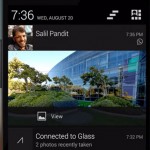
Google Glass Explorers will soon be able to see all their phone’s notifications (not just the ones from compatible apps) right on the eyewear’s screen. It’s the same feature that comes with Android Wear , which allows the platform to forward each and every notification to smartwatches, so users won’t have to take out their phones unless it’s for something truly important. Explorers have to wait for the latest MyGlass software to arrive sometime later today to be able to glimpse each ping with just a flick of the eye. Once they’ve installed the update, they’ll need to activate Notification Sync in their phone’s settings. There are a few pages to go through during the process, but nothing overly complicated, so long as they follow the video after the break. Filed under: Wearables , Mobile , Google Comments Source: Google Glass

See the original post:
Google Glass can now display all your phone notifications

Samsung’s experimental 5G network delivers 150MB per second at freeway speeds

5G isn’t quite a thing yet. Industrial standards and the finer details are yet to be completely cemented , but that’s not stopping companies with a thumb in the carrier network pie trying to show us some crazy ( but awesome ) ideal of future wireless… ness. Samsung’s next in line, and it’s been able to crank its 5G network download speeds to 940MB while stationary, which is bananas. However, the company then decided to take the testing outdoors, to the racetrack, and apparently notched download speeds of around 150MB per second, while racing around at 100KPH (roughly 62MPH). Samsung says these impressive figures are due to the high-frequency 28GHz signal used. Previously, this meant a short range, but the company says it’s got around that weakness with “Hybrid Adaptive Array Technology” that boosts the range of the signal. And if that collaboration between Korea and Europe still stands, these ridiculous on-the-go speeds could well make their way outside Asia. Please. Please. Filed under: Wireless , Networking , Samsung Comments

View original post here:
Samsung’s experimental 5G network delivers 150MB per second at freeway speeds

AT&T’s GigaPower fiber set to hit Chicago and Atlanta

If you’ve tried burning incense or seeing an internet shaman but Google Fiber still won’t come to your city, you may still be able to get gigabit speeds — from AT&T. The carrier’s U-verse GigaFiber service will finally venture away from Texas and hit Chicago and Atlanta . That marks 14 cities (including Cupertino and Miami) set to receive the fiber lines so far, on top of current locations Dallas, Fort Worth and Austin. On top of that, AT&T has announced 100 candidate markets — including Mountain View — which may have tweaked, well, Mountain View’s nose a bit. Google’s Fiber is still stuck in Austin, Provo and Kansas City, with 34 other candidate cites still waiting. There’s no news of pricing or availability in the two new GigaFiber markets yet, but pricing in Texas is $99 a month, or $70 if you don’t mind targeted ads. [Image credit: Getty Images] Filed under: Internet , AT&T Comments Source: AT&T (1) , (2)

Follow this link:
AT&T’s GigaPower fiber set to hit Chicago and Atlanta

Nielsen admits a software glitch has been screwing up recent TV ratings

Fist the bad news: No, Firefly isn’t coming back. But, if you’ve ever felt like the ratings system didn’t accurately represent the popularity of your favorite show, this might be something to take note of. Today The Nielsen Company issued a statement admitting it found a “technical error that impacts national network television ratings over several months.” The problem apparently didn’t apply to cable networks or local TV, but given their impact on billions of dollars in advertising, even a small problem can significant. According to reports ABC benefited from the glitch, which became more noticeable as the fall premieres rolled out. For several days in a row, the network’s TV shows always gained ratings between early morning quick estimates, and later more complete reports. The error started on March 2nd, but Nielsen says it will reprocess data going back to August 18th, when the first network fall premiere aired — maybe next time they’ll stick to just counting Tweets . Filed under: Home Entertainment , HD Comments Source: Nielsen

See the original post:
Nielsen admits a software glitch has been screwing up recent TV ratings

Netflix for Linux is here, but only if you use Ubuntu and Chrome

We told you it was coming , and now it’s here! Canonical announced today that it’s popular Linux distro Ubuntu now supports Netflix playback through Chrome. If you’re running a fully updated install of Ubuntu 12.04 LTS, 14.04 LTS or later you can simply go install Chrome 37 right now and immediately start enjoying Netflix. (Provided you’re a paying subscriber, of course.) There’s no word on if or when support might be coming to other browsers, so sorry Firefox fans. That being said, Mozilla is one of the main contributors to Network Security Services, which is key to Netflix support on Linux, so it probably won’t be too far behind. Filed under: Internet , Software , HD , Google Comments Source: Ubuntu Insights

Follow this link:
Netflix for Linux is here, but only if you use Ubuntu and Chrome