Windows 8 more widely used than OS X, IE still on the rise

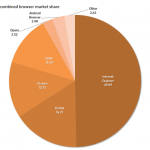
Net Market Share In July, Windows 8 passed Windows Vista in market share. In August, it passed every single version of Apple’s OS X, combined. Internet Explorer 10 grew sharply, too, with almost one in five Internet users now on the latest version of Microsoft’s browser. Net Market Share Windows 8 made substantial gains in August, picking up 2.01 points of share. This is 37 percent growth on July’s figure. Windows XP also fell substantially, losing 3.53 points. With luck, this might mean that Windows XP is finally on the way out. It has less than a year until it stops receiving free security patches from Microsoft; once this happens, it will essentially be in a state of permanent zero day exploits. Even this level of decline isn’t enough to see the operating system eradicated in time for its end of life. That’s good news for spammers, who’ll have plenty of zombie machines to recruit into botnets, but bad news for everyone else. Net Market Share Net Market Share Among desktop browsers, Internet Explorer was up 0.99 points, Firefox was up 0.59 points, and Safari was up 0.17 points. Chrome, however, was down significantly, losing 1.76 points. This means that yet again Chrome has closed in on Firefox, almost passing it, only to fall back. Read 5 remaining paragraphs | Comments        

Originally posted here:
Windows 8 more widely used than OS X, IE still on the rise

Feds plow $10 billion into “groundbreaking” crypto-cracking program

Wikimedia The federal government is pouring almost $11 billion per year into a 35, 000-employee program dedicated to “groundbreaking” methods to decode encrypted messages such as e-mails, according to an intelligence black budget published by The Washington Post. The 17-page document, leaked to the paper by former National Security Agency (NSA) contractor Edward Snowden, gives an unprecedented breakdown of the massive amount of tax-payer dollars—which reached $52 billion in fiscal 2013—that the government pours into surveillance and other intelligence-gathering programs. It also details the changing priorities of the government’s most elite spy agencies. Not surprisingly, in a world that’s increasingly driven by networks and electronics, they are spending less on the collection of some hard-copy media and satellite operations while increasing resources for sophisticated signals intelligence, a field of electronic spying feds frequently refer to as “SIGINT.” “We are bolstering our support for clandestine SIGINT capabilities to collect against high priority targets, including foreign leadership targets, ” James Clapper, director of national intelligence, wrote in a summary published by the WaPo . “Also, we are investing in groundbreaking cryptanalytic capabilities to defeat adversarial cryptography and exploit Internet traffic.” Read 3 remaining paragraphs | Comments        

Read More:
Feds plow $10 billion into “groundbreaking” crypto-cracking program

In historic vote, New Zealand bans software patents

A major new patent bill, passed in a 117-4 vote by New Zealand’s Parliament after five years of debate, has banned software patents. The relevant clause of the patent  bill actually states that a computer program is “not an invention.” Some have suggested that was a way to get around the wording of the TRIPS intellectual property treaty which requires patents to be “available for any inventions, whether products or processes, in all fields of technology.” Processes will still be patentable if the computer program is merely a way of implementing a patentable process. But patent claims that cover computer programs “as such” will not be allowed. Read 5 remaining paragraphs | Comments        

See the original post:
In historic vote, New Zealand bans software patents

Amazon and Microsoft, beware—VMware cloud is more ambitious than we thought

vCloud Hybrid Service integrates with on-premises VMware deployments. VMware VMware today announced that vCloud Hybrid Service , its first public infrastructure-as-a-service (IaaS) cloud, will become generally available in September. That’s no surprise, as we already knew it was slated to go live this quarter. What is surprising is just how extensive the cloud will be. When first announced, vCloud Hybrid Service was described as infrastructure-as-a-service that integrates directly with VMware environments. Customers running lots of applications in-house on VMware infrastructure can use the cloud to expand their capacity without buying new hardware and manage both their on-premises and off-premises deployments as one. That’s still the core of vCloud Hybrid Service—but in addition to the more traditional infrastructure-as-a-service, VMware will also have a desktops-as-a-service offering, letting businesses deploy virtual desktops to employees without needing any new hardware in their own data centers. There will also be disaster recovery-as-a-service, letting customers automatically replicate applications and data to vCloud Hybrid Service instead of their own data centers. Finally, support for the open source distribution of Cloud Foundry and Pivotal’s deployment of Cloud Foundry  will let customers run a platform-as-a-service (PaaS) in vCloud Hybrid Service. Unlike IaaS, PaaS tends to be optimized for building and hosting applications without having to manage operating systems and virtual computing infrastructure. Read 8 remaining paragraphs | Comments        

Original post:
Amazon and Microsoft, beware—VMware cloud is more ambitious than we thought

After “technical glitch” halts Nasdaq for hours, trading finally resumes

Trading was halted on the Nasdaq stock market for a few hours on Thursday after what was described as a “technical glitch.” No other detailed technical information has been released other than that the snafu involved a problem with the “quote dissemination system” and a “data feed issue.” The exchange , on which many major tech stocks are traded, re-opened  later in the afternoon. As the modern stock market operates almost entirely by computer and happens with crazy-fast speed, this problem is troubling, particularly when there have been a few major technological problems in recent years. Read 4 remaining paragraphs | Comments        

Visit link:
After “technical glitch” halts Nasdaq for hours, trading finally resumes

FBI director calls on private sector to man up, help with cyber threat

Robert Mueller, FBI Director, says Keith and John are his BFFs. FBI FBI Director Robert S. Mueller, CIA Director John Brennan, and National Security Agency (NSA) Director Gen. Keith Alexander shared the stage on August 8 at the International Conference on Cyber Security  (ICCS), an event cohosted by the FBI and Fordham University in New York. The three spoke on a panel about the future of cybersecurity. Mueller spoke about the Lulzec case and how the FBI caught Hector “Sabu” Monsegur , along with how it will deal with increasingly sophisticated hackers and cybercriminals. Key to the bureau’s success, he said, was “focusing on the individuals behind the keyboards”—with the help of the NSA, CIA, and private industry. “I do believe that in the future, the cyber threat will equal or even eclipse the terrorist threat, ” Mueller said in his opening remarks. “And just as partnerships have enabled us to address the terrorist threat, partnerships will enable us to address the cyber threat. But the array of partners critical to defeating the cyber threat is different. In this case, the private sector is the essential partner.” Getting into hackers’ heads “In the years to come, we will encounter new intrusion methods, hacking techniques, and other unpleasant surprises, ” Mueller said in his prepared remarks for the panel. “And in response, our nation will continue to develop—as we must—the technical skills and tools to prevent these intrusions and limit their damage.” Read 8 remaining paragraphs | Comments        

Read this article:
FBI director calls on private sector to man up, help with cyber threat

Update: Researchers say Tor-targeted malware phoned home to NSA

A search reveals the address used in an attack on Tor users’ privacy referenced an IP address belonging to the NSA, routed through SAIC. Malware planted on the servers of Freedom Hosting — the “hidden service” hosting provider on the Tor anonymized network brought down late last week—may have de-anonymized visitors to the sites running on that service. This issue could send identifying information about site visitors to an Internet Protocol address that was hard-coded into the script the malware injected into browsers. And it appears the IP address in question belongs to the National Security Agency (NSA). This revelation comes from analysis done collaboratively by Baneki Privacy Labs , a collective of Internet security researchers, and VPN provider Cryptocloud . When the IP address was uncovered in the JavaScript exploit —which specifically targets Firefox Long-Term Support version 17, the version included in Tor Browser Bundle—a source at Baneki told Ars that he and others reached out to the malware and security community to help identify the source. The exploit attacked a vulnerability in the Windows version of the Firefox Extended Support Release  17 browser —the one used previously in the Tor Project’s Tor Browser Bundle (TBB).  That vulnerability had been patched by Mozilla in June, and the updated browser is now part of TBB. But the TBB configuration of Firefox doesn’t include automatic security updates, so users of the bundle would not have been protected if they had not recently upgraded. Read 6 remaining paragraphs | Comments        

View post:
Update: Researchers say Tor-targeted malware phoned home to NSA

Indian IT firm accused of discrimination against “stupid Americans”

Sean MacEntee Infosys, an Indian IT software and services company with offices throughout the world, has been accused of discriminating against American job applicants. One Infosys employee who raised concerns about the company’s hiring practices was repeatedly called a “stupid American, ” the lawsuit states. Infosys has about 15, 000 employees in the US “and approximately 90 percent of these employees are of South Asian descent (including individuals of Indian, Nepalese, and Bangladeshi descent), ” the lawsuit states . Infosys allegedly achieved this ratio “by directly discriminating against individuals who are not of South Asian decent in hiring, by abusing the H-1B visa process to bring workers of South Asian descent into the country rather than hiring qualified individuals already in the United States, and by abusing the B-1 visa system to bring workers of South Asian descent into the United States to perform work not allowed by their visa status rather than hiring individuals already in the United States to perform the work.” Infosys “used B-1 visa holders because they could be paid considerably lower wages than other workers including American-born workers, ” the lawsuit states. Read 11 remaining paragraphs | Comments        

View the original here:
Indian IT firm accused of discrimination against “stupid Americans”

Simple technique puts graphene capacitors on par with lead-acid battery

If the bottom is a layer of graphene in a super capacitor, then storage can be increased by making the solution above it as low-volume as possible. Lawrence Livermore National Lab Individual pieces of graphene have some pretty amazing properties, but finding a way to produce bulk materials that make good use of those properties has been rather challenging. Now, researchers have figured out a way to make graphene-based electrodes in bulk through a process so simple that it can be adapted to the manufacturing techniques that we currently use to make paper. And the resulting capacitors, at least in these test cases, had storage capacities that approached those of lead-acid batteries. Those of us who have taken basic physics tend to think of capacitors as two parallel, charge-holding plates, since that’s how they’re taught. But electrochemical capacitors perform a similar trick on a much smaller scale, by having the charges held by individual ions that absorb to an electrode. To boost capacity, the simplest thing to do is to increase the surface area for the ions to interact with. That’s why graphene seems so appealing; since it’s only a single atom thick, it should be possible to stick a tremendous amount of surface into a relatively small volume. The problem, however, has been getting the ions into the graphene itself in order for them to interact. Once the graphene is prepared, lots of factors like pore size and inter-sheet spacing come into play, since these control how quickly ions can get into the graphene. A team at Australia’s Monash University came up with an easy solution to this: put the ions in place during the manufacturing process. Read 4 remaining paragraphs | Comments        

Continued here:
Simple technique puts graphene capacitors on par with lead-acid battery

University of California to allow open access to new academic papers

The University of California—an enormous institution that encompasses 10 campuses and over 8, 000 faculty members— introduced an Open Access Policy late last week. This policy grants the UC a license to its faculty’s work by default, and requires them to provide the UC with copy of their peer-reviewed papers on the paper’s publication date. The UC then posts the paper online to eScholarship , its open access publishing site, where the paper will be available to anyone, free of charge. Making the open access license automatic for its faculty leverages the power of the institution—which publishes over 40, 000 scholarly papers a year—against the power of publishers who would otherwise lock content behind a paywall. “It is much harder for individuals to negotiate these rights on an individual basis than to assert them collectively, ” writes the UC. “By making a blanket policy, individual faculty benefit from membership in the policy-making group, without suffering negative consequences. Faculty retain both the individual right to determine the fate of their work, and the benefit of making a collective commitment to open access.” Faculty members will be allowed to opt out of the scheme if necessary—if they have a prior contract with a journal, for example. Academic papers published in traditional journals before the enactment of this policy will not be made available on eScholarship at this time. Read 3 remaining paragraphs | Comments        

View article:
University of California to allow open access to new academic papers