Tesla Model S Floats Well Enough To Act As a Boat, According To Elon Musk

It appears a Tesla Model S car can float and effectively drive on water. Tesla CEO Elon Musk tweeted a video of a Model S car which was able to float well through a flooded tunnel in Kazakhstan. Musk also noted that the company “definitely” doesn’t recommend trying this — but still vouched for the availability of this feature. The Guardian reports: The car appears to power through the water using the thrust of the wheels turning in the water, as the bow wave laps over the car’s bonnet. Most internal combustion engine cars are sunk in water when the exhaust becomes flooded, which is why serious off-roaders have big exhaust scoops leading to the roof. Electric cars don’t suffer from that particular issue, but how the rest of the car will react is unknown. Read more of this story at Slashdot.

More here:
Tesla Model S Floats Well Enough To Act As a Boat, According To Elon Musk

Microsoft trashes Chrome’s battery life

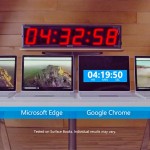
Your choice of web browser can have a tremendous effect on your laptop’s battery life, and Microsoft is determined to prove that its Edge browser the most efficient of them all… at Google’s expense, of course. The crew in Redmond has posted battery tests showing that Edge lasted longer in web video playback and standardized surfing tests than any other browser (including Opera in low-power mode ), and over 3 hours longer than Chrome in the video test. And this is with the current version of Windows 10, Microsoft notes. Edge in Windows’ Anniversary Update should be downright miserly thanks to lower resource usage and tighter restrictions on Flash. Of course, it’s a wise idea to take this (and any other company-run benchmark) with a grain of salt. Most people don’t spend all day watching Netflix on the web, and Microsoft doesn’t mention exactly how long the browsers lasted in the generic browsing test. Also, it conducted the tests on Surface Books . Your mileage is likely to vary with third-party hardware. The company does point to lower overall power consumption based on data from “millions” of Windows 10 PCs, but that will only tell you so much about your own experience. Still, it’s no secret that Chrome is relatively power-hungry. Google’s attempts to improve Chrome’s battery efficiency have only gone so far, and it’s practically common wisdom that you use another browser if you need an extra hour or two of runtime. It’s just important to remember that Microsoft has a strong incentive to trash talk Chrome, and that battery life isn’t always the most important factor. Via: The Verge Source: Windows Experience Blog

View post:
Microsoft trashes Chrome’s battery life

FCC lays out its big 5G push

Speaking at the National Press Club on Monday, Federal Communications Commission Chairman Tom Wheeler made an impassioned plea for the US to take the lead in developing a wireless 5G standard. “To seize the opportunities before us, we need the next generation of wireless connectivity – a fifth generation, or 5G, ” he said. What’s more he laid forth a plan to do it. On Thursday, Wheeler will seek to “open up” a swath of high-band spectrum for 5G applications; he’s calling it the Spectrum Frontiers proceeding. The FCC plans to use 200 MHz-wide chunks of high-band spectrum because, unlike lower frequencies, it can offer the gigabit per second throughput and sub-millisecond latency that 5G applications demand. 5G will usher in an Internet of Everything, Wheeler told the Press Club. “If something can be connected, it will be connected in a 5G world.” Wheeler cited various remote operation scenarios, such as surgeons using VR to operate on patients hundreds of miles away, to illustrate the need for ultrafast wireless connectivity. He expects the commission’s research to be completed and the proposal ready for a vote by July 14th. Should it be adopted, America would become the first nation on Earth to actively reserve frequency for 5G development. 5G networks will require a number of infrastructure updates, specifically a large number of small cell sites. To account for this, the FCC will streamline its environmental and historic preservation rules, which will allow local governments more flexibility in where they situate these devices. The commission will also reportedly take a collaborative approach to addressing the networks cybersecurity and will reach out to “all stakeholders”. Wheeler stated that he expects the private sector to lead this development and produce the necessary technical standards on its own. Verizon and AT&T have both already announced that they’ll begin testing 5G next year. And if what we saw at Mobile World Congress is any indication, they won’t be the last. “Turning innovators loose is far preferable to expecting committees and regulators to define the future.” Wheeler said. “We won’t wait for the standards to be first developed in the sometimes arduous standards-setting process or in a government-led activity.” That said, the end result of the coming 5G revolution is still very much up in the air. “I’ve listed some examples of what 5G makes possible, ” Wheeler told the crowd. “But if anyone tells you they know the details of what 5G will deliver, walk the other way.”

Taken from:
FCC lays out its big 5G push

Single-molecule switch gets us closer to light-powered computers

The computer and gadget industries have boosted the power of components by shrinking them to near-microscopic scale. One radical field, molecular electronics, takes this to its logical extreme: constructing circuits and devices from single molecules. Researchers at the Peking University of Beijing have just created a switch that can be dependably flipped on and off when hit with one photon, clearing the way for infinitesimally small applications in systems that use light instead of electricity. Researchers are diving into the field of optical electronics for obvious reasons: light moves faster than electricity, which means faster computations. Shrinking those components results in even faster speeds, which could be useful in systems like solar panels, light sensors or biomedical applications, suggests Scientific American . Previous attempts to create this single-molecule component were finicky , resulted in switches that got stuck in the “on” position or couldn’t be activated by different types of light. The Peking University researchers used different materials that allowed the switch to stabilize in either binary position yet still be activated by light. This switch could last for up to a year, which is a vast improvement on the shelf lives of earlier attempts. “In many cases, molecular junctions have lives of minutes, hours, or in fortunate cases days, ” Ioan Bâldea of the University of Heidelberg, Germany told Scientific American . While we’re still years from seeing these switches deployed in commercial products, it’s an important step to building stable components at a microscopic scale. Source: Scientific American

Excerpt from:
Single-molecule switch gets us closer to light-powered computers

New ‘Hardened’ Tor Browser Protects Users From FBI Hacking

An anonymous reader quotes an article from Motherboard: According to a new paper, security researchers are now working closely with the Tor Project to create a “hardened” version of the Tor Browser, implementing new anti-hacking techniques which could dramatically improve the anonymity of users and further frustrate the efforts of law enforcement… “Our solution significantly improves security over standard address space layout randomization (ASLR) techniques currently used by Firefox and other mainstream browsers, ” the researchers write in their paper, whose findings will be presented in July at the Privacy Enhancing Technologies Symposium in Darmstadt, Germany. The researchers say Tor is currently field-testing their solution for an upcoming “hardened” release, making it harder for agencies like the FBI to crack the browser’s security, according to Motherboard. “[W]hile that defensive advantage may not last for too long, it shows that some in the academic research community are still intent on patching the holes that their peers are helping government hackers exploit.” Read more of this story at Slashdot.

Follow this link:
New ‘Hardened’ Tor Browser Protects Users From FBI Hacking

Russia debuts the largest ever nuclear icebreaker

Russian cargo ships understandably have to wade through a lot of ice, and the country plans to deal with that frozen water in style. It recently floated out the Arktika , which it bills as the “largest and most powerful” nuclear-powered icebreaker in the world. At nearly 569 feet long and 112 feet wide, the twin-reactor boat can carve a gigantic path through some of the sea’s toughest obstacles — it can cut through ice roughly 10 feet thick. It can haul about 36, 000 short tons, and there’s a helicopter to scout for any upcoming floes. Arktika won’t go into service until near the end of 2017, when it’ll escort oil and gas ships through northern waters to their destinations in Asia-Pacific. However, there’s already a lot of pressure on it to succeed. The project behind the ship is estimated to cost the equivalent of $1.9 billion, so the vessel will have to work hard to justify its investment. Via: Telegraph Source: TASS

Follow this link:
Russia debuts the largest ever nuclear icebreaker

Acer admits hackers stole up to 34,000 customer credit cards

If you bought an Acer device from the company’s store in the last year, there’s a chance that your credit card info was hijacked. The Taiwan-based company informed California’s attorney general that attackers made off with the “name, address, card number, expiration date and three-digit security codes” of users between May 12, 2015 and April 28, 2016. It sent form letters to the 34, 500 affected customers, all of whom are in the US, Canada and Puerto Rico. The theft isn’t particularly large and no social security numbers were taken. However, it’s one of the few we’ve seen involving a major PC company’s online store. Acer hasn’t yet revealed how it happened, but such breaches are usually a result of employees opening infected email, not any fancy hacking . While the breach was still ongoing, Acer recently held an event to reveal its latest laptops and desktop computers. If you bought something from its stores soon after, you may want to ensure that your credentials weren’t stolen. Via: ZDNet Source: US Attorney General

Read More:
Acer admits hackers stole up to 34,000 customer credit cards

Roland Emmerich is Rebooting the Stargate Franchise From Scratch

We’ve known that Roland Emmerich has been planning on continuing his 1994 film Stargate for a while , but while chatting with the press about Independence Day: Resurgence , he and producer Dean Devlin have been dropping some more hints about what’s next for the franchise. Read more…

View the original here:
Roland Emmerich is Rebooting the Stargate Franchise From Scratch

South Australia Refuses To Stop Using An Expired, MS-DOS-Based Health Software

jaa101 writes: The Australian state of South Australia is being sued for refusing to stop using CHIRON, an MS-DOS-based software from the ’90s that stores patient records. Their license expired in March of 2015, but they claim it would be risky to stop using it. CHIRON’s vendor, Working Systems, says SA Health has been the only user of CHIRON since 2008 when they declined to migrate to the successor product MasterCare ePAS. SA Health has 64 sites across South Australia — all of which are apparently still using the MS-DOS-based health software from the 1990s. Read more of this story at Slashdot.

Read this article:
South Australia Refuses To Stop Using An Expired, MS-DOS-Based Health Software

One Million IP Addresses Used In Brute-Force Attack On A Bank

Cisco says in just one week in February they detected 1, 127, 818 different IP addresses being used to launch 744, 361, 093 login attempts on 220, 758, 340 different email addresses — and that 93% of those attacks were directed at two financial institutions in a massive Account Takeover (ATO) campaign. An anonymous reader writes: Crooks used 993, 547 distinct IPs to check login credentials for 427, 444, 261 accounts. For most of these attacks, the crooks used proxy servers, but also two botnets, one of compromised Arris cable modems, and one of ZyXel routers/modems. Most of these credentials have been acquired from public breaches or underground hacking forums. This happened before the recent huge data breaches such as MySpace, LinkedIn, Tumblr, and VK.com. It’s apparently similar to the stolen-credentials-from-other-sites attack that was launched against GitHub earlier this week. Read more of this story at Slashdot.

Excerpt from:
One Million IP Addresses Used In Brute-Force Attack On A Bank