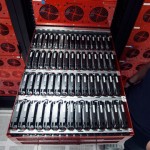
4U Storage Pods offer 240TB of storage for 3.6¢/GB

That’s a lot of hard disks. (credit: Backblaze) For the last few years, we’ve looked at the hard disk reliability numbers from cloud backup and storage company Backblaze, but we’ve not looked at the systems it builds to hold its tens of thousands of hard disks. In common with some other cloud companies, Backblaze publishes the specs and designs of its Storage Pods, 4U systems packed with hard disks, and today it announced its sixth generation design , which bumps up the number of disks (from 45 to 60) while driving costs down even further. The first design, in 2009, packed 45 1.5TB disks into a 4U rackable box for a cost of about 12¢ per gigabyte. In the different iterations that have followed, Backblaze has used a number of different internal designs—sometimes using port multipliers to get all the SATA ports necessary, other times using PCIe cards packed with SATA controllers—but it has stuck with the same 45 disk-per-box formula. The new system marks the first break from that setup. It uses the same Ivy Bridge Xeon processor and 32GB RAM of the version 5, adding extra controllers and port multipliers to handle another 15 disks for 60 in total. The result is a little long—it overhangs the back of the rack by about four inches—but it’s packed full of storage. Read 2 remaining paragraphs | Comments

See the original article here:
4U Storage Pods offer 240TB of storage for 3.6¢/GB

Over 1M BeautifulPeople Dating Site User Details Leak Online

An anonymous reader writes: Personal information of over one million users stored by popular dating site BeautifulPeople has leaked, and is now accessible online. We already knew that BeautifulPixel.com was hacked (it happened in November 2015), but this is the first confirmation from a security researcher that the details are legitimate. (BeautifulPeople had downplayed it at the time, saying that it was a staging server, and not a production server, that was hacked.) Security researcher Troy Hunt, citing a source, noted that the data has been sold online. The leaked personal information include email addresses, phone numbers, as well as hair color, weight, job and other details.Troy also noted that of the 1.1 million users details, 170 of them have government email addresses. Some of you may remember BeautifulPixel as the creator the “Shrek” virus. Read more of this story at Slashdot.

Read More:
Over 1M BeautifulPeople Dating Site User Details Leak Online

This Battery-Free Computer Sucks Power Out Of Thin Air

An anonymous reader shares an article on Fast Co Design (edited and condensed for clarity): Researchers at University of Washington’s Sensor Lab have created the WISP, or Wireless Identification and Sensing Platform: a combination sensor and computing chip that doesn’t need a battery or a wired power source to operate. Instead, it sucks in radio waves emitted from a standard, off-the-shelf RFID reader — the same technology that retail shops use to deter shoplifters — and converts them into electricity. The WISP isn’t designed to compete with the chips in your smartphone or your laptop. It has about the same clock speed as the processor in a Fitbit and similar functionality, including embedded accelerometers and temperature sensors. It has about the same bandwidth as Bluetooth Low Energy mode, the wireless power-sipping technology which drives most Bluetooth speakers and wireless headphones. Read more of this story at Slashdot.

Read More:
This Battery-Free Computer Sucks Power Out Of Thin Air

Researchers Discovered New Observations of the 1006 AD Supernova

Ancient astronomers have long been providing observations of supernovae, such as SN 185 by Chinese astronomers in 185 AD, SN 1054, which produced the Crab Nebula, and SN 1006, the brightest stellar event ever recorded. Now, a new paper has uncovered a new observation of the 1006 event. Read more…

More:
Researchers Discovered New Observations of the 1006 AD Supernova

Solar Impulse 2 completes its flight across the Pacific

After months of delays and days of flying , Solar Impulse 2 has finished crossing the Pacific . The sunlight-powered aircraft arrived in San Francisco Bay on the night of April 23rd, with an expected touchdown at Moffett Field (as of this writing) around 3AM Eastern on the 24th. This isn’t the toughest stint to date (that honor goes to the 5, 061-mile trip from Japan to Hawaii), but it was no mean feat. Pilot Bertrand Piccard had to travel 2, 717 miles between Hawaii and San Francisco, with only short naps allowed during the 3-day expedition. As daunting as this and the eight previous legs of the trip have been, the tough part isn’t over yet. While flying over the US will be a relative cakewalk (Solar Impulse 2 should reach New York by early June), the aircraft will then have to travel 3, 566 miles to Europe. That’s a straight 5 days in the air, folks. After that, the plane will complete its around-the-world mission by heading to Abu Dhabi. This hasn’t been the quickest adventure given that the aircraft took off back in March 2015. However, speed isn’t really the point. Solar Impulse 2 and its namesake technology are meant to show that green energy can accomplish as spectacular a feat as flying across the planet. If the flight encourages anyone to embrace clean power, it accomplishes its goal. Source: Solar Impulse , YouTube

See more here:
Solar Impulse 2 completes its flight across the Pacific

Facebook was the victim of a backdoor hack

Even a tech giant like Facebook isn’t immune to significant security breaches. Devcore’s Orange Tsai recently discovered that someone had installed a backdoor on one of Facebook’s corporate servers (that is, not the social network itself) in a bid to swipe workers’ login details. While it’s not clear how successful the script-based exploit was, Tsai noted that the file transfer app hosted on the server had several vulnerabilities that effectively gave any intruder free rein. The attacker could have checked employee email, for instance, or even connected to Facebook’s virtual private network to get access to the company’s inner workings. Thankfully, this is all past tense. You’re only hearing about this now because Tsai reported the bugs to Facebook (to get a bounty, naturally), and waited until the firm completed its investigation before disclosing the flaws. That backdoor isn’t there anymore, folks. All the same, the incident is bound to humble Facebook a bit — it’s proof that the company is a prime target for hackers, and that it can’t assume it’s always on top of every possible security flaw. Via: Hacker News Source: Devcore

View post:
Facebook was the victim of a backdoor hack

Dutch Police Seize Encrypted Communication Network With 19,000 Users

An anonymous reader writes: Dutch police have seized and shut down Ennetcom, an encrypted communications network with 19, 000 users, according to Reuters. The network’s 36-year-old owner, Danny Manupassa, has also been arrested, and faces charges of money laundering and illegal weapons possession, while the information obtained in the seizure may also be used for other criminal prosecutions. “Police and prosecutors believe that they have captured the largest encrypted network used by organized crime in the Netherlands, ” prosecutors said in a statement. “Although using encrypted communications is legal, ” Reuters reports, “many of the network’s users are believed to have been engaged in ‘serious criminal activity, ‘ said spokesman Wim de Bruin of the national prosecutor’s office, which noted that the company’s modified phones have repeatedly turned up in cases involving drugs, criminal motorcycle gangs, and gangland killings. A spokesman for the National Prosecutor’s office “declined to comment on whether and how police would be able to decrypt information kept on the servers.” Read more of this story at Slashdot.

Link:
Dutch Police Seize Encrypted Communication Network With 19,000 Users

First Successful Gene Therapy Against Human Aging?

An anonymous reader writes: For the first time data may show that a human being has been successfully rejuvenated by gene therapy, claims Bioviva USA. “In September 2015, then 44 year-old CEO of Bioviva USA Inc. Elizabeth Parrish received two of her own company’s experimental gene therapies: one to protect against loss of muscle mass with age, another to battle stem cell depletion responsible for diverse age-related diseases and infirmities.” Bypassing America’s FDA, the controversial therapies were described by the MIT Technology Review as “do-it-yourself medicine, ” saying it “raises ethical questions about how quickly such treatments should be tested in people and whether they ought to be developed outside the scrutiny of regulators.” “The treatment was originally intended to demonstrate the safety of the latest generation of the therapies, ” reports Bioviva’s web site. “But if early data is accurate, it is already the world’s first successful example of telomere lengthening via gene therapy in a human individual.” Read more of this story at Slashdot.

Read the original post:
First Successful Gene Therapy Against Human Aging?

CERN Releases 300TB of Large Hadron Collider Data Into Open Access

An anonymous reader writes: The European Organization for Nuclear Research, known as CERN, has released 300 terabytes of collider data to the public. “Once we’ve exhausted our exploration of the data, we see no reason not to make them available publicly, ” said Kati Lassila-Perini, a physicist who works on the Compact Muon Solenoid detector. “The benefits are numerous, from inspiring high school students to the training of the particle physicists of tomorrow. And personally, as CMS’s data preservation coordinator, this is a crucial part of ensuring the long-term availability of our research data, ” she said in a news release accompanying the data. Much of the data is from 2011, and much of it is from protons colliding at 7 TeV (teraelectronvolts). The 300 terabytes of data includes both raw data from the detectors and “derived” datasets. CERN is providing tools to work with the data which is handy. Read more of this story at Slashdot.

See more here:
CERN Releases 300TB of Large Hadron Collider Data Into Open Access

Log in with your skull via bone conduction biometrics

Researchers looking for a better way to secure their face computers have come up with a novel solution for hands-free, head-mounted password entry. A device could potentially identify its wearer by emitting an ultrasonic hum through their skull and listening for the unique frequency that bounces back. The ” SkullConduct ” setup was devised by university researchers in Germany and works on a modified pair of Google Glass. Using the integrated bone conduction speaker and microphone, the device played an imperceptible sound that was then picked up by the microphone. A test device was able to correctly identify the user 97 percent of the time in a lab. While the researchers originally envisioned the system as a way to keep unwanted users from accessing devices like Glass, Gizmodo thinks it could potentially be another TouchID for your skull. Imagine, if you will, a scenario where you can unlock your phone by placing it against your ear. But, then again, who actually takes phone calls anymore?

Continued here:
Log in with your skull via bone conduction biometrics