Seagate’s Shingled Magnetic Recording Tech Boosts HDD Capacities to 5TB and Up

crookedvulture writes “Seagate has begun shipping hard drives based on a new technology dubbed Shingled Magnetic Recording. SMR, as it’s called, preserves the perpendicular bit orientation of current HDDs but changes the way that tracks are organized. Instead of laying out the tracks individually, SMR stacks them on top of each other in a staggered fashion that resembles the shingles on a roof. Although this overlap enables higher bit densities, it comes with a penalty. Rewrites compromise the data on the following track, which must be read and rewritten, which in turn compromises the data on the following track, and so on. SMR distributes the layered tracks in narrow bands to mitigate the performance penalty associated with rewrites. The makeup of those bands will vary based on the drive’s intended application. We should see the first examples of SMR next year, when Seagate intends to introduce a 5TB drive with 1.25TB per platter. Traditional hard drives top out at 4TB and 1TB per platter right now.” Read more of this story at Slashdot.

See the original post:
Seagate’s Shingled Magnetic Recording Tech Boosts HDD Capacities to 5TB and Up

iPhone 5s fingerprint sensor called Touch ID, recognizes your thumb on the Home button: here’s how it works and what it does

Apple’s brand-new iPhone 5s isn’t dramatically different from last year’s model , but it has at least one major addition: a “Touch ID” sensor. Us human beings are calling it a fingerprint sensor, and it’s built into the phone’s main Home button below the screen. Apple’s Phil Schiller says, “It reads your fingerprint at an entirely new level” — it’s 170 microns in thickness with 500 ppi resolution. According to Cupertino, it “scans sub-epidermal skin layers, ” and can read 360 degrees. As expected, the sensor is actually part of the Home button, making it less of a button and more of a…well, sensor. Using Touch ID, users can authorize purchases in iTunes, the App Store, or in iBooks by simply using their thumbprint (starting in iOS 7, of course). Pretty neat / scary! As rumored , the sensor uses a laser cut sapphire crystal cover; it retains a tactile input for those wary of the sensor wearing down after lengthy use. The sapphire crystal, acting as a lens, takes a highly detailed image of your fingerprint, which Apple says is “never stored on Apple servers or backed up to iCloud.” According to Apple’s official PR on the new phone, Touch ID’s fingerprint info is “encrypted and stored securely in the Secure Enclave inside the A7 chip” (the A7 chip is the new processor at the heart of the 5s ). Apple hasn’t made clear whether Touch ID allows for multiple users on a single iPhone or not, nor has the company said whether you could turn off fingerprint authentication (though we have to presume the answer is yes given previous authentication standards on the iPhone). The fingerprint ID technology was long rumored as heading to 2013’s iPhone following Apple’s acquisition of Authentec last summer . A render of the iPhone 5s outed the new functionality’s name just this week. We’ll have more on Touch ID in our upcoming hands-on live from Cupertino, and you can find all our Apple event coverage from today right here . ” Follow our liveblog for all of the iPhone news as it happens.” %Gallery-slideshow83645% Filed under: Cellphones , Handhelds , Software , Mobile , Apple Comments

Continue Reading:
iPhone 5s fingerprint sensor called Touch ID, recognizes your thumb on the Home button: here’s how it works and what it does

Intel announces Quark system on a chip, the company’s smallest to date

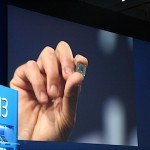
The hits keep coming from IDF. After showing off svelte new 14nm silicon built for laptops , CEO Brian Krzanich announced a brand new SoC series named Quark. It’s the smallest SoC the company has ever built, one-fifth the size of an Atom chip, and is built upon an open architecture meant so spur its use. Early on in his keynote, Krzanich said that Intel plans to “lead in every segment of computing, ” and Quark is positioned to put Intel in wearables — and, in fact, he even showed off a prototype smartwatch platform Intel constructed to help drive wearable development. And, Intel President Renee James pointed out that Quark’s designed for use in integrated systems, so we’ll be seeing Quark in healthcare and municipal use cases, too. Unfortunately, no details about the new SoC’s capabilities or specs are yet available, but we can give you some shots of Intel’s wearable wristband prototype in our gallery below.%Gallery-slideshow83631% Filed under: Intel Comments

Original post:
Intel announces Quark system on a chip, the company’s smallest to date

iOS 7 Is Coming on September 18, Here’s What’s New

Apple’s live event is underway , and while most of the event is about the new iPhone, they recapped their iOS 7 announcement with the addition of new “Share Sheets” for social network sharing and confirmed a September 18th release date. You can see everything that’s coming in iOS 7 in our original post below. Read more…        

Excerpt from:
iOS 7 Is Coming on September 18, Here’s What’s New

iTunes Radio launches September 18th alongside the release of iOS 7

We heard rumblings a few weeks ago that Apple’s streaming service was due to launch this month and now it seems those reports were true. The folks in Cupertino just announced that iTunes Radio will launch on September 18th in tandem with a redesigned iOS 7 . The ability to create custom stations based on individual music tastes and personal iTunes libraries will hit Apple devices in a week’s time. Of course, you’ll need a $25 per year iTunes Match subscription to keep listening sessions ad-free , otherwise you’ll be prone to regular interruptions of that Yacht Rock station every few minutes. Follow our liveblog for all of the iPhone news as it happens. Filed under: Internet , Software , Apple Comments

Read the original:
iTunes Radio launches September 18th alongside the release of iOS 7

Apple introduces the iPhone 5S

Ladies and gentleman, the moment you’ve all been waiting for . As expected, this afternoon’s day-brightening news (or part of it , at least) arrived in Cupertino in the form of a brand-new handset. CEO Tim Cook took to the stage at Apple HQ to introduce the world to the iPhone 5S, the second of two handsets announced today. The new phone follows the number / letter naming scheme set in place way back in twenty ‘o nine with the introduction of the 3GS and carried on with 2011’s 4S . As with those handsets, the new device’s name implies that this round is something of an iterative update to last year’s iPhone 5 . According to Phil Schiller, the handset is ” the most forward-thinking phone we’ve ever created.” As expected, it’s set to arrive in three colors: black, silver and gold. The 5S is crafted in high-grade aluminum with chamfered edges. What the the “S” stand for? Well, inside, you’ll find a 64-bit A7 processor that features twice the number of transistors as its predecessor, clocking in at more than one billion, according to Schiller — the CPU and GPU, meanwhile, promise speeds twice as fast. There’s OpenGL ES 3.0 on-board, but the next-gen handset still promises, thankfully, to remain compatible with the 32-bit apps of yesteryear. Developing… %Gallery-slideshow83641% ” Follow our liveblog for all of the iPhone news as it happens.” Filed under: Cellphones , Mobile , Apple Comments

Read the article:
Apple introduces the iPhone 5S

Apple iPhone 5S: Everything You Need to Know

There’s a new iPhone. Well, to be completely accurate there are two new iPhones. But the new iPhone 5S is Apple’s flagship phone and it’s the best iPhone you can buy. It looks exactly like how the iPhone 5 looked last year but with improved internals and guts that will make everything run even faster. Read more…        

View article:
Apple iPhone 5S: Everything You Need to Know

Apple unveils A7 chip, brings 64-bit processing to the iPhone 5S

Apple has just laid claim to a world first: 64-bit processing inside a smartphone. The new A7 processor will power the iPhone 5S with a “desktop-class architecture” consisting of over 1 billion transistors. Developing… Filed under: Cellphones , Mobile , Apple Comments

Visit link:
Apple unveils A7 chip, brings 64-bit processing to the iPhone 5S

New Research Could Slow Human Aging

schliz writes “A team of scientists from Japan and New Zealand have helped baker’s yeast live 50% longer than usual by artificially stabilizing a genetic sequence called ribosomal DNA. The study’s authors say that rDNA is a ‘hot spot for production of the aging signal.’ Because rDNA genes are very similar in yeast and humans, they say their experiment is a first step towards anti-aging drugs.” Read more of this story at Slashdot.

Read this article:
New Research Could Slow Human Aging

Big Jump For Tablet Storage: Seagate Intros 5mm Hard Disk For Tablets

cold fjord writes “ZDNet reports, ‘Seagate on Monday took the wraps off a hard drive designed for tablets that brings 7x the storage capacity of a 64GB device with the same performance as a Flash drive. The drive, the Seagate Ultra Mobile HDD, uses software to boost performance. The idea is that Android tablet manufacturers will use the Seagate drive, along with the company’s mobile enablement kit and caching software, to up the storage. The 2.5-inch drive is 5 mm thin and weighs 3.3 ounces. As for capacity, the drive has 500GB—enough for 100, 000 photos and 125, 000 songs.’ More at The Wall Street Journal.” Read more of this story at Slashdot.

Read More:
Big Jump For Tablet Storage: Seagate Intros 5mm Hard Disk For Tablets