Famous Authors’ Handwritten Outlines for Great Works of Literature

Many authors make outlines of their novels to keep the story arc in place, make sure the important parts are not missed, and to keep up with each character. They each have their own style, as well. See some handwritten outlines from James Salter, J.K. Rowling, Sylvia Plath, William Faulkner, and more at Flavorwire. The chart shown is how Joseph Heller kept up with the characters and their plot lines in Catch-22 . You can click the image twice at Flavorwire to bring up the large size, but you might need to put on your glasses to read it anyway. Link

Continue reading here:
Famous Authors’ Handwritten Outlines for Great Works of Literature

See Inside a Butterfly Chrysalis

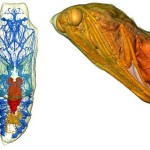
Just like everyone else, you learned about how a caterpillar turns into a butterfly (or moth) inside a chrysalis (or cocoon) and you desperately tried to envision what happens inside and what it looks like. Scientists who’ve opened a lot of chrysalises will tell you the caterpillar turns to goop and then a butterfly, but that’s not completely accurate, and the process of opening one destroys the structure anyway. But now, two teams of scientists have started to captured intimate series of images showing the same caterpillars metamorphosing inside their pupae. Both teams used a technique called micro-CT, in which X-rays capture cross-sections of an object that can be combined into a three-dimensional virtual model. By dissecting these models rather than the actual insects, the teams could see the structures of specific organs, like the guts or breathing tubes. They could also watch the organs change over time by repeatedly scanning the same chrysalis over many days. And since insects tolerate high doses of radiation, this procedure doesn’t seem to harm them, much less kill them. Ed Yong explains more about this technology, and you’ll more pictures of an insect going through the metamorphosis at Not Exactly Rocket Science. Link (Image credit: Lowe et al. 2013. Interface)

Read the original post:
See Inside a Butterfly Chrysalis

The Most Sleep Deprived Students in the World

Who *yawn* are the most sleep deprived students in the world? Students from the United States, according to new research by Chad Minnich of Boston College: “I think we underestimate the impact of sleep. Our data show that across countries internationally, on average, children who have more sleep achieve higher in maths, science and reading. That is exactly what our data show,” says Chad Minnich, of the TIMSS and PIRLS International Study Center. “It’s the same link for children who are lacking basic nutrition,” says Mr Minnich, based at the Lynch School of Education, Boston College. But what about those Asian students who study all the time? Asian countries are the highest-performing in maths tests – and Mr Minnich says this has often been associated with long hours and cramming in after-school classes. “One would assume that they would be extremely tired,” he said. “And yet when we look at the sleep factor for them, they don’t necessarily seem to be suffering from as much sleep deprivation as the other countries.” Minnich placed the blame on smartphones and laptops. Sean Coughlan of the BBC has more: Link

Read more here:
The Most Sleep Deprived Students in the World

The Curious Case of the Nonexistent Turtle

With all the stories about “de-extinction” of animal species lately, there’s one method that doesn’t get much notice -when scientists decide that an extinct species never existed in the first place. That applies to the case of Pelusios seychellensis , which, according to specimens collected by German naturalist August Brauer over 100 years ago, lived in the Seychelles off the east coast of Africa. Curiously, these turtles closely resembled turtles on the west coast of Africa, Pelusios castaneus . But they couldn’t be the same, because they lived so far apart. So the separate species name was coined in 1983. But even more curious, no one could find any specimens of Pelusios seychellensis in the Seychelles, and scientists concluded that the species had gone extinct during the 20th century. Not only that, they assumed that humans had caused the extinction. But wait… Brauer took the trip during which he was supposed to have collected the turtles between May 1895 to January 1896. But he didn’t immediately give his finds to a museum. Specimens from his private collection didn’t get transferred to the Zoological Museum Hamburg until five years after the Seychelles trip, and those turtles soon went on to Vienna’s Natural History Museum. Somewhere in all that shuffling, the west African turtles might have been lumped in with the Seychelles reptiles or otherwise confused. Whatever happened, though, a prominent clue indicates that the turtles were not collected from the wild. One, and possibly two, of the turtles have a perforation through their shells identical to the sort that turtle purveyors have traditionally used to tie turtles together until they are sold for food. Wherever Brauer got the turtles from, he seems to have purchased them. Oops. On the bright side, this means that humans did not cause the extinction of a turtle species, because Pelusios castaneus is still around -on Africa’s west coast. Read the saga of the disappearing turtles at Laelaps. Link   -via Not Exactly Rocket Science (Image credit: Stuckas et al., 2013)

More:
The Curious Case of the Nonexistent Turtle

Look How Quickly the U.S. Got Fat

Watch this CDC map change from 1985 to 2010 -and get more colorful along the way. It shows the percentage of people medically defined as obese. Obesity was once an odd condition, but for the U.S. it just gets more common every year. The Atlantic has a list of the metropolitan areas that have the lowest and highest rates of obesity. Moving to Colorado will only help if you are willing to climb mountains, hike, and ski. Link

View original post here:
Look How Quickly the U.S. Got Fat

Icefish Bleeds Clear Blood

The ocellated icefish you see above has a very unique blood: it’s totally transparent. Discovery News tells us: The reason, say experts at Tokyo Sea Life Park, is that the Ocellated Ice Fish has no hemoglobin, making it unique among vertebrates the world over. Hemoglobin is the protein found in every other animal with bones. It is what makes blood red and is the agent that carries oxygen around the body. Researchers believe the fish can live without hemoglobin because it has a large heart and uses blood plasma to circulate oxygen throughout its body. Link

Follow this link:
Icefish Bleeds Clear Blood

The Startling Rise of Disability in America

As the American economy has moved away from manufacturing to information services and the economy limps along, not keeping up with the number of people who need jobs, the U.S. Social Security Disability program has boomed. This boom covers up the real numbers of people who would otherwise be on welfare or counted among the unemployed. NPR looks at several factors that made this happen: for example, disability is for people who can no longer perform heavy labor, and don’t have the education or skills for other jobs. One woman I met, Ethel Thomas, is on disability for back pain after working many years at the fish plant, and then as a nurse’s aide. When I asked her what job she would have in her dream world, she told me she would be the woman at the Social Security office who weeds through disability applications. I figured she said this because she thought she’d be good at weeding out the cheaters. But that wasn’t it. She said she wanted this job because it is the only job she’s seen where you get to sit all day. At first, I found this hard to believe. But then I started looking around town. There’s the McDonald’s, the fish plant, the truck repair shop. I went down a list of job openings — Occupational Therapist, McDonald’s, McDonald’s, Truck Driver (heavy lifting), KFC, Registered Nurse, McDonald’s. And disability payments shift the expense of maintaining people without jobs away from states and onto the federal government. A person on welfare costs a state money. That same resident on disability doesn’t cost the state a cent, because the federal government covers the entire bill for people on disability. So states can save money by shifting people from welfare to disability. And the Public Consulting Group is glad to help. PCG is a private company that states pay to comb their welfare rolls and move as many people as possible onto disability. “What we’re offering is to work to identify those folks who have the highest likelihood of meeting disability criteria,” Pat Coakley, who runs PCG’s Social Security Advocacy Management team, told me. Other factors come into play, but the result is that 14 million Americans receive a disability check every month -and health care through Medicare. Learn more about the trend at NPR. Link

See the article here:
The Startling Rise of Disability in America

Whole Milk Linked to Slimmer Kids

The American Academy of Pediatrics recommends that children switch from whole milk to a lower fat milk at age two. The conventional wisdom is that getting children used to reduced fat milk will help keep them at a healthy weight. Skim, 1%, or 2% milk has fewer calories per cup. It just makes sense, doesn’t it? So here’s where things gets confusing. A new study of preschool-aged children published in the Archives of Disease in Childhood, a sister publication of the British Medical Journal, finds that low-fat milk was associated with higher weight. That’s right, kids drinking low-fat milk tended to be heavier. “We were quite surprised” by the findings, Dr. Mark DeBoer told me in an email. He and his co-author, Dr. Rebecca Scharf, both of the University of Virginia, had hypothesized just the opposite. But they found the relationship between skim-milk drinkers and higher body weights held up across all racial/ethnic and socioeconomic groups. DeBoer says their data also show that low-fat milk did not restrain weight gain in preschoolers over time. This is not the first study to show such results, but the authors call for further research, as this study did not take into account what types of food the children were consuming or their total caloric intake. And scientists say sugary drinks make a bigger difference in overall child obesity. Link (Image credit: Flickr user David Goehring )

Visit site:
Whole Milk Linked to Slimmer Kids

How China Becomes Smarter: Through Education and Genetic Engineering

First, China decided to become a manufacturing giant, then an economic and military superpower. So you shouldn’t be surprised that their next plan is to improve the actual Chinese people themselves. They’re doing this two ways: the first is not controversial. China is massively investing in education. Keith Bradsher of The New York Times wrote : China is making a $250 billion-a-year investment in what economists call human capital. Just as the United States helped build a white-collar middle class in the late 1940s and early 1950s by using the G.I. Bill to help educate millions of World War II veterans, the Chinese government is using large subsidies to educate tens of millions of young people as they move from farms to cities. Source: UNESCO (degrees, enrollment); China finance ministry via CEIC Data (Spending) Chart: The New York Times And it seems to be working (though as some people pointed out, quantity isn’t the same as quality – and that, similar to United States and Europe, China is already facing a glut of educated college graduates who can’t find jobs). Again, from Bradsher’s article : Sheer numbers make the educational push by China, a nation of more than 1.3 billion people, potentially breathtaking. In the last decade, China doubled the number of colleges and universities, to 2,409. As recently as 1996, only one in six Chinese 17-year-olds graduated from high school. That was the same proportion as in the United States in 1919. Now, three in five young Chinese graduate from high school, matching the United States in the mid-1950s. China is on track to match within seven years the United States’ current high school graduation rate for 18-year-olds of 75 percent — although a higher proportion of Americans than Chinese later go back and finish high school. By quadrupling its output of college graduates in the past decade, China now produces eight million graduates a year from universities and community colleges. By the end of the decade, China expects to have nearly 195 million community college and university graduates — compared with no more than 120 million in the United States then. The second method is more controversial. According to this article by Aleks Eror published in VICE, China is working on making its people more intelligent by genetic-engineering: At BGI Shenzhen , scientists have collected DNA samples from 2,000 of the world’s smartest people and are sequencing their entire genomes in an attempt to identify the alleles which determine human intelligence. Apparently they’re not far from finding them, and when they do, embryo screening will allow parents to pick their brightest zygote and potentially bump up every generation’s intelligence by five to 15 IQ points. Eror interviewed evolutionary psychologist Geoffrey Miller who said that smart people were being recruited, through scientific conference and word of mouth, to contribute their genetic material to be sequenced so the genes for intelligence can be identified (and later on, used to determine the intelligence potential of embryos). What does that mean in human language? Any given couple could potentially have several eggs fertilized in the lab with the dad’s sperm and the mom’s eggs. Then you can test multiple embryos and analyze which one’s going to be the smartest. That kid would belong to that couple as if they had it naturally, but it would be the smartest a couple would be able to produce if they had 100 kids. It’s not genetic engineering or adding new genes, it’s the genes that couples already have. And over the course of several generations you’re able to exponentially multiply the population’s intelligence. Right. Even if it only boosts the average kid by five IQ points, that’s a huge difference in terms of economic productivity, the competitiveness of the country, how many patents they get, how their businesses are run, and how innovative their economy is. (Top image: Shutterstock )

Read the original post:
How China Becomes Smarter: Through Education and Genetic Engineering

Higgs Boson is Now Official!

There it is! Where’s Higgs Boson T-Shirt by Mike Jacobsen | More Higgs boson T-Shirts After the big announcement last year, physicists have made it official. They have indeed found the Higgs boson: Physicists announced on July 4, 2012, that, with more than 99 percent certainty, they had found a new elementary particle weighing about 126 times the mass of the proton that was likely the long-sought Higgs boson. The Higgs is sometimes referred to as the “God particle,” to the chagrin of many scientists, who prefer its official name. But the two experiments, CMS and ATLAS, hadn’t collected enough data to say the particle was, for sure, the Higgs boson, the last undiscovered piece of the puzzle predicted by the Standard Model, the reigning theory of particle physics. Now, after collecting two and a half times more data inside the Large Hadron Collider (LHC) — where protons zip at near light-speed around the 17-mile-long (27 kilometer) underground ring beneath Switzerland and France — physicists say the particle is a Higgs. Jeanna Bryner of LiveScience has the full story: Link

Originally posted here:
Higgs Boson is Now Official!