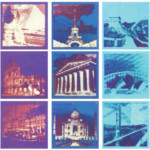
New ultra-high resolution printer makes colors from nanostructures

Researchers from the Technical University of Denmark demonstrated a new nanotechnology-based printing technique that produces long-lasting color images on plastic at resolutions up to 127,000 dots per inch, many times more detailed than traditional laser printers. The system uses a laser to alter the structure of nanoscale structures on the plastic material. (A nanometer is one-billionth of a meter; a human hair is around 60,000 nanometers in diameter.) The nanoprinting technique could also lead to new kinds of 3D displays or invisible watermarks. From New Scientist : The surface of the plastic is shaped so that it has lots of tiny pillars, one roughly every 200 nanometers. A thin film of the element germanium is then spread over the plastic. Heat from a laser melts the germanium on each pillar, morphing its shape and thickness. As a result, it reflects a specific color. The coating protects the shapes of the newly carved nanostructures. Resonant laser printing of structural colors on high-index dielectric metasurfaces (ScienceAdvances)

More here:
New ultra-high resolution printer makes colors from nanostructures

New ultra-high resolution printer makes colors from nanostructures

Researchers from the Technical University of Denmark demonstrated a new nanotechnology-based printing technique that produces long-lasting color images on plastic at resolutions up to 127,000 dots per inch, many times more detailed than traditional laser printers. The system uses a laser to alter the structure of nanoscale structures on the plastic material. (A nanometer is one-billionth of a meter; a human hair is around 60,000 nanometers in diameter.) The nanoprinting technique could also lead to new kinds of 3D displays or invisible watermarks. From New Scientist : The surface of the plastic is shaped so that it has lots of tiny pillars, one roughly every 200 nanometers. A thin film of the element germanium is then spread over the plastic. Heat from a laser melts the germanium on each pillar, morphing its shape and thickness. As a result, it reflects a specific color. The coating protects the shapes of the newly carved nanostructures. Resonant laser printing of structural colors on high-index dielectric metasurfaces (ScienceAdvances)

Follow this link:
New ultra-high resolution printer makes colors from nanostructures

New ultra-high resolution printer makes colors from nanostructures

Researchers from the Technical University of Denmark demonstrated a new nanotechnology-based printing technique that produces long-lasting color images on plastic at resolutions up to 127,000 dots per inch, many times more detailed than traditional laser printers. The system uses a laser to alter the structure of nanoscale structures on the plastic material. (A nanometer is one-billionth of a meter; a human hair is around 60,000 nanometers in diameter.) The nanoprinting technique could also lead to new kinds of 3D displays or invisible watermarks. From New Scientist : The surface of the plastic is shaped so that it has lots of tiny pillars, one roughly every 200 nanometers. A thin film of the element germanium is then spread over the plastic. Heat from a laser melts the germanium on each pillar, morphing its shape and thickness. As a result, it reflects a specific color. The coating protects the shapes of the newly carved nanostructures. Resonant laser printing of structural colors on high-index dielectric metasurfaces (ScienceAdvances)

Follow this link:
New ultra-high resolution printer makes colors from nanostructures

New ultra-high resolution printer makes colors from nanostructures

Researchers from the Technical University of Denmark demonstrated a new nanotechnology-based printing technique that produces long-lasting color images on plastic at resolutions up to 127,000 dots per inch, many times more detailed than traditional laser printers. The system uses a laser to alter the structure of nanoscale structures on the plastic material. (A nanometer is one-billionth of a meter; a human hair is around 60,000 nanometers in diameter.) The nanoprinting technique could also lead to new kinds of 3D displays or invisible watermarks. From New Scientist : The surface of the plastic is shaped so that it has lots of tiny pillars, one roughly every 200 nanometers. A thin film of the element germanium is then spread over the plastic. Heat from a laser melts the germanium on each pillar, morphing its shape and thickness. As a result, it reflects a specific color. The coating protects the shapes of the newly carved nanostructures. Resonant laser printing of structural colors on high-index dielectric metasurfaces (ScienceAdvances)

Continue Reading:
New ultra-high resolution printer makes colors from nanostructures

New ultra-high resolution printer makes colors from nanostructures

Researchers from the Technical University of Denmark demonstrated a new nanotechnology-based printing technique that produces long-lasting color images on plastic at resolutions up to 127,000 dots per inch, many times more detailed than traditional laser printers. The system uses a laser to alter the structure of nanoscale structures on the plastic material. (A nanometer is one-billionth of a meter; a human hair is around 60,000 nanometers in diameter.) The nanoprinting technique could also lead to new kinds of 3D displays or invisible watermarks. From New Scientist : The surface of the plastic is shaped so that it has lots of tiny pillars, one roughly every 200 nanometers. A thin film of the element germanium is then spread over the plastic. Heat from a laser melts the germanium on each pillar, morphing its shape and thickness. As a result, it reflects a specific color. The coating protects the shapes of the newly carved nanostructures. Resonant laser printing of structural colors on high-index dielectric metasurfaces (ScienceAdvances)

Continue Reading:
New ultra-high resolution printer makes colors from nanostructures

Nintendo programmer coded Game Boy classic without using a keyboard

Nintendo programmer Masahiro Sakura coded the Game Boy classic Kirby’s Dream Land on a cartridge-based Famicom console and Disk System that lacked a hardware keyboard. According to a recent presentation given by Sakura, “values had to be input using a trackball and an on-screen keyboard.” Sakura, who was 20-years-old at the time, said he just thought that was “the way it was done.” From Game Watch’s report in Japanese, translated by Source Gaming : At the time, the development tool that HAL Laboratory was using was the Twin Famicom, a console that combined the Famicom and the Famicom Disk System. A trackball made specifically for the Twin Famicom was used with the machine, which read and wrote data to a floppy disk and uploaded data to the floppy disks [during development]. Essentially, they were using a Famicom to make Famicom games. Sakurai told the crowd, “It’s like using a lunchbox to make lunch”. However, because of that, they were able to create a functional test product before the project plan was even completed. (via Ars Technica )

View the original here:
Nintendo programmer coded Game Boy classic without using a keyboard

Incredible giant chocolate geodes

Alex Yeatts, a student at the Culinary Institute of America, worked for six months to cook up amazing chocolate geode cakes. Crack one open to reveal the dazzling sugar crystals. Stunning work. A post shared by Alex Yeatts (@alex.yeatts) on Mar 11, 2017 at 10:18am PST A post shared by Alex Yeatts (@alex.yeatts) on Mar 20, 2017 at 6:59am PDT

Read this article:
Incredible giant chocolate geodes

What is the fastest music that humans can play and appreciate?

Bass player/instructor Adam Neely explores the fastest “useful” music that humans can play. It’s a fascinating topic, really, especially how he, and scientists/musicologists, frame the question around what’s musically “useful.” And yes, speed metal is considered “useful.”

Read More:
What is the fastest music that humans can play and appreciate?

The amazing whistling language of Greek shepherds

In the village of Antia on Greece’s Evia island, shepherds use whistling to communicate over long distances. This isn’t a code but rather a real language. “Whistles let shepherds communicate between distant hillsides because a whistled sound wave travels farther than spoken words.” ( Scientific American )

See the original article here:
The amazing whistling language of Greek shepherds