US Army committed $6.5 trillion in accounting fraud in one year

In June, the Defense Department’s Inspector General released a report on the US Army’s accounting, revealing that the Army had invented $6.5 trillion in “improper adjustments” ($2.8T in one quarter!) to make its books appear balanced though it could not account for where the funds had gone. (more…)

View the original here:
US Army committed $6.5 trillion in accounting fraud in one year

Univision to buy Gawker for $135m

Univision won the auction for Gawker Media with a $135m bid , reports Peter Kafka. … the auction is a disappointing conclusion for Gawker Media owner Nick Denton, who founded the company in 2002. Last year, as rival media companies like Vice, BuzzFeed and Vox Media (which owns this site) were raising money at increasingly high valuations, Denton was arguing that his company was worth $250 million or more. The price was depressed by the circumstances of the sale: a $140m award against it after publishing a Hulk Hogan sex tape and losing the subsequent lawsuit, which was secretly funded by vengeful billionaire Peter Thiel. Though experts generally expect Gawker to prevail on appeal, it was forced into bankruptcy by the penalty and the only other bidder was Ziff Davis, at $90m. This weds Gawker to The Onion and Fusion in the Univision website stable; The Onion is very much its own thing, but Fusion’s web presence is quite similar to Gawker itself and one wonders will it blend?

Read More:
Univision to buy Gawker for $135m

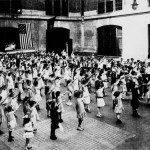
Why are these children "sieg heiling" the American flag?

In this 1915 photo, the children appear to be raising their arms in a siege heil salute of the American flag. Actually, this gesture was part of the Pledge of Allegiance ritual for decades. Then, um, Hitler happened. From Smithsonian : Originally known as the Bellamy Salute, the gesture came to be in the 1890s, when the Pledge of Allegiance was written by Francis J. Bellamy. The Christian socialist minister was recruited to write a patriotic pledge to the American flag as part of magazine mogul Daniel Sharp Ford’s quest to get the flag into public schools. At the time… Bellamy and his boss both agreed that the Civil War had divided American loyalties and that the flag might be able to bridge those gaps. His campaign centered around the 400th anniversary of Christopher Columbus’ arrival in the new world. He published his new Pledge as part of a unified Columbus Day ceremony program in September 1892 in the pages of the Youth’s Companion, a popular children’s magazine with a circulation of 500,000. “At a signal from the Principal,” Bellamy wrote, “the pupils, in ordered ranks, hands to the side, face the Flag. Another signal is given; every pupil gives the flag the military salute—right hand lifted, palm downward, to a line with the forehead and close to it. Standing thus, all repeat together, slowly, ‘I pledge allegiance to my Flag…’” Then in the 1930s, Hitler reportedly saw Italian Fascists doing a similar gesture, likely based on an ancient Roman custom, and adopted it for the Nazi party.

Read more here:
Why are these children "sieg heiling" the American flag?

Generate your own random fantasy maps

Martin O’Leary not only made a cool fantasy map generator , he’s giving away the source code and has described the process at a high enough level for an idiot like me to partly understand how it works. I wanted to make maps that look like something you’d find at the back of one of the cheap paperback fantasy novels of my youth. I always had a fascination with these imagined worlds, which were often much more interesting than whatever luke-warm sub-Tolkien tale they were attached to. At the same time, I wanted to play with terrain generation with a physical basis. There are loads of articles on the internet which describe terrain generation, and they almost all use some variation on a fractal noise approach, either directly (by adding layers of noise functions), or indirectly (e.g. through midpoint displacement). These methods produce lots of fine detail, but the large-scale structure always looks a bit off. Features are attached in random ways, with no thought to the processes which form landscapes. I wanted to try something a little bit different. It’s an odd feeling to look at these instantly-generated, detailed maps and realize that they represent nothing. I feel like I’m being wasteful pressing the “Generate high resolution map.” The Uncharted Atlas is a twitterbot that posts a new map every hour.

Read more here:
Generate your own random fantasy maps

Mystery magic spells, etched on gold, unearthed in Serbia

Buried nearly 2,000 years ago in Serbia, rolls of gold and silver etched with “magic spells” are baffling archaologists. Reuters reports on a “Middle Eastern mystery” unearthed at the site of an ancient Roman city. “We read the names of a few demons, that are connected to the territory of modern-day Syria,” archaeologist Ilija Dankovic said at the dig, as more skeletons from the 4th century A.D. were being uncovered. The fragile, golden and silver scrolls – which once unrolled look like rectangles of foil similar in size to a sweet wrapper – may never be fully understood. They are the first such items discovered in Serbia but resemble amulets of “binding magic” found in other countries, Dankovic said. Very Pazuzu , isn’t it?

View original post here:
Mystery magic spells, etched on gold, unearthed in Serbia

Proof-of-concept ransomware for smart thermostats demoed at Defcon

Last week, Andrew Tierney and Ken Munro from Pen Test Partners demoed their proof-of-concept ransomware for smart thermostats, which relies on users being tricked into downloading malware that then roots the device and locks the user out while displaying a demand for one bitcoin. (more…)

Read the article:
Proof-of-concept ransomware for smart thermostats demoed at Defcon

1 billion computer monitors vulnerable to undetectable firmware attacks

A team led by Ang Cui ( previously ) — the guy who showed how he could take over your LAN by sending a print-job to your printer — have presented research at Defcon, showing that malware on your computer can poison your monitor’s firmware, creating nearly undetectable malware implants that can trick users by displaying fake information, and spy on the information being sent to the screen. (more…)

Originally posted here:
1 billion computer monitors vulnerable to undetectable firmware attacks

Iraq stops using $60,000 dowsing rods for bomb detection

After the July 3 suicide bomb that killed 300 people in Baghdad, Prime Minister Haider al-Abadi banned the use of the ADE 651. a fake bomb detector made by British fraudsters, who claimed the gadgets could detect bombs, ivory, drugs, and golf balls. The Iraqi military had purchased $60 million worth of the bogus devices. The founder of the company that made the useless devices is in prison serving a ten-year sentence. I think he should spend a lot more time than that behind bars, since a great many people died by putting their trust in the devices. ABC News Faced with mounting criticism, former Prime Minister Nouri al-Maliki ordered an investigation into the effectiveness of the devices in 2010. The outcome was inconclusive, and they continued to be used. The head of the Interior Ministry’s bomb squad department, Jihad al-Jabri, was convicted in 2012 and sentenced to four years in prison for accepting a bribe from the British manufacturers. But the case against him did not address whether the wands were effective. Many Iraqis believe he was a scapegoat to protect more senior Iraqi officials from prosecution. Politics also may have played a role. After the July 3 blast, al-Abadi fired the military officer in charge of Baghdad’s security and accepted the resignation of Interior Minister Mohammed Salem al-Ghabban, who was in charge of police.

Read the original:
Iraq stops using $60,000 dowsing rods for bomb detection