Scientists Managed to Clone Human Embryos

Donor egg held by pipette prior to nuclear extraction. Image: OHSU Photos/Flickr A significant, and undoubtedly controversial, milestone in stem cell therapy was reached yesterday. Scientists at the Oregon Health and Science University managed to achieve the Holy Grail of stem cell research : they’ve cloned a human embryo. OHSU cell biologist Shoukhrat Mitalipov led a team of 23 scientists who methodically culled the lessons learned from stem cell research on amphibians, mice and rhesus monkeys — as well as from the abundant failures of others in the field. They devised a welter of new techniques to use the DNA of a fully formed skin cell in its most primitive embryonic form. In past efforts to coax such an assemblage of components to life, researchers have burned through dozens of donor eggs without getting any embryos even to the 16-cell stage at which stem cells become a remote possibility. This time, the researchers said their methods were so efficient that they could create at least one embryonic stem cell line from each batch of eggs donated by 10 female volunteers. In one case, a single donor produced eight eggs of such exceptional quality that researchers were able to derive four embryonic stem cell lines. Some hailed the development as an important advance in the paving the way to treat a range of diseases, but others feared that it’s one step closer to cloning humans. Melissa Healy of the Los Angeles Times has the post: Link

See the article here:
Scientists Managed to Clone Human Embryos

Famous Authors’ Handwritten Outlines for Great Works of Literature

Many authors make outlines of their novels to keep the story arc in place, make sure the important parts are not missed, and to keep up with each character. They each have their own style, as well. See some handwritten outlines from James Salter, J.K. Rowling, Sylvia Plath, William Faulkner, and more at Flavorwire. The chart shown is how Joseph Heller kept up with the characters and their plot lines in Catch-22 . You can click the image twice at Flavorwire to bring up the large size, but you might need to put on your glasses to read it anyway. Link

Continue reading here:
Famous Authors’ Handwritten Outlines for Great Works of Literature

See Inside a Butterfly Chrysalis

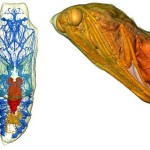
Just like everyone else, you learned about how a caterpillar turns into a butterfly (or moth) inside a chrysalis (or cocoon) and you desperately tried to envision what happens inside and what it looks like. Scientists who’ve opened a lot of chrysalises will tell you the caterpillar turns to goop and then a butterfly, but that’s not completely accurate, and the process of opening one destroys the structure anyway. But now, two teams of scientists have started to captured intimate series of images showing the same caterpillars metamorphosing inside their pupae. Both teams used a technique called micro-CT, in which X-rays capture cross-sections of an object that can be combined into a three-dimensional virtual model. By dissecting these models rather than the actual insects, the teams could see the structures of specific organs, like the guts or breathing tubes. They could also watch the organs change over time by repeatedly scanning the same chrysalis over many days. And since insects tolerate high doses of radiation, this procedure doesn’t seem to harm them, much less kill them. Ed Yong explains more about this technology, and you’ll more pictures of an insect going through the metamorphosis at Not Exactly Rocket Science. Link (Image credit: Lowe et al. 2013. Interface)

Read the original post:
See Inside a Butterfly Chrysalis

Look How Quickly the U.S. Got Fat

Watch this CDC map change from 1985 to 2010 -and get more colorful along the way. It shows the percentage of people medically defined as obese. Obesity was once an odd condition, but for the U.S. it just gets more common every year. The Atlantic has a list of the metropolitan areas that have the lowest and highest rates of obesity. Moving to Colorado will only help if you are willing to climb mountains, hike, and ski. Link

View original post here:
Look How Quickly the U.S. Got Fat

The Amazing Dr. Baker

The following is an article from the book Uncle John’s Supremely Satisfying Bathroom Reader . Illustrations by Kate Beaton of Hark! A Vagrant . Of all of the incredible women we’ve ever read about, Dr. Sara Josephine Baker is one of the most incredible. Her accomplishments are astounding, especially when you consider the time in which she lived. Next time you think one person can’t make a difference, remember Dr. Baker. RICHES TO RAGS Sara Josephine Baker was born to a life of privilege in Poughkeepsie, New York, in 1873. In those days there were no water treatment plants or indoor plumbing -people pulled their drinking water right out of the Hudson River. Unfortunately, the Baker family lived downstream from a hospital that discharged its waste right into the same river. The hospital treated people suffering from typhoid fever -and the germs went straight into the water. Baker’s father and younger brother both contracted the disease and died when she was 16 years old. Although the family was left with no income and small savings, Baker announced that she wanted to go to college to become a doctor, so that she could combat diseases like typhoid. But not many women became doctors in those days. Nevertheless, the young woman insisted, and her mother finally agreed. In 1900, after graduating from the Women’s Medical College of the New York Infirmary and completing her internship, Baker hung out her shingle in New York City. THe next year, she took the civil service exam and scored very high -high enough to qualify for the job of medical inspector for the Department of Health. A MISSION Perhaps because she was a woman, she was given the worst assignment of all: reducing the death rate in Hell’s Kitchen -one of the worst slums in New York. But among rat-infested buildings crammed with poverty-stricken immigrants, Dr. Baker found her calling. She went from tenement to tenement, searching for people with infectious diseases. She said, “I climbed stair after stair, knocked on door after door, met drunk after drunk, filthy mother after filthy mother, and dying baby after dying baby.” Every week, more than 4,500 people in this district died from cholera, dysentery, smallpox, typhoid, and other illnesses, fully a third of them newborn babies. Dr. Baker rolled up her sleeves and went to work. CHILDREN’S CRUSADE Focusing on the infant mortality rate, Baker led a team of nurses who went door to door teaching mothers the value of nutrition, cleanliness, and ventilation. She set up milk stations where free pasteurized milk was given away; she standardized inspections of schoolchildren for contagious diseases; she insisted each school needed its own doctor and nurse; she set up a system for licensing midwives; she invented a simple baby formula that mothers could mix up at home; and she devised a widespread club for young girls to teach them how to properly babysit their younger siblings. In short, she set up a comprehensive health care program for the prevention of disease in children. Her goal: Prevent disease rather than treating it after it occurred. Baker found that babies wrapped in cumbersome clothing were dying of the oppressive heat or from accidental suffocation. So she designed baby clothing that was light, roomy, comfortable, and opened down the front. This clothing became so popular so quickly that McCall’s Pattern Company bought the design, playing Baker a penny royalty for each one sold. The Metropolitan Life Insurance Company ordered 20,000 copies of the pattern and distributed them to policy holders. She found that babies routinely received silver nitrate eyedrops to prevent blindness from gonorrhea. But bottles of the solution often became contaminated, or they evaporated so that the concentration of silver nitrate was at a dangerous level, thus causing the blindness that it was intended to prevent.  Baker invented a foolproof sanitary solution: beeswax capsules, each containing enough solution for one eye. The capsules could not become contaminated and the drops inside could not evaporate. The method was soon being used around the world, and the rate of blindness in babies plummeted. CHEATING DEATH After finding that orphanages had a high rate of infant deaths, Baker became on of the first people to theorize that babies who received no cuddling and cooing simply died of loneliness. After a plan was followed to place orphaned infants with foster mothers, the death rate dropped. Because of Baker’s efforts, the city created the Division of Child Hygiene in 1908 and appointed her the chief. Within 15 years, New York City had the lowest infant mortality rate of any city in the United States or Europe. An astounding statistic: It’s estimated that from 1908, when she went to work for the new division, to 1923, when she left, she saved some 82,000 lives. EXPERT ADVICE Dr. Baker was without a doubt the leading expert of the time on children’s health. In 1916 the dean of the New York University Medical School asked her to lecture the students on the subject. She agreed, on one condition -that he allow her to enroll and attend classes. He refused; women weren’t allowed at his college. So she told him to find someone else. But there wasn’t anyone who knew as much as Baker did. He finally gave in, and because he allowed her to attend the college, he had to open the campus to other women as well. In 1917 she became the first woman to receive a doctorate in public health from the school. World War I strained the U.S. economy, and the poor got poorer. Baker pointed out to a reporter for The New York Times that American soldiers were dying at the rate of 4%, while babies in the United States were dying at a rate of 12%, making it safer to be in the trenches of France than to be born in the USA. Because of the publicity this generated, she was able to start a citywide school lunch program for older children, which became a model for the world. WORLD-CLASS Suddenly, Dr. Baker was in high demand. An international charity asked her to take care of war refugees in France. London offered her the job of health director for their public school system. But she turned the offers down and was appointed Assistant Surgeon General of the United States, the first woman ever to receive a federal government position. What else did this amazing woman accomplish? Following her retirement in 1923: * She represented the United States on the Health Committee of the League of Nations, as the first woman to be a professional representative to the League. * She helped apprehend Typhoid Mary -twice. * She oversaw creation of the Federal Children’s Bureau and Public Health Services, which evolved into the Department of Health and Human Services. * She helped establish child hygiene departments in every state in the union. * She served as a member of over 25 medical societies. * She was a consultant to the New York State Department of Health. * She served as president of the American Medical Women’s Association. * She wrote over 250 articles and five books, including her autobiography in 1939. Dr. Baker’s enduring legacy: by the time she died in 1945, over half of the babies born each year in New York City were cared for at the health stations she established.   See more of Kate Beaton’s artwork at Hark! A Vagrant .   The article above is reprinted with permission from Uncle John’s Supremely Satisfying Bathroom Reader . Since 1988, the Bathroom Reader Institute had published a series of popular books containing irresistible bits of trivia and obscure yet fascinating facts . If you like Neatorama, you’ll love the Bathroom Reader Institute’s books – go ahead and check ’em out!  

View article:
The Amazing Dr. Baker

Icefish Bleeds Clear Blood

The ocellated icefish you see above has a very unique blood: it’s totally transparent. Discovery News tells us: The reason, say experts at Tokyo Sea Life Park, is that the Ocellated Ice Fish has no hemoglobin, making it unique among vertebrates the world over. Hemoglobin is the protein found in every other animal with bones. It is what makes blood red and is the agent that carries oxygen around the body. Researchers believe the fish can live without hemoglobin because it has a large heart and uses blood plasma to circulate oxygen throughout its body. Link

Follow this link:
Icefish Bleeds Clear Blood

Google Maps Features Treasure Map for April Fools’ Day

Before his execution, the infamous pirate Captain Kidd claimed to have hidden 200 bars of gold somewhere in the world. Google has embedded his elaborate coded treasure map into Google Maps. You’ll have to use various tricks, such as applying heat to the image, to reveal the hidden symbols. Now let’s go get rich! ( Video Link )  Link -via @eruditechick

Link:
Google Maps Features Treasure Map for April Fools’ Day

Woodpecker Shot at a Slow Shutter Speed

This image, shot by a photographer unknown to me, allegedly shows a wryneck ( Jynx torquilla ) pecking away at a tree branch. The head looks like a spindle, doesn’t it? -via TYWKIWDBI

Originally posted here:
Woodpecker Shot at a Slow Shutter Speed

How China Becomes Smarter: Through Education and Genetic Engineering

First, China decided to become a manufacturing giant, then an economic and military superpower. So you shouldn’t be surprised that their next plan is to improve the actual Chinese people themselves. They’re doing this two ways: the first is not controversial. China is massively investing in education. Keith Bradsher of The New York Times wrote : China is making a $250 billion-a-year investment in what economists call human capital. Just as the United States helped build a white-collar middle class in the late 1940s and early 1950s by using the G.I. Bill to help educate millions of World War II veterans, the Chinese government is using large subsidies to educate tens of millions of young people as they move from farms to cities. Source: UNESCO (degrees, enrollment); China finance ministry via CEIC Data (Spending) Chart: The New York Times And it seems to be working (though as some people pointed out, quantity isn’t the same as quality – and that, similar to United States and Europe, China is already facing a glut of educated college graduates who can’t find jobs). Again, from Bradsher’s article : Sheer numbers make the educational push by China, a nation of more than 1.3 billion people, potentially breathtaking. In the last decade, China doubled the number of colleges and universities, to 2,409. As recently as 1996, only one in six Chinese 17-year-olds graduated from high school. That was the same proportion as in the United States in 1919. Now, three in five young Chinese graduate from high school, matching the United States in the mid-1950s. China is on track to match within seven years the United States’ current high school graduation rate for 18-year-olds of 75 percent — although a higher proportion of Americans than Chinese later go back and finish high school. By quadrupling its output of college graduates in the past decade, China now produces eight million graduates a year from universities and community colleges. By the end of the decade, China expects to have nearly 195 million community college and university graduates — compared with no more than 120 million in the United States then. The second method is more controversial. According to this article by Aleks Eror published in VICE, China is working on making its people more intelligent by genetic-engineering: At BGI Shenzhen , scientists have collected DNA samples from 2,000 of the world’s smartest people and are sequencing their entire genomes in an attempt to identify the alleles which determine human intelligence. Apparently they’re not far from finding them, and when they do, embryo screening will allow parents to pick their brightest zygote and potentially bump up every generation’s intelligence by five to 15 IQ points. Eror interviewed evolutionary psychologist Geoffrey Miller who said that smart people were being recruited, through scientific conference and word of mouth, to contribute their genetic material to be sequenced so the genes for intelligence can be identified (and later on, used to determine the intelligence potential of embryos). What does that mean in human language? Any given couple could potentially have several eggs fertilized in the lab with the dad’s sperm and the mom’s eggs. Then you can test multiple embryos and analyze which one’s going to be the smartest. That kid would belong to that couple as if they had it naturally, but it would be the smartest a couple would be able to produce if they had 100 kids. It’s not genetic engineering or adding new genes, it’s the genes that couples already have. And over the course of several generations you’re able to exponentially multiply the population’s intelligence. Right. Even if it only boosts the average kid by five IQ points, that’s a huge difference in terms of economic productivity, the competitiveness of the country, how many patents they get, how their businesses are run, and how innovative their economy is. (Top image: Shutterstock )

Read the original post:
How China Becomes Smarter: Through Education and Genetic Engineering

Higgs Boson is Now Official!

There it is! Where’s Higgs Boson T-Shirt by Mike Jacobsen | More Higgs boson T-Shirts After the big announcement last year, physicists have made it official. They have indeed found the Higgs boson: Physicists announced on July 4, 2012, that, with more than 99 percent certainty, they had found a new elementary particle weighing about 126 times the mass of the proton that was likely the long-sought Higgs boson. The Higgs is sometimes referred to as the “God particle,” to the chagrin of many scientists, who prefer its official name. But the two experiments, CMS and ATLAS, hadn’t collected enough data to say the particle was, for sure, the Higgs boson, the last undiscovered piece of the puzzle predicted by the Standard Model, the reigning theory of particle physics. Now, after collecting two and a half times more data inside the Large Hadron Collider (LHC) — where protons zip at near light-speed around the 17-mile-long (27 kilometer) underground ring beneath Switzerland and France — physicists say the particle is a Higgs. Jeanna Bryner of LiveScience has the full story: Link

Originally posted here:
Higgs Boson is Now Official!