Why a one-room West Virginia library runs a $20,000 Cisco router

Yes, this library has a Cisco 3945 router. Marmet, West Virginia is a town of 1,500 people living in a thin ribbon along the banks of the Kanawha River just below Charleston. The town’s public library is only open Thursdays, Fridays, and Saturdays. It’s housed in a small building the size of a trailer, which the state of West Virginia describes as an “extremely small facility with only one Internet connection.” Which is why it’s such a surprise to learn the Marmet Public Library runs this connection through a $15,000 to $20,000 Cisco 3945 router intended for “mid-size to large deployments,” according to Cisco. In an absolutely scathing report  (PDF) just released by the state’s Legislative Auditor, West Virginia officials are accused of overspending at least $5 million of federal money on such routers, installed indiscriminately in both large institutions and one-room libraries across the state. The routers were purchased without ever asking the state’s libraries, cops, and schools what they needed. And when distributed, the expensive routers were passed out without much apparent care. The small town of Clay received seven of them to serve a total population of 491 people… and all seven routers were installed within only .44 miles of each other at a total cost of more than $100,000. In total, $24 million was spent on the routers through a not-very-open bidding process under which non-Cisco router manufacturers such as Juniper and Alcatel-Lucent were not “given notice or any opportunity to bid.” As for Cisco, which helped put the massive package together, the Legislative Auditor concluded that the company “had a moral responsibility to propose a plan which reasonably complied with Cisco’s own engineering standards” but that instead “Cisco representatives showed a wanton indifference to the interests of the public in recommending using $24 million of public funds to purchase 1,164 Cisco model 3945 branch routers.” Read 20 remaining paragraphs | Comments

Original post:
Why a one-room West Virginia library runs a $20,000 Cisco router

Grammarly Checks the Grammar and Spelling of Any Document and Helps You Fix It

Grammar can be a tough nut to crack, and there are times when a few mistakes here and there can determine whether or not you get a job or an A on your paper. Grammarly is a web app that scrutinizes your sentence structure to find errors and help you correct them. More »

Continue reading here:
Grammarly Checks the Grammar and Spelling of Any Document and Helps You Fix It

Sony patent application measures load times to detect pirated games

Sony seems prepared to unleash a new tool in its never-ending battle against game pirates, using measured load times, of all things, to detect certain illegitimate copies of its games. Sony’s patent for “Benchmark measurement for legitimate duplication validation” was filed way back in August 2011, but it was only published by the US patent office late last week. The patent describes a method for a system that would measure load times for games loaded into a system against a previously measured threshold for what those load times ought to be on a standard, unmodified game and system: For example, if an authentic game title is distributed exclusively on [Blu-ray discs] having a total benchmark load time of 45 seconds on a game console BD drive, the acceptable range of load times could be from 40 to 50 seconds. Thus, a total measured title load time of four seconds would be outside of the acceptable range of total load times for a legitimate media type. Even if the pirated media results in similar overall load times to the original media (if a hacker added an intentional delay, for instance, or if a pirated game on a hard drive loaded similarly to an authentic game on a flash drive), the method described in the patent also measures load times for individual segments of the game code to detect fraudulent copies. Read 4 remaining paragraphs | Comments

Continued here:
Sony patent application measures load times to detect pirated games

Visa and Samsung ink worldwide NFC deal, practically guarantees payWave on your Galaxy S IV

First, the good news. It appears that Visa and Samsung’s Olympics trial went over so well, that it’s expanding those mobile payment dreams to a global audience. Now, the rough news — Visa has convinced Samsung to pre-load the payWave app onto every future Samsung smartphone with an NFC module. Granted, you’d be using that anyway for contactless payments… but only if you had a Visa card. At this point, it’s practically a given that the impending Galaxy S IV will boast not only an NFC chip, but payWave integration from the factory. The deal also gives banks the ability to load payment account information over-the-air to a secure chip embedded in Samsung devices (thanks, Mobile Provisioning Service), but neither company is coming clean on what devices in particular will be taking advantage. Unfortunately, this news may be even gloomier for non-Visa users — it’s unlikely Samsung’s contract will allow it to announce similar deals with competing mobile payment services, but we suppose we’ll see in time. Filed under: Cellphones , Mobile , Samsung Comments Via: TechCrunch Source: Visa

Follow this link:
Visa and Samsung ink worldwide NFC deal, practically guarantees payWave on your Galaxy S IV

AssistantEnhancer Adds a Ton of New Commands to Siri

iOS ( Jailbroken ): Siri is a fine assistant if you’re using all of Apple’s default software, but it doesn’t support third-party apps. AssistantEnhancer is a jailbreak tweak that adds a bunch of new commands to Siri, including the ability to control third-party music apps like Spotify and Pandora. More »

See more here:
AssistantEnhancer Adds a Ton of New Commands to Siri

Earthquakes’ booms big enough to be detected from orbit

Artist’s impression of GOCE satellite. European Space Agency Last year, we reported on some mysterious booms in a small Wisconsin town that turned out to be small earthquakes. While it was an unusual story, it’s actually not that uncommon of an occurrence. Early in the summer of 2001, folks in Spokane, Washington started reporting similar booms. The sounds continued, off and on, for about five months. The mystery didn’t last long, as the earthquakes responsible were picked up by seismometers in the area. (A particularly loud one that took place exactly one month after the September 11, 2001 terrorist attacks in New York did rattle some nerves, however.) In total, 105 earthquakes were detected, with a couple as large as magnitude 4.0. For most of them, there wasn’t good enough seismometer coverage to really pinpoint locations, but some temporary units deployed around the city in July located a number of events pretty precisely: the earthquakes were centered directly beneath the city itself. While a dangerously large earthquake is pretty unlikely in Wisconsin, the possibility can’t be ignored in Washington. The 2011 earthquake in Christchurch, New Zealand was only a magnitude 6.3, but the damage was extensive because the epicenter was so close to the city. In L’Aquila, Italy, a swarm of small earthquakes in 2009 was followed by a deadly magnitude 6.3. (The poor public communication of risk during that swarm netted six seismologists manslaughter convictions .) Read 10 remaining paragraphs | Comments

View article:
Earthquakes’ booms big enough to be detected from orbit

The camera that captured the first millisecond of a nuclear bomb blast

These are photographs of the first few milliseconds of nuclear explosions. They lead scientists to several new discoveries as to how nuclear bombs worked. But how do you capture the first millisecond of a nuclear bomb? With several rapatronic cameras, a Kerr cell, and a little physics. More »

View original post here:
The camera that captured the first millisecond of a nuclear bomb blast

Human Rights Watch: Petition Against Robots On the Battle Field

First time accepted submitter KublaCant writes “‘At this very moment, researchers around the world – including in the United States – are working to develop fully autonomous war machines: killer robots. This is not science fiction. It is a real and powerful threat to humanity.’ These are the first words of a Human Rights Watch Petition to Presdient Obama to keep robots from the battlefield. The argument is that robots possess neither common sense, ‘real’ reason, any sense of mercy nor — most important — the option to not obey illegal commands. What with the fast-spreading use of drones et al. , we are allegedly a long way off from Asimov’s famous Three Laws of Robotics being implanted in autonomous fighting machines, or into any ( semi- ) autonomous robot. A ‘Stop the Killer Robots’ campaign will also be launched in April at the British House of Commons and includes many of the groups that successfully campaigned to have international action taken against cluster bombs and landmines. They hope to get a similar global treaty against autonomous weapons. The Guardian has more about this, including quotes from well-known robotics researcher Noel Sharkey from Sheffield University.” Read more of this story at Slashdot.
Read the original:
Human Rights Watch: Petition Against Robots On the Battle Field

Islamists In Bangladesh Demand Murder of More Bloggers

An anonymous reader writes “Days after the killing of leftist blogger Thaba Baba, mosques throughout Bangladesh called for a popular uprising to demand the killing of other bloggers who had held a rally calling for the death of Jama’at-e-Islami leaders convicted of war crimes. This happens in an atmosphere of ongoing tension between Left and Right, with the leftist government threatening to outlaw rightist parties while the right uses violence to quiet selected enemies.” Read more of this story at Slashdot.

More:
Islamists In Bangladesh Demand Murder of More Bloggers

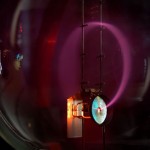
Circular Beam of Electrons

Beam of electrons moving in a circle, due to the presence of a magnetic field. Purple light is emitted along the electron path, due to the electrons colliding with gas molecules in the bulb. (Photo: Marcin Bialek ) Oh, how I love you guys. In our recent post A Fiery Dance on the Sun , Neatoramanaut PlasmaGryphon kindly took the time to explain to us the physics behind solar flares. In the explanation , there was a link to Wikipedia article on Lorentz force , where I found this fascinating image of a circular beam of electrons in a Teltron tube . Neat, huh? ( Thanks PlasmaGryphon! )

See more here:
Circular Beam of Electrons