Someone Bought Einstein’s Smelly Leather Jacket for Nearly $150,000

Today, Christie’s auctioned off the well-worn leather jacket of Albert Einstein . You may know him as the Nobel Prize-winning mathematician who figured out the essence of the universe almost a full century before science could prove him right . But he also had great fashion sense. Read more…

Continued here:
Someone Bought Einstein’s Smelly Leather Jacket for Nearly $150,000

Tor Project Completely Replaces Board After Sexual Assault Scandal

A little more than one month after the Tor Project’s public face Jacob Applebaum stepped down following accusations from multiple women that he sexually assaulted them, the nonprofit has completely replaced its board. Read more…

Excerpt from:
Tor Project Completely Replaces Board After Sexual Assault Scandal

Rare US version of the N64’s disc-drive add-on unearthed near Seattle

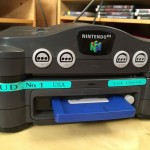
Jason Lindsey That’s quite the find! 6 more images in gallery Nintendo has launched a few pieces of hardware in Japan that never made their way to the West, including the backlit Game Boy Light and the Satellaview online attachment for the Super Famicom. But the best-known of Nintendo’s Japan-only hardware has to be the 64DD—as in, the disk-drive attachment for the Nintendo 64 that landed with a whopping thud in Japan in 1999. Though Nintendo of America had originally hinted at the add-on launching in the United States, that never happened, even though the company had once reached out to Western developers about making software for the system—and taking advantage of its disks’ maximum 38MB of rewritable memory (which was huge compared to the N64’s 32KB memory cards). But that doesn’t mean an American 64DD  never existed. A game-console collector announced on Tuesday that he had discovered an English-language version of the 64DD hardware—and based on insider Nintendo knowledge, this is almost certainly a retail prototype, as opposed to a dev kit. Former Sierra game developer Jason Lindsey took to the Assembler Games forums this week—where you’ll find no shortage of classic and rare gaming topics —to show off his latest acquisition. Lindsey told the forum that he had purchased a “prototype for the US version of the 64DD.” His attached photos include two screens of the 64DD’s boot-up sequence, which normally contains kanji characters asking players to insert a disk; his unit, however, offers those instructions in English. Read 5 remaining paragraphs | Comments

Read this article:
Rare US version of the N64’s disc-drive add-on unearthed near Seattle

FDIC was hacked by China, and CIO covered it up

Insuring deposits, but not your identity. Thanks, FDIC. (credit: Matthew G. Bisanz ) A report published by the House Committee on Science, Space and Technology today found that hackers purported to be from China had compromised computers at the Federal Deposit Insurance Corporation repeatedly between 2010 and 2013. Backdoor malware was installed on 12 workstations and 10 servers by attackers—including the workstations of the chairman, chief of staff, and general counsel of FDIC. But the incidents were never reported to the US Computer Emergency Response Team (US-CERT) or other authorities, and were only brought to light after an Inspector General investigation into another serious data breach at FDIC in October of 2015. The FDIC failed at the time of the “advanced persistent threat” attacks to report the incidents. Then-Inspector General at FDIC, Jon Rymer, lambasted FDIC officials for failing to follow their own policies on breach reporting. Further investigation into those breaches led the committee to conclude that former FDIC CIO Russ Pittman misled auditors about the extent of those breaches, and told employees not to talk about the breaches by a foreign government so as not to ruin FDIC Chairman Martin Gruenberg’s chances of confirmation. The cascade of bad news began with an FDIC Office of the Inspector General (OIG) investigation into the October “Florida incident.” On October 23, 2015, a member of the Federal Deposit Insurance Corporation’s Information Security and Privacy Staff (ISPS) discovered evidence in the FDIC’s data loss prevention system of a significant breach of sensitive data—over 1,200 documents, including Social Security numbers from bank data for over 44,000 individuals and 30,715 banks, were copied to a USB drive by a former employee of FDIC’s Risk Management Supervision field office in Gainesville, Florida. The employee had copied the files prior to leaving his position at FDIC. Despite intercepting the employee, the actual data was not recovered from him until March 25, 2016. The former employee provided a sworn statement that he had not disseminated the information, and the matter was dropped. Read 3 remaining paragraphs | Comments

Read More:
FDIC was hacked by China, and CIO covered it up
Windows Server 2016 coming in September, with new servicing for Nano Server

It’s not quite an exact launch date, but Microsoft has announced that both Windows Server 2016 and System Center 2016 will launch at its Ignite conference (the successor to TechEd) this fall. Ignite runs from September 26-30 and is being held in Atlanta, Georgia. Microsoft has also described how Windows Server 2016 will be serviced going forward. Full installations of the operating system—including the GUI and shell—will continue to be serviced on the “5+5” model that Microsoft has used for previous operating systems. That’s five years of mainstream support, during which both bug fixes and feature improvements are made, and then five years of extended support, during which only security bugs will be fixed. The slimmed down Server Core installation will also be given this 5+5 servicing. The new Nano Server option, however, will be handled in a different way. Nano Server installations will be updated more or less in tandem with the Windows 10 Current Branch for Business (CBB) release. CBB trails the main consumer branch by about six months, giving new features a bit of time to receive some real-world testing before being distributed to more conservative organizations. CBB is expected to be updated two to three times a year, and this will apply to Nano Server deployments of Windows Server 2016 just as it does to CBB deployments of Windows 10. Read 3 remaining paragraphs | Comments

View article:
Windows Server 2016 coming in September, with new servicing for Nano Server

Sega Saturn’s DRM Cracked Almost 23 Years After Launch

An anonymous reader writes from a report via Gamasutra: The Sega Saturn’s DRM has finally been cracked after it hit store shelves nearly 23 years ago in November 1994. Engineer James Laird-Wah first set forth to break through the console’s copy protection in an attempt to harness its chiptune capabilities. Laird-Wah has, however, developed a way to run games and other software from a USB stick in the process. Since disc drive failure is a common fault with the game console, his method circumvents the disc drive altogether, instead reworking the Video CD Slot so it can take games stored on a USB stick and run them directly through the Saturn’s CD Block. “This is now at the point where, not only can it boot and run games, I’ve finished just recently putting in audio support, so it can play audio tracks, ” explained Laird-Wah, speaking to YouTuber debuglive. “For the time being, I possess the only Saturn in the world that’s capable of writing files to a USB stick. There’s actually, for developers of home-brew, the ability to read and write files on the USB stick that’s attached to the device. Read more of this story at Slashdot.

Link:
Sega Saturn’s DRM Cracked Almost 23 Years After Launch

Posing as ransomware, Windows malware just deletes victim’s files

Scammers, via Cisco Talos Ranscam’s “ransom note”: Pay us and then we’ll make everything better. 2 more images in gallery There has been a lot of ingenuity poured into creating crypto-ransomware, the money-making malware that has become the scourge of hospitals, businesses, and home users over the past year. But none of that ingenuity applies to Ranscam, a new ransom malware reported by Cisco’s Talos Security Intelligence and Research Group. Ranscam is a purely amateur attempt to cash in on the cryptoransomware trend that demands payment for “encrypted” files that were actually just plain deleted by a batch command. “Once it executes, it, it pops up a ransom message looking like any other ransomware,” Earl Carter, security research engineer at Cisco Talos, told Ars. “But then what happens is it forces a reboot, and it just deletes all the files. It doesn’t try to encrypt anything—it just deletes them all.” Talos discovered the file on the systems of a small number of customers. In every case, the malware presented exactly the same message, including the same Bitcoin wallet address. The victim is instructed: Read 6 remaining paragraphs | Comments

Taken from:
Posing as ransomware, Windows malware just deletes victim’s files

Honda unveils first hybrid motor without heavy rare earth metals

Honda pledged to reduce its use of rare earth metals a decade ago, and the automaker took another step towards that goal this week. It unveiled its new hybrid motor that was co-developed alongside Daido Steel, another Japan-based company. The new motor doesn’t use heavy rare earth metals like dysprosium and terbium, instead relying on magnets from Daido Steel that cost 10 percent less and weigh 8 percent lighter than the previous components. In fact, the automaker is the first to develop a hybrid motor that doesn’t use the heavy metals. Honda says the new engines will reduce its reliance on the pricey rare earth metals that are primarily supplied by China. The new hybrid motors will make their debut in the compact Freed minivan this fall, a vehicle that’s already on the road in Asia. Honda also noted during the announcement that not only would cutting out the rare earth metals save money, but it would also reduce the potential for price fluctuations on the materials it uses to build the engines. The new motors don’t nix rare earth elements entirely though, as the new version still has neodymium which is found in North America, Australia and China. Source: Reuters

See original article:
Honda unveils first hybrid motor without heavy rare earth metals

Pokemon Go Added $7.5 Billion to Nintendo’s Value in Two Days 

It’s been a strange week for Pokemasters, dealing with armed robberies , dead bodies , and even accidental exercise . And nobody is happier than Nintendo, whose market value grew by $7.5 billion in two days as stock surged because everyone got hooked on Pokemon Go . Read more…

See original article:
Pokemon Go Added $7.5 Billion to Nintendo’s Value in Two Days