VMware brings Windows 10 and graphics boost to Fusion and Workstation

VMware’s desktop virtualization software for Macs, Windows PCs, and Linux are being upgraded today to support Windows 10 and new features to boost performance. VMware Fusion for Macs is up to version 8, while Workstation for Windows and Linux is up to version 12. Both products have an improved graphics engine to support DirectX 10 and OpenGL 3.3. VMware’s release comes one week after Parallels upgraded its desktop virtualization software for Macs. Here’s what Fusion 8 looks like: Read 26 remaining paragraphs | Comments

Read More:
VMware brings Windows 10 and graphics boost to Fusion and Workstation

Mirror your Android device on your Mac or PC with Vysor

There are plenty of ways to mirror your smartphone onto your desktop, but none are as apparently easy (or snappy) as this one. Vysor has been cooked-up by AllCast creator Koush as a seamless way to mirror your Android device’s display onto a Windows, Linux or Mac computer. All you’ll need to do is connect one to the other over USB and install the Chrome plugin and in a few seconds, you should be able to control your phone with a keyboard and mouse. It may have been intended as a developer tool, but one keen-eyed Reddit user spotted the app while it was in private beta and shared it with the world. As Koush himself points out in the second video below, one feature that hasn’t been noticed was Vysor Share. With it, users can remotely control a smartphone from another machine through the internet, as long as both PCs have the app installed. That way, power users can actually push (or pull) updates to far-off phones using Android’s Debug Bridge functionality. In the future, the developer is hoping to tweak this offering to enable developers to connect to multiple devices at a time. Right now, users are asked to just give it a try and offer your feedback, so have at it! Filed under: Cellphones , Internet , Software , Google Comments Via: Reddit Source: Google Plus , (2) , Vysor Tags: ADB, Android, AndroidMirroring, google, Koush, KoushikDutta, Mirroring, Remote, video, Vysor

Excerpt from:
Mirror your Android device on your Mac or PC with Vysor

Intel introduces its smallest socketed form factor yet: the 5×5

If you think mini-ITX is too big but don’t like the soldered down processor of the Intel NUC , the chip giant has come up with a new form factor that splits the difference: 5×5. Measuring, er, 5.5 inches by 5.8 inches (compared to the 4.5″×4.4″ of the NUC, and the 6.7″×6.7″ of mini-ITX), the new offering in many ways slides directly in between the form factors that bookend it. Like mini-ITX, it has an LGA socket compatible with Intel’s Core-branded processors. But like the NUC, it uses SODIMM memory, M.2 drives , and an external power supply. It also sacrifices mini-ITX’s PCIe slot. 2.5″ SATA drives are also an option, though they will increase the system height a little. So while the 5×5 leans much closer to the NUC spec list than the mini-ITX one, that processor and socket make a world of difference. The NUC processors top out at 28W for the Broadwell Core i7-5557U. Even that’s something of an outlier; every other current generation NUC uses a 15W or 6W chip. The 5×5, however, will have two thermal targets: 35W and 65W. Though 65W systems will be a little taller to accommodate a larger heatsink, support for any Intel Core processor with a TDP up to 65W makes the system a lot more versatile. For example, the Broadwell Core i7-5775C is a 65W part. This powerhouse chip includes 128MB of eDRAM, and as a result it’s surprisingly credible at gaming. This is a chip that can play Bioshock Infinite at 1920×1080 in high quality at 30 fps, Tomb Raider in low quality at 64 fps, and Dirt Showdown in medium quality at 46 fps. Read 4 remaining paragraphs | Comments

Original post:
Intel introduces its smallest socketed form factor yet: the 5×5

MIT’s newest 3D printer spouts 10 materials at a time

One of the biggest hindrances to current 3D printers is that they almost exclusively stick to a single precursor be it plastic, metal or glass . At most, you can get one that extrudes three materials at a time and they’re going set you back a quarter of a million dollars . However, a team of researchers at MIT’s Computer Science and Artificial Intelligence Laboratory ( CSAIL ) have debuted a novel solution that allows users to create more complex items in a fraction of the time and cost by printing up to ten different materials simultaneously. Dubbed the MultiFab, this machine doesn’t extrude materials. Instead, it mixes microscopic droplets of photopolymers together and shoots them through inkjet-style printers. The system is also quite complex despite being constructed primarily from off-the-shelf components. A central computer directs the printer while receiving a continual stream of data from a 40-micron resolution 3D scanner and camera array as the item is being created. This feedback data — which measures in the dozens of gigabytes — allows the machine to correct and re-calibrate itself as the item is being printed. It also allows the user to place other objects, say a CPU chip, into the project and then print around it. The team envisions users being able to place a cellphone in the machine and 3D-print a case directly onto it. “The platform opens up new possibilities for manufacturing, giving researchers and hobbyists alike the power to create objects that have previously been difficult or even impossible to print.”says Javier Ramos, CSAIL research engineer at CSAIL co-author of the paper. The team believes that the technology could easily be scaled for use in commercial and hobbyist applications alike. Filed under: Science Comments Via: Popular Science Source: MIT Tags: 3D, 3D printing, 3D scanner, camera, Massachusetts Institute of Technology, MIT, MultiFab, scanner

See the original post:
MIT’s newest 3D printer spouts 10 materials at a time

Microsoft’s prototype keyboard cover has an e-ink touchscreen

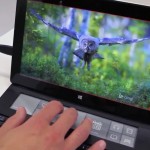
Tablets are becoming more useful for getting real work done. Looking to further bridge the gap between slate and laptop, Microsoft Applied Sciences built a prototype device it calls the DisplayCover: a keyboard cover that houses an e-ink touchscreen display. The 1, 280 x 305 resolution panel not only provides access to app shortcuts, but it can also handle touch gestures for navigation and accept stylus input. The stylus feature seems to make things like signing documents and scribbling notes a breeze, based on the demo video. In the case of an app like Photoshop where you need constant access to tool palettes, those items can be parked at the top of the keyboard so they don’t take up valuable space on the tablet’s display (in this case a Surface ). Why e-ink? Well, the team says the material was selected because it wouldn’t put too much added strain on battery life like a full-color touch panel would. Sure, the DisplayCover is a prototype that’s obviously far from finished. However, it’s interesting to take a look at what companies are doing to make efficient use of small screen sizes for maximizing productivity. [Thanks, Antonio] Filed under: Peripherals , Microsoft Comments Source: Microsoft Applied Sciences Tags: cover, displaycover, e-ink, keyboardcover, microsoft, surface, tablet, touchscreen

Read More:
Microsoft’s prototype keyboard cover has an e-ink touchscreen

Twitter shuts down accounts monitoring politicians’ deleted tweets

After suspending API access to the Open State Foundation’s (OSF) primary American account in May, Twitter went ahead and nixed the foundation’s 30 remaining satellite accounts over the weekend. OSF employed these accounts to monitor and publicize the deleted tweets of elected officials in countries worldwide. Twitter also shut down the group’s Diplotwoops account, which served the same purpose but for diplomats. Notice:Twitter have killed part of @politwoops that powers this account. No new posts for now but tweets available at http://t.co/w6y19ppzRZ — Tweets MPs Delete (@deletedbyMPs) August 22, 2015 Twitter reportedly decided to shut out the OSF after “thoughtful internal deliberation and close consideration of a number of factors.” The foundation cited a note from Twitter regarding its decision, stating “Imagine how nerve-racking – terrifying, even – tweeting would be if it was immutable and irrevocable? No one user is more deserving of that ability than another.” The OSF has since released a statement on the matter: What elected politicians publicly say is a matter of public record. Even when tweets are deleted, it’s part of parliamentary history. These tweets were once posted and later deleted. What politicians say in public should be available to anyone. This is not about typos but it is a unique insight on how messages from elected politicians can change without notice. It should be noted however that Twitter is not a government entity and, even here in the US, has precisely zero responsibility to allow accounts that it feels violate its TOS. In light of the shutdown, the foundation states that it will continue working ensure messages sent by elected politicians remain visible. Just not on Twitter. Filed under: Internet Comments Via: The Next Web Source: Open State Foundation Tags: openstatefoundation, OSF, politics, twitter

Original post:
Twitter shuts down accounts monitoring politicians’ deleted tweets

Comcast planning gigabit cable for entire US territory in 2-3 years

While Comcast has started deploying  2Gbps fiber-to-the-home service to certain parts of its territory, much of its network is going to be stuck on cable for years to come. But customers outside the fiber footprint will still be able to buy gigabit Internet service after Comcast upgrades to DOCSIS 3.1, a faster version of the Data Over Cable Service Interface Specification. Comcast said in April  that DOCSIS 3.1 will be available to some of its customers in early 2016 and eventually across its whole US footprint. Last week, Comcast said it wants to complete the whole upgrade within two years. “Our intent is to scale it through our footprint through 2016,” Comcast VP of network architecture Robert Howald said in an interview with FierceCable . “We want to get it across the footprint very quickly… We’re shooting for two years.” It could take up to three years, the story said. Read 4 remaining paragraphs | Comments

Continued here:
Comcast planning gigabit cable for entire US territory in 2-3 years

The gorgeous faces and stunning cinematography of ‘Until Dawn’

The PlayStation 4’s latest exclusive Until Dawn is absolutely stunning visually. In particular? Its faces. By using 3D performance capture techniques that include strapping an HD camera rig attached to their heads to grab practically every minute detail and expression, the actors (including Hayden Panettiere and Peter Stormare) bring life to the characters in a pretty realistic fashion. What’s really cool is that oftentimes once you let the DualShock 4 sit idle for a moment, the camera will zoom in on the face of whichever of the randy teens you’re controlling. If motion controls are enabled, you can tilt the gamepad this way and that and the possibly-doomed cabeza will follow suit accordingly. It’s pretty neat! Slideshow-314565 Sadly, Until Dawn is severely lacking a proper photo mode though. I never thought I’d praise a game’s cinematography, but I was consistently wowed by how every scene was composed and framed during my playthrough. Those sometimes-annoying camera angles, combined with just how good the game looks, scream for the ability to futz with exposure, saturation and depth of field adjustments for even more stunning, shareable shots. Seriously. Take a gander at the gallery below and try telling me that something like The Last of Us: Remastered ‘s or Infamous: Second Son ‘s digital dark-rooms couldn’t make the screenshots look even cooler and more desktop-image worthy. Slideshow-314571 Filed under: Gaming , Home Entertainment , HD , Sony Comments Tags: 3dMotionCapture, cinematography, faces, gallery, gaming, HaydenPanettiere, hd, hdpostcross, PerformanceCapture, PeterStormare, photogrpahy, PlayStation, playstation4, ps4, sony, supermassivegames, untildawn

View original post here:
The gorgeous faces and stunning cinematography of ‘Until Dawn’