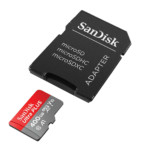
SanDisk just unveiled a 400GB microSD card, which it claims is the world’s biggest. Really, it was only a matter of time until something of this stature arrived. Especially, now that we’re capturing every aspect of our daily lives in glorious 4K , in 360-degrees , and from drones way up high. All those high-res images are taking up a lot of space on our devices. Therefore, storage providers had to step it up, which brings us to this miniature marvel. The 400GB SanDisk Ultra microSDXC UHS-I card (yes, it’s a mouthful) comes two years after the release of its 200GB predecessor . The company claims it can rack up transfer speeds of 100MB, meaning you can expect to move up to 1, 200 photos per minute. It also meets the A1 App Performance Class specification, allowing it to load apps faster. Ultimately, it can hold up to 40 hours of full HD video. That all sounds enticing, but it comes at a hefty price: The microSD card will set you back $250. For that money, you get 144GB more storage than any other microSD card out there. There were rumblings of a 512GB microSD card hitting the market this year (courtesy of Microdia ), but we’ve not heard anything recently. Plus, that half-a-terabyte of storage was going to set you back $1, 000 — which makes SanDisk’s card look cheap in comparison. All you iPhone owners feeling left out right now, SanDisk has your back. Well, kinda. The company’s also dropping a new local storage dock for Apple’s handset. Just plug your iPhone into the SanDisk iXpand Base to backup your files, with up to 256GB of storage (for $200). Additional versions include 32GB, 64GB, and 128GB storage, with prices starting from $50. Source: Business Wire (press release) , Business Wire (press release)
Follow this link:
SanDisk crams 400GB into a microSD card

 In America the Internal Revenue Service used to pick who got audited based on math mistakes or discrepancies with W-2 forms — but not any more. schwit1 shares an article from the Vanderbilt Journal of Entertainment and Technology Law describing their new technique: The IRS is now engaging in data mining of public and commercial data pools (including social media) and creating highly detailed profiles of taxpayers upon which to run data analytics. This article argues that current IRS practices, mostly unknown to the general public, are violating fair information practices. This lack of transparency and accountability not only violates federal law regarding the government’s data collection activities and use of predictive algorithms, but may also result in discrimination. While the potential efficiencies that big data analytics provides may appear to be a panacea for the IRS’s budget woes, unchecked these activities are a significant threat to privacy [PDF]. Other concerns regarding the IRS’s entrée into big data are raised including the potential for political targeting, data breaches, and the misuse of such information. While tax evasion cost the U.S.$3 trillion between 2000 and 2009, one of the report’s authors argues that people should be aware âoethat what they say and do onlineâ could be used against them. Read more of this story at Slashdot.